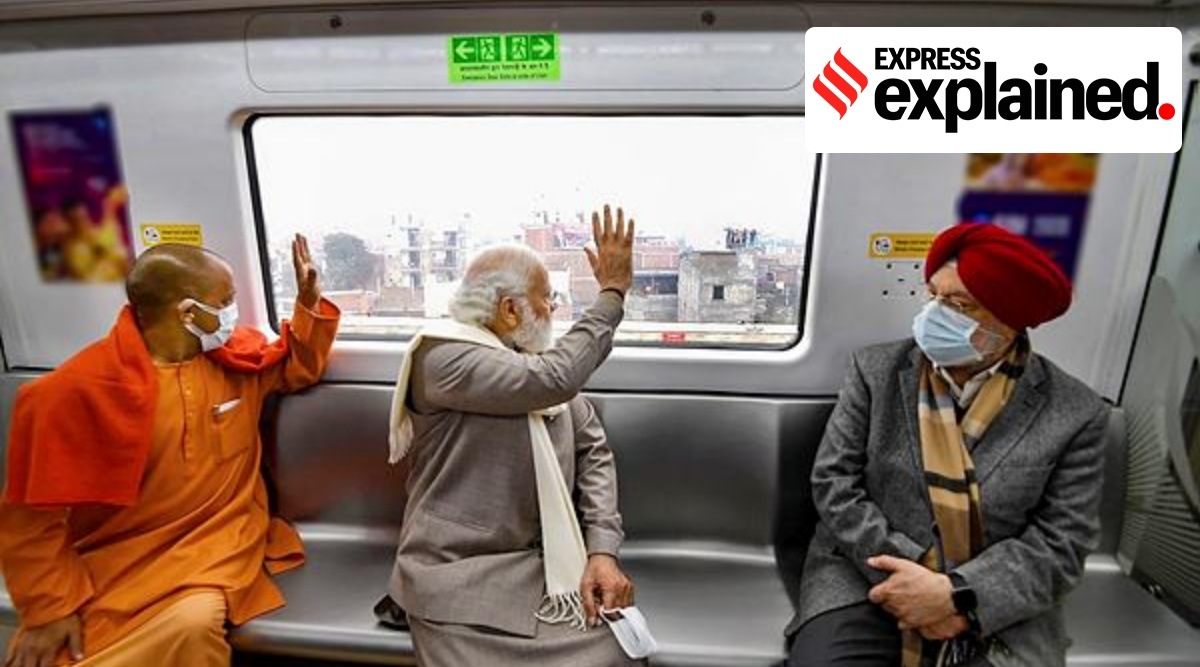
Prime Minister Narendra Modi on Tuesday inaugurated the Kanpur Metro rail project, whose foundation stone was laid by former Uttar Pradesh Chief Minister Akhilesh Yadav along with then Union Minister Venkaiah Naidu in 2016 just before 2017 Assembly elections. Work for the project was started by Chief Minister Yogi Adityanath in 2019 and a 9 km stretch of the 32.5 km long route has been completed so far.
The project and its foundation

The project is proposed to have two corridors. While the first stretch of 23.8 km corridor has been planned from IIT Kanpur to Naubasta area of Kanpur city, the second stretch of 8.6 km is proposed from Chandrashekhar Azad Agriculture University to Barra area of Kanpur city. The cost of the project is about Rs 11,000 crore.
The foundation stone of the project was laid in October 2016, just before the 2017 Assembly polls, by Akhilesh Yadav along with Venkaiah Naidu. The Yogi government, however, claims that the actual construction work on the 9km long “priority stretch”, which was inaugurated today, was started on November 15, 2019. Claiming that the work on this stretch has been completed at a fast pace despite COVID pandemic, CM Yogi had ordered a trial run on November 10, 2021.
What is the ‘priority stretch’ inaugurated by PM Modi today?
While the entire project would take time to be completed, the government decided to proceed with the priority stretch, where the metro project is needed the most to relieve the city of traffic congestion. This priority stretch would have 9 metro stations. The second stretch of Kanpur metro would connect Motijheel to Transport Nagar area, which is scheduled to have under-ground stations.
The plan is to run six metro trains on the 9km stretch of the priority corridor in the initial phase and then add another six more trains.
Technology used
The project is unique in terms of using new technology. The ‘regenerative braking’ technology used in the project will save energy. It would ensure that for every 1000 units used, about 35 to 45 per cent units would be regenerated.
Story continues below this ad
Facilities
The Kanpur Metro rail project, among other things proposes to provide about 56 USB charging points per train, talk-back button in case of emergency, long stop request button for the differently-abled. Further the train plans to use 100 per cent LED lights to reduce energy consumption. It would also have LCD panels for infotainment, along with CCTV cameras.
Newsletter | Click to get the day’s best explainers in your inbox


 3 min read