5 min read
© The Indian Express Pvt Ltd



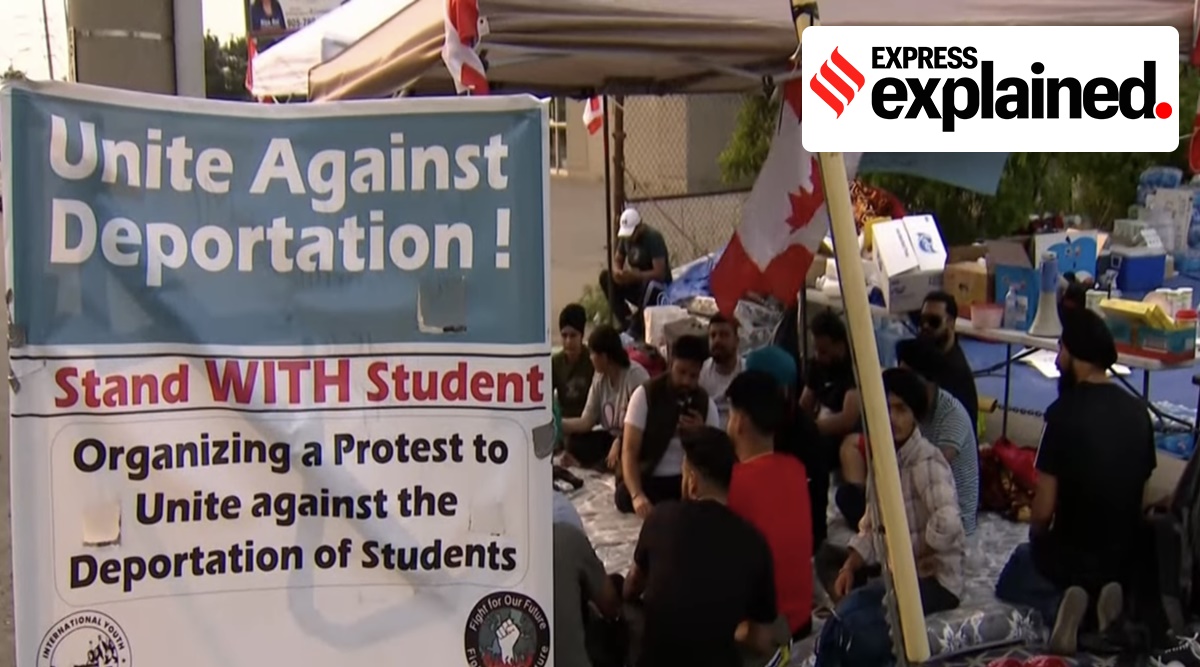 To protest against these deportations, hundreds of Indian students, primarily from Punjab, have gathered outside the CBSA headquarters since May 29. (Express photo)
 Union External Affairs Minister S Jaishankar assured the Punjab government on Thursday (June 8) that the Ministry of External Affairs and the Indian High Commission in Canada would help the around 700 Indians facing deportation over a case of fake documents. Most of them are from Punjab, and have claimed they were defrauded by their immigration agent, who sent them to Canada on forged college admission offer letters.
Punjab Minister of NRI Affairs, Kuldeep Singh Dhaliwal, had sought Jaishankar’s intervention in the issue, saying the students were victims of fraud.
Canadian Prime Minister Justin Trudeau has also assured the 700 Indians that each case will be evaluated individually and they will be given the opportunity to present their case.
The matter came to light in March, when these Indians, who had finished their studies and got jobs, applied for permanent residency and were told by the Canadian Border Security Agency (CBSA) that their college admission letters had been fake and they would have to be deported.
Why action now when matter came to light in March?
To protest against these deportations, hundreds of Indian students, primarily from Punjab, have gathered outside the CBSA headquarters since May 29, engaging in an “indefinite sit-in”. They argue that it would be a great injustice if they were expelled from the country where they completed their studies, worked for five years, and lived legally. Most of them had gone to Canada on study visas between 2017 and 2018.
One student, Kramjit Kaur from Punjab, was initially ordered to leave Canada by May 29, but her expulsion orders were stayed just in time. Another student, Lovepreet Singh from Punjab’s Mohali, has been asked to leave the country by June 13, and he is currently contesting his case in court.
What is the case?
Most of these students had come to Canada on admission offer letters provided by a Jalandhar-based agent, Brijesh Mishra. Mishra, who is currently facing a police case and has gone missing, headed a firm called Education Migration Services. He would charge each student lakhs of rupees to process their documents. He procured offer letters for the affected students, and after they landed in Canada, asked them to switch their college, giving different reasons.
As one of the affected women from Jalandhar said, “When I reached Canada in 2018, my agent, who had charged me around Rs16 lakh, called me and asked me to enroll in another college because all the seats were filled in the college for which I had received the admission letter. He returned some of my money and helped me secure admission in another college, where I pursued my studies. I never suspected his intentions until I received a deportation letter from CBSA, revealing that the admission letter on which I obtained my visa was fake.”
How did the students not realise their offer letters were fake?
Consultants and agents who facilitate students are registered with the state government. Those who work in the business told The Indian Express that the students generally trust their agents, and so do not check if the offer letter is genuine.
Also, Canada allows students to switch colleges after landing in the country, so the agent simply told them their admission in a particular college had “fallen through”, or that another college could be a better fit for them.
Why were offer letters forged when admission in other colleges was possible?
Experts cited two major reasons for this.
An educational consultant who has been sending students to Canada for more than a decade said Mishra must have been aware that offer letters from reputable institutes are not subjected to much scrutiny. “But it is quite surprising how a big number of offer letters from a particular college was ignored at the embassy level, where a lot of scrutiny takes place before issuing the visa,” the consultant said.
“The second reason is that if a particular college is quite reputable, an offer letter from it enhances the visa success rate, as compared with other private colleges,” he said.
To change colleges after landing in Canada, students have to inform Immigration Refugees and Citizenship Canada (IRCC), along with providing the details of Designated Learning Institute (DLI), the ID number and the name of the new college, which the duped students did.
What action has been taken?
The licence of Mishra’s agency has been cancelled and the Jalandhar police have filed a case against him and two accomplices. The role of Canadian embassy officials who granted visas based on these fraudulent letters is also being looked into.