5 min read

© The Indian Express Pvt Ltd



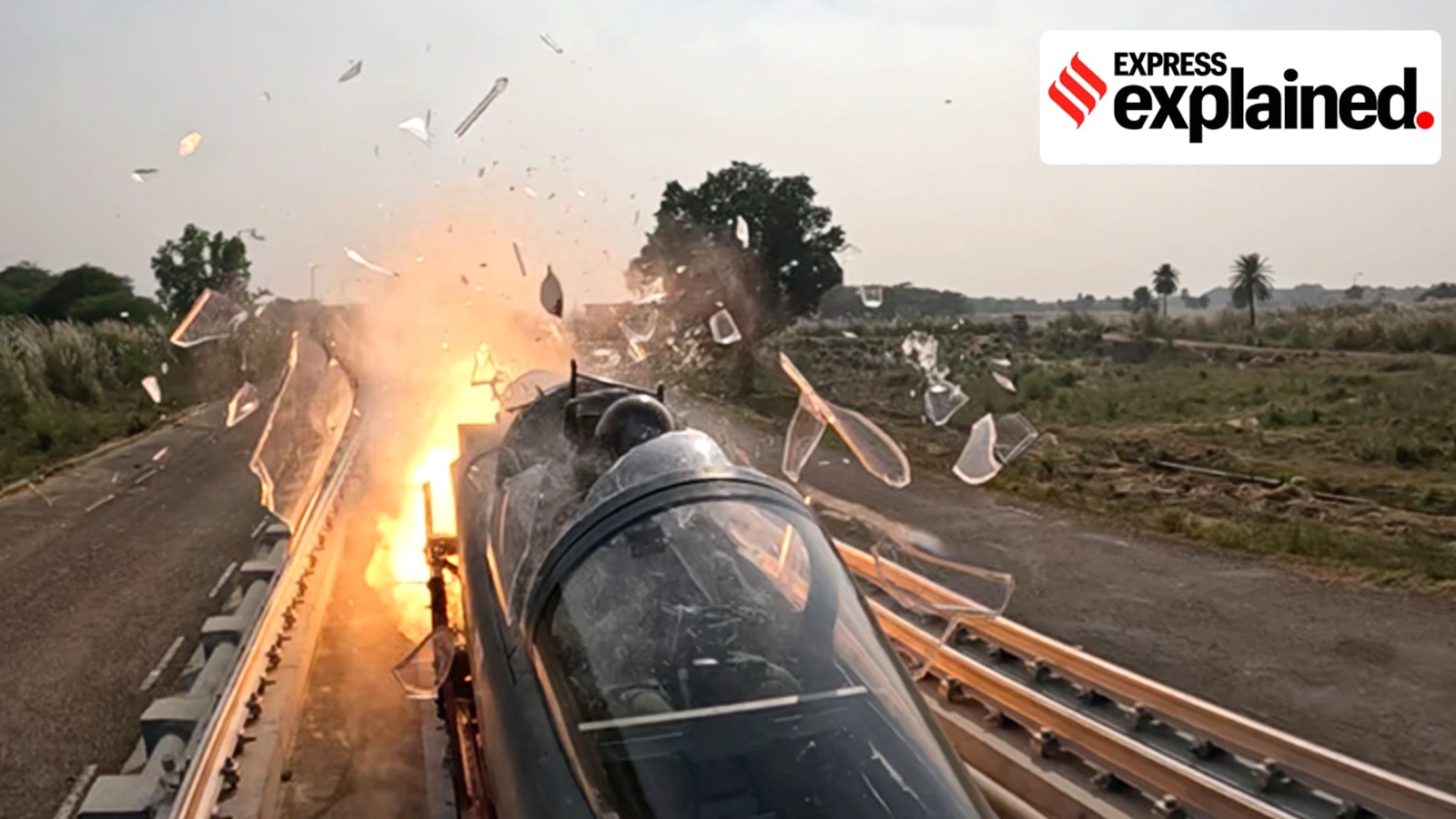 The rocket sled is a ground-based testing system, which is propelled by rockets to climb to high speeds while moving on rail tracks, simulating the aerodynamic conditions of an aircraft in flight. (Ministry of Defence)
The Defence Research and Development Organisation (DRDO) on Tuesday (December 2) conducted a successful high-speed rocket-sled test of a fighter aircraft escape system at controlled velocity. The technical achievement places India in an elite club of nations with advanced in-house escape system testing capability.
Here is a closer look at how the test was conducted, and why it is crucial to have such a dynamic test facility.
The test was conducted in collaboration with the Aeronautical Development Agency (ADA) of the Ministry of Defence and public sector entity Hindustan Aeronautics Limited (HAL). It was carried out at the Rail Track Rocket Sled (RTRS) facility of the Terminal Ballistics Research Laboratory (TBRL), a key DRDO facility in Chandigarh.
The rocket sled is a ground-based testing system, which is propelled by rockets to climb to high speeds while moving on rail tracks, simulating the aerodynamic conditions of an aircraft in flight.
Here, the dual-sled system allows the forebody of an aircraft to be mounted and tested under controlled velocities. In the recent test, a system with the forebody of the indigenous Light Combat Aircraft (LCA) was propelled to a precisely controlled velocity of 800 kilometres per hour through phased firing of multiple solid propellant rocket motors.
Dynamic ejection tests are significantly more complex than static tests, which occur with the aircraft stationary or at zero altitude and zero speed. They are also considered the true measure of evaluating the pilot’s escape aid, such as ejection seats and canopy severance systems.
Modern ejection seats use a combination of small explosive cartridges and, in many cases, rocket motors to propel the seat out of the aircraft. The initial explosive charge fires and lifts the seat. On the other hand, canopy severance is the controlled breaking of an aircraft’s cockpit canopy to create a clear path for the ejection seat. The sequence includes canopy removal, seat firing, stabilisation, and parachute deployment that ensures the pilot’s safe exit.
This is a highly sensitive mechanism, and pilot survival depends on timing, down to the millisecond.
At high speeds, pilots experience extreme aerodynamic forces. Emergency ejections can happen under a variety of circumstances — low or high altitude, zero or supersonic speed, during aircraft spin, or even inverted flight. The safety systems must function perfectly across all these conditions, which makes testing critical.
The pilot’s body is exposed to forces at a massive scale, and wrong sequencing can cause serious injuries. Thus, safety testing under flight-like conditions is critical to meet global safety standards, officials said.
This test used human-like test dummies, fitted with sensors and devices that record physical stresses to assess pilot safety, simulating processes such as ejection sequencing and complete aircrew recovery. It recorded critical loads, moments — a measure of rotational force — and accelerations that ejected pilots would experience.
The entire sequence was captured through onboard and ground-based imaging systems. The test was witnessed by the officials from the Indian Air Force (IAF) and the Institute of Aerospace Medicine. After the successful test, Defence Minister Rajnath Singh complimented the DRDO, IAF, ADA, HAL and the wider industry. He described it as a significant milestone for India’s indigenous defence capability towards self-reliance, according to the MoD.
The successful test of India’s indigenous fighter aircraft escape system represents a major strategic milestone. Escape systems are among the most safety-critical components of a combat aircraft, and their reliability directly affects pilot survivability during emergencies.
Until now, India has had to rely upon test ecosystems abroad to evaluate the performance of the ejection mechanisms. Sources have said that the indigenous tests cost between one-fourth and one-fifth as much as the tests conducted abroad.
Officials said that possessing an in-house dynamic ejection-testing facility boosts India’s ability to design, certify, and upgrade ejection systems for both current and future fighter platforms. A DRDO scientist said that this not only reduces dependence on foreign testing facilities but also significantly shortens development cycles.
Moreover, the ability to simulate real-world emergency conditions using instrumented anthropomorphic dummies provides India with valuable insights into pilot safety parameters such as loads, accelerations, and impact forces.
Notably, TBRL has had an RTRS since 2014, which can test defence and aerospace systems at supersonic speeds (exceeding the speed of sound). Earlier in February, drogue parachutes of Gaganyan, India’s planned crewed orbital spacecraft, were successfully tested at the RTRS facility of the TBRL in Chandigarh.
The test involved the simultaneous firing of two drogue parachutes to simulate deployment at the maximum angle of attack of the crew module during descent. The escape system testing facility, which includes high-speed cameras and state-of-the-art measurement mechanisms, was developed over the last year.


Bangladesh have brought back pacer Taskin Ahmed and dropped Jaker Ali in their squad for the 2026 T20 World Cup. Litton Das will be leading the side and senior pacer Mustafizur Rahman, who has been caught in the middle of a storm after being released by his Indian Premier League (IPL) side Kolkata Knight Riders (KKR), has also been included.