6 min read
© The Indian Express Pvt Ltd



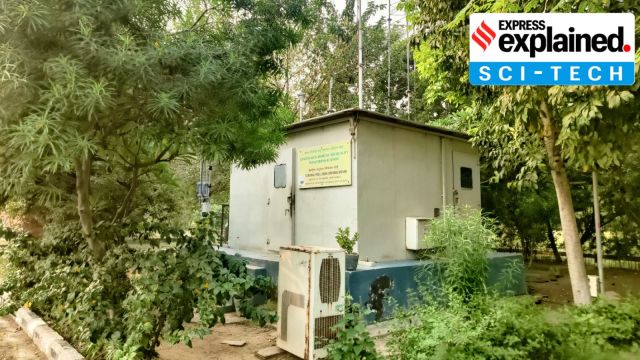 The air quality testing centre in Dilshad Gardens (Express Photo - Devansh Mittal)
Earlier this week, the Supreme Court asked authorities to explain the equipment used in Delhi air-quality monitoring stations and whether it is suited to the city’s conditions — a question raised at a time when Delhi relies heavily on AQI readings to gauge daily exposure to pollution.
The city’s network comprises 40 Continuous Ambient Air Quality Monitoring Stations (CAAQMS) — compact, temperature-controlled cabins that function as automated laboratories. Spread across the city for representative measurement, each station must track eight pollutants: PM2.5, PM10, nitrogen dioxide, sulphur dioxide, carbon monoxide, ozone, ammonia and lead. They operate under Central Pollution Control Board (CPCB) guidelines issued in 2012, which specify the principles, calibration steps and quality-control procedures all instruments must follow.
Each air-conditioned, dust-proof station contains racks of analysers, pumps and data loggers, with sampling inlets mounted on a mast above the roof.
Particulate matter is measured using Beta Attenuation Monitors (BAM), which rely on the beta ray attenuation principle. A small Carbon-14 or Krypton-85 source emits beta rays through a clean patch of filter tape. After air is drawn through and dust collects on the tape, the instrument re-measures the spot. Fewer beta rays pass through, and the decline in signal is used to calculate PM2.5 and PM10 concentrations.
For gaseous pollutants, stations mainly use optical methods because gases absorb or emit specific wavelengths of light. Sulphur dioxide is measured by UV fluorescence, which detects the weak glow SO2 emits under ultraviolet light. Ozone is measured by UV photometry, which tracks how much UV light it absorbs. Carbon monoxide is measured using non-dispersive infrared (NDIR) absorption, based on how much infrared light CO absorbs.
Nitrogen oxides are measured through chemiluminescence, where instruments detect the faint light produced when the gases react with ozone inside the analyser. Ammonia is measured using optical spectroscopy based on its characteristic absorption of light. These methods are approved under the National Ambient Air Quality Standards (NAAQS) of 2009, which list “gravimetric, wet-chemical (for manual stations) and automatic instrument-based techniques” to ensure comparable data across India.
AQI quality depends on both equipment performance and the amount of validated data recorded. CPCB requires at least 16 hours of reliable daily data for at least three pollutants — one of which must be PM2.5 or PM10. If instruments shut down due to calibration, power issues or extreme weather, a station may miss this threshold. A CAG report tabled this year showed that many DPCC stations failed to generate adequate valid data each month, and several did not measure pollutants such as lead, limiting how complete the AQI picture is on any day.
Technical and operational issues can also affect accuracy. High humidity can interfere with particulate monitors, causing particles to absorb water and appear heavier. Instruments may drift if not calibrated frequently enough. Station location matters too: if installed too close to buildings, trees or exhaust vents, distorted airflow can skew readings. Power fluctuations or data-transmission failures can interrupt real-time updates.
Recent scientific studies have examined the reliability of particulate measurements in Delhi, including a 2021 analysis of BAM performance under the city’s extreme meteorological conditions. Researchers from CSIR-National Physical Laboratory and AcSIR found that biases in beta gauge readings “vary with ambient high RH, particle mass loading, boundary layer height and ventilation coefficient”. When relative humidity exceeded 60 percent, “PM2.5 measurements by beta gauge method show more deviation… leading to high mass concentration”, with overestimation rising in winter and post-monsoon periods.
The study reported that “more than 30% overestimation was observed especially when RH reaches over 60%,” and that during high-pollution episodes, the bias could increase “by a factor up to ~5 when particle mass loading also becomes high.” The authors recommended “site-specific correction factor approaches… to get better results of beta gauge monitors,” noting that applying such corrections reduced measurement bias from 46% to under 2%.
The U.S. EPA’s operating procedure for PM2.5 also notes that “high filter loading can lead to flow perturbations,” meaning excessive particulate accumulation can disturb airflow inside the instrument and destabilise measurements. Such data blackouts occurred at Delhi’s AQI stations on Diwali night (October 20 this year), when pollution spiked suddenly.
Continuous monitors require frequent calibration and strict adherence to CPCB protocols. The CPCB’s 2012 guidelines stress that “the time to time [sic] calibration record of each particulate matter monitor… shall be maintained by the concerned laboratory staff”. Daily operations also require periodic checks, as even small drifts can affect concentrations, especially for gases measured through sensitive optical techniques.
The CAG report noted that “none of the 24 air quality monitoring stations of DPCC were measuring Pb levels”, despite lead being required for AQI. It found that “monthly AQI data for less than 21 days was available for 12 per cent months during the period April 2014 to January 2021,” indicating gaps in monthly data generation.
Among its key recommendations, the CAG urged that “CAAQMSs are relocated at suitable places or obstacles are removed. If equipment is not fit to monitor all pollutants like Lead, they should be suitably augmented or replaced.” It also advised the Delhi government to “ensure sufficient data for all pollutants is generated by every monitoring station, so that air quality at various locations in Delhi is known on all days”.
Anumita Roychowdhury, Executive Director at the Centre for Science and Environment and part of the expert group that devised the National Air Quality Index in 2014, said regular third-party audits are essential to ensure station efficacy.