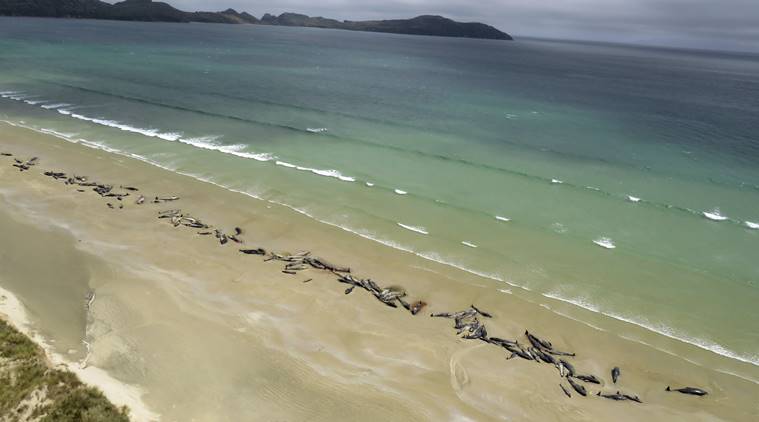
In this Sunday, Nov. 25, 2018 photo, pilot whales lie beached at Mason Bay, Rakiura on Stewart Island, New Zealand. As many as 145 pilot whales have died after the mass stranding which was discovered by a hiker on Saturday, Nov. 24, 2018.(Department of Conservation via AP) On New Zealand’s Stewart Island Sunday. (New Zealand government via AP)
Over 140 pilot whales have died after beaching themselves on Stewart Island in New Zealand. Several smaller beachings occurred around the country over the weekend. In February 2017, over 650 whales were involved in a major cetacean stranding, and about 400 died on Farewell Spit on South Island’s northern tip. And in March 2018, only a few of the more than 150 short-finned pilot whales stranded on a beach on Hamelin Bay near Perth survived.
Cetacean strandings are common; some 2,000 are beached every year on average around the world. A large number of beachings occur in New Zealand; scores of whales die on Farewell Spit almost every year. Scientists don’t know for sure why whales beach themselves, why they choose New Zealand, or whether trying to refloat animals that are discovered alive is the best way to save them.
You’ve Read Your Free Stories For Now
Sign up and keep reading more stories that matter to you.
While individual strandings are attributable to sickness or injury, the reasons that researchers have given for mass strandings include rough weather, following prey too close to the shore or being herded towards the shore by larger whales, and the failure of their echolocation faculties to detect very gentle slopes, such as those in many places along the coast of Australia. There is also the theory of ‘follow-me’ strandings, which says entire pods sometimes end up on beaches after one or a few members lose their bearings.
Research published in September last year submitted that solar storms triggered geomagnetic disruptions that impacted the ability of whales to navigate in the North Sea, leading them towards shallow waters. Earlier, in March 2017, researchers tied several of these theories together with the pattern of energy expenditure by the animals, and submitted that panicked or vigorous swimming to escape threats from human (such as sonar) or natural (such as predators) agencies could be leading to catastrophic exertion and inadequate oxygen supply to their brains.
(Williams et al., Journal of Experimental Biology)