Premium
This is an archive article published on November 29, 2021

ExplainSpeaking: What to look for in India’s Q2 GDP data this week

🔴 High growth rates can be misleading; best to focus on absolute levels of GDP

A worker fixes his show as he prepares work to lay an underground electricity cable in Mumbai (AP)A worker fixes his show as he prepares work to lay an underground electricity cable in Mumbai (AP)

ExplainSpeaking-Economy is a weekly newsletter by Udit Misra, delivered in your inbox every Monday morning. Click here to subscribe 

Dear Readers,

Last week was quite hectic if one tracks the Indian economy. Apart from the ups and downs of the stock markets, the Niti Aayog came up with a National Multidimensional Poverty Index. This index uses the methodology used by Oxford Poverty and Human Development Initiative (OPHI) and looks at various parameters of health, education and standard of living to arrive at the index. However, it should also be noted that this report only provides the baseline for the index since it uses data from the fourth round of the National Family Health Survey, which was released in 2015-16. Considering that last week also saw the release of the fifth round of the NFHS, the poverty index would need to be updated quickly.

This week will likely see politics dominate everything else as the Winter Session of the Parliament gets underway. However, on the economic front, the biggest news peg will come when the Ministry of Statistics and Programme Implementation releases the GDP data for the second quarter (that is, the period covering July, August and September).

Before we get down to what to look for in the Q2 data, here’s a quick recap on some of the GDP explainers:

As explained in the past, the better way to read the Q2 GDP data would be to look at the absolute levels of real GDP (gross domestic product) and GVA (gross value added) — the demand-side and the supply-side methods, respectively, of calculating a nation’s total income. One should avoid focussing on growth rates per se. Growth rates provide a good understanding in normal times, but, thanks to the low base of GDP and GVA set in 2020-21, every quarter will throw up very handsome growth rates. However, such fast growth rates may hide the true pain in the economy.

Let’s first see what to look for in the GDP data for this quarter. GDP provides a national income estimate by looking at the demand side of the economy. In other words, GDP measures who spent how much and then aggregates it to arrive at the total national income.

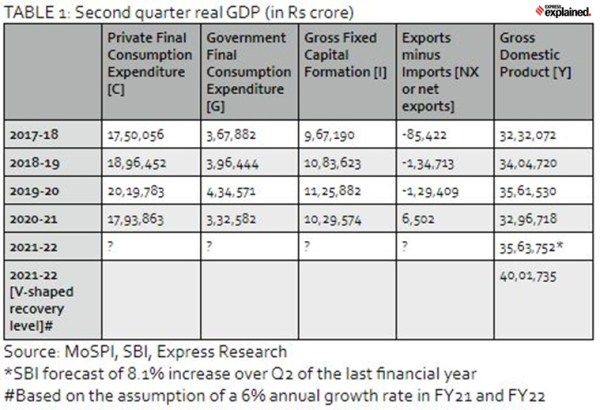
The table below gives the data for the total GDP and its four key subcomponents for the past 5 years.

As such, broadly speaking, GDP is the total of

Story continues below this ad
  • All the money that you and I as private individuals spend [C]
  • All the money that our government spends [G]
  • All the money that businesses spend (or invests) [I]
  • The net effect of exports (what foreigners spend on our goods) and imports (what Indians spend on foreign goods).

As the table below shows, last year Q2’s GDP had fallen to levels last seen 2017-18. This year, if we assume that the State Bank of India’s forecast to be correct, the GDP is expected to grow by 8.1% over the last year’s level and be around Rs 35.63 lakh crore.

Second quarter real GDP (in Rs crore)

The first thing to note is that, if this happens, while it would be an impressive recovery, it would fall short of the so-called V-shaped recovery. That’s because it would still bring the GDP level just back to what it was in the second quarter of 2019-20.

As such, it again shows that the Indian economy has effectively lost two years of economic growth. If the economy grew at a 6% level in each of these years — that is FY21 and FY22 — then it would have touched the Rs 40 lakh crore mark (last row, last column in Table 1). For a true blue V-shaped recovery, this is the level that the economy had to achieve in total GDP. As things stand, at a 6% growth rate, India would take another two years before its Q2 GDP reaches the Rs 40 lakh crore mark.

The other big data point to look for is the actual level of private final consumption expenditure (or C). This is the biggest engine of GDP growth — it accounts for roughly 55% of all GDP. If “C” is growing fast, it would trigger “I”, which is the second-biggest engine of growth — accounting for 32% of all GDP in India. As Table 1 bears out, the private consumption expenditure component had fallen back to the 2017-18 levels. A sharp recovery in this category would be the best kind of recovery because it will trigger a virtuous cycle of economic growth. On the other, if this number exhibits a weak recovery then it would imply a long-drawn and feeble economic recovery for India.

Story continues below this ad

Now let’s evaluate what may or may not happen on the GVA front. The GVA is another way to calculate national income; in this case, one calculates the overall value added by different productive sectors of the economy.

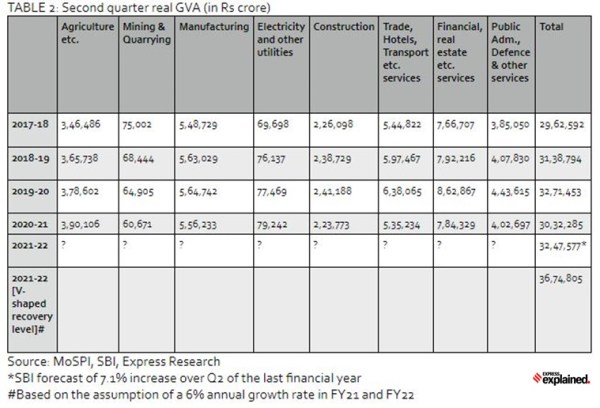
The table below gives the GVA data for the different productive sectors of the economy over the past 5 years.

Second quarter real GVA (in Rs crore)

The total GVA, as forecast by SBI, is expected to grow by 7.1% over the GVA in Q2 of the last financial year. But, again, the last row, last column entry shows what a V-shaped recovery level might be, and that India will take another two years before it reaches that level. In essence, it underscores the loss of two full years for the Indian economy.

Among the sub-components, the most important one would be “manufacturing”. As the data shows, manufacturing has largely been stagnant over the past four years. This is one sector that has the best hope of creating millions of new jobs, especially for an India that is not highly skilled.

Story continues below this ad

Newsletter | Click to get the day’s best explainers in your inbox

Going forward, that is in Q3 (October, November and December) and Q4 (January to March), the GDP and GVA data would perhaps be decided by the manner in which the news Covid variant — Omicron — is handled.

You can do your bit by getting vaccinated and wearing masks. And Write to me at udit.misra@expressindia.com

Regards,

Udit

Udit Misra is Senior Associate Editor at The Indian Express. Misra has reported on the Indian economy and policy landscape for the past two decades. He holds a Master’s degree in Economics from the Delhi School of Economics and is a Chevening South Asia Journalism Fellow from the University of Westminster. Misra is known for explanatory journalism and is a trusted voice among readers not just for simplifying complex economic concepts but also making sense of economic news both in India and abroad. Professional Focus He writes three regular columns for the publication. ExplainSpeaking: A weekly explanatory column that answers the most important questions surrounding the economic and policy developments. GDP (Graphs, Data, Perspectives): Another weekly column that uses interesting charts and data to provide perspective on an issue dominating the news during the week. Book, Line & Thinker: A fortnightly column that for reviewing books, both new and old. Recent Notable Articles (Late 2025) His recent work focuses heavily on the weakening Indian Rupee, the global impact of U.S. economic policy under Donald Trump, and long-term domestic growth projections: Currency and Macroeconomics: "GDP: Anatomy of rupee weakness against the dollar" (Dec 19, 2025) — Investigating why the Rupee remains weak despite India's status as a fast-growing economy. "GDP: Amid the rupee's fall, how investors are shunning the Indian economy" (Dec 5, 2025). "Nobel Prize in Economic Sciences 2025: How the winners explained economic growth" (Oct 13, 2025). Global Geopolitics and Trade: "Has the US already lost to China? Trump's policies and the shifting global order" (Dec 8, 2025). "The Great Sanctions Hack: Why economic sanctions don't work the way we expect" (Nov 23, 2025) — Based on former RBI Governor Urjit Patel's new book. "ExplainSpeaking: How Trump's tariffs have run into an affordability crisis" (Nov 20, 2025). Domestic Policy and Data: "GDP: New labour codes and opportunity for India's weakest states" (Nov 28, 2025). "ExplainSpeaking | Piyush Goyal says India will be a $30 trillion economy in 25 years: Decoding the projections" (Oct 30, 2025) — A critical look at the feasibility of high-growth targets. "GDP: Examining latest GST collections, and where different states stand" (Nov 7, 2025). International Economic Comparisons: "GDP: What ails Germany, world's third-largest economy, and how it could grow" (Nov 14, 2025). "On the loss of Europe's competitive edge" (Oct 17, 2025). Signature Style Udit Misra is known his calm, data-driven, explanation-first economics journalism. He avoids ideological posturing, and writes with the aim of raising the standard of public discourse by providing readers with clarity and understanding of the ground realities. You can follow him on X (formerly Twitter) at @ieuditmisra           ... Read More


Latest Comment
Post Comment
Read Comments
Advertisement
Advertisement
Advertisement
Advertisement