Premium
This is an archive article published on October 9, 2021

Explained: What Air India deal means for the Govt, Tata Group

Air India deal: The sale of the national carrier underlines the govt’s commitment to disinvestment, but still leaves it with significant debt. For the Tatas, it is emotional — as well as a long-term business bet.

Air India Tata Group deal, Air India sale, air india ratan tata, air india share price, tata airlines, air india, Indian ExpressThe sale of Air India to a private player has been in the offing for a long time. (Express Photo: Amit Chakravarty)

On Friday, the government announced its decision to sell all its stake in Air India (AI) as well as AI’s stake in two other businesses — Air India Express Ltd (AIXL) and Air India SATS Airport Services Pvt Ltd (AISATS).

Why was Air India sold?

The sale of Air India to a private player has been in the offing for a long time. AI was started by the Tata Group in 1932, but in 1947, as India gained Independence, the government bought 49% stake in AI. In 1953, the government bought the remaining stake, and AI was nationalised.

For the next few decades, the national carrier dominated Indian skies. However, with economic liberalisation and the growing presence of private players, this dominance came under serious threat. Ideologically too, the government running an airline did not quite gel with the mantra of liberalisation.

By 2007, AI (which flew international flights) was merged with the domestic carrier, Indian Airlines, to reduce losses. But it is the mark of how poorly the airline was run that it has never made a profit since 2007.

In fact, since 2009-10, the government (and indirectly the taxpayer) has spent over Rs 1.1 lakh crore to either directly make up the losses or raise loans to do so. As of August 2021, AI’s debt was Rs 61,562 crore. Moreover, every additional day that AI remains operational, the government suffers a loss of Rs 20 crore — or Rs 7,300 crore per year.

Why wasn’t it sold earlier?

The first attempt to reduce the government’s stake — disinvestment — was made in 2001 under the then NDA government. But that attempt — to sell 40% stake — failed. As the viability of running AI worsened with every passing year, it was clear to all, including the government, that sooner or later the government would have to privatise the airline.

Air India Tata Group deal, Air India sale, air india ratan tata, air india share price, tata airlines, air india, Indian Express

Story continues below this ad

In 2018, during its first term, the Narendra Modi government made another attempt to sell the government stake — this time, 76%. But it did not elicit even a single response.

The latest attempt was started in January 2020, and even though aviation is one of the worst hit sectors due to the pandemic, the government has been able to finally conclude the sale.

So how was it managed this time?

There were two main hurdles.

One, the mere fact that the government retained a partial stake. In other words, as long as the government kept a certain shareholding of AI, private players did not seem interested. That’s because the mere idea of government ownership, even if it was as little as 24%, made private firms wonder if they would have the operational freedom needed to turn around such a heavy loss-making airline. Unlike all the past attempts, this time the government put 100% of its stake on sale.

Two, the sheer mountain of debt on AI’s books, not to mention the ongoing losses. In the past, the government expected the bidders to pick up a certain amount of the debt along with the airline. That approach did not work. This time, the government let the bidders decide the amount of debt they wanted to pick up. These two factors made the difference.

Story continues below this ad

What is the significance of this sale?

From the government’s perspective, there are two ways to look at it.

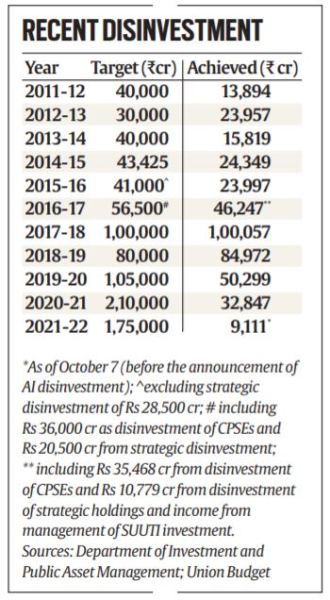
One, it underscores PM Modi’s commitment to reducing the government’s role in the economy; he can claim to have saved taxpayers from paying for daily losses of AI. Given the historical difficulties in AI’s disinvestment, or any disinvestment at all (see table), this is a significant achievement.

However, purely in terms of money, the deal does not result in as big a step towards achieving the government’ s disinvestment target of the current year. Moreover, of the total AI debt of Rs 61,562 crore, the Tatas will take care of Rs 15,300 crore and will pay an additional Rs 2,700 crore in cash to the government. That leaves Rs 43,562 crore of debt. The assets left with the government, such as buildings, etc., will likely generate Rs 14,718 crore. But that will still leave the government with a debt of Rs 28,844 crore to pay back.

Story continues below this ad

So, it can be argued that if the government had run AI well, it could have made profits and paid off the debts — instead of selling the airline (that can make profits) and still be left with a lot of debt.

From the Tatas’ perspective, apart from the emotional aspect of regaining control of an airline that they started, AI’s acquisition is a long-term bet. The Tatas are expected to invest far more than what they have paid the government if this bet is to work for them.

Newsletter | Click to get the day’s best explainers in your inbox

Udit Misra is Senior Associate Editor at The Indian Express. Misra has reported on the Indian economy and policy landscape for the past two decades. He holds a Master’s degree in Economics from the Delhi School of Economics and is a Chevening South Asia Journalism Fellow from the University of Westminster. Misra is known for explanatory journalism and is a trusted voice among readers not just for simplifying complex economic concepts but also making sense of economic news both in India and abroad. Professional Focus He writes three regular columns for the publication. ExplainSpeaking: A weekly explanatory column that answers the most important questions surrounding the economic and policy developments. GDP (Graphs, Data, Perspectives): Another weekly column that uses interesting charts and data to provide perspective on an issue dominating the news during the week. Book, Line & Thinker: A fortnightly column that for reviewing books, both new and old. Recent Notable Articles (Late 2025) His recent work focuses heavily on the weakening Indian Rupee, the global impact of U.S. economic policy under Donald Trump, and long-term domestic growth projections: Currency and Macroeconomics: "GDP: Anatomy of rupee weakness against the dollar" (Dec 19, 2025) — Investigating why the Rupee remains weak despite India's status as a fast-growing economy. "GDP: Amid the rupee's fall, how investors are shunning the Indian economy" (Dec 5, 2025). "Nobel Prize in Economic Sciences 2025: How the winners explained economic growth" (Oct 13, 2025). Global Geopolitics and Trade: "Has the US already lost to China? Trump's policies and the shifting global order" (Dec 8, 2025). "The Great Sanctions Hack: Why economic sanctions don't work the way we expect" (Nov 23, 2025) — Based on former RBI Governor Urjit Patel's new book. "ExplainSpeaking: How Trump's tariffs have run into an affordability crisis" (Nov 20, 2025). Domestic Policy and Data: "GDP: New labour codes and opportunity for India's weakest states" (Nov 28, 2025). "ExplainSpeaking | Piyush Goyal says India will be a $30 trillion economy in 25 years: Decoding the projections" (Oct 30, 2025) — A critical look at the feasibility of high-growth targets. "GDP: Examining latest GST collections, and where different states stand" (Nov 7, 2025). International Economic Comparisons: "GDP: What ails Germany, world's third-largest economy, and how it could grow" (Nov 14, 2025). "On the loss of Europe's competitive edge" (Oct 17, 2025). Signature Style Udit Misra is known his calm, data-driven, explanation-first economics journalism. He avoids ideological posturing, and writes with the aim of raising the standard of public discourse by providing readers with clarity and understanding of the ground realities. You can follow him on X (formerly Twitter) at @ieuditmisra           ... Read More


Latest Comment
Post Comment
Read Comments
Advertisement
Advertisement
Advertisement
Advertisement