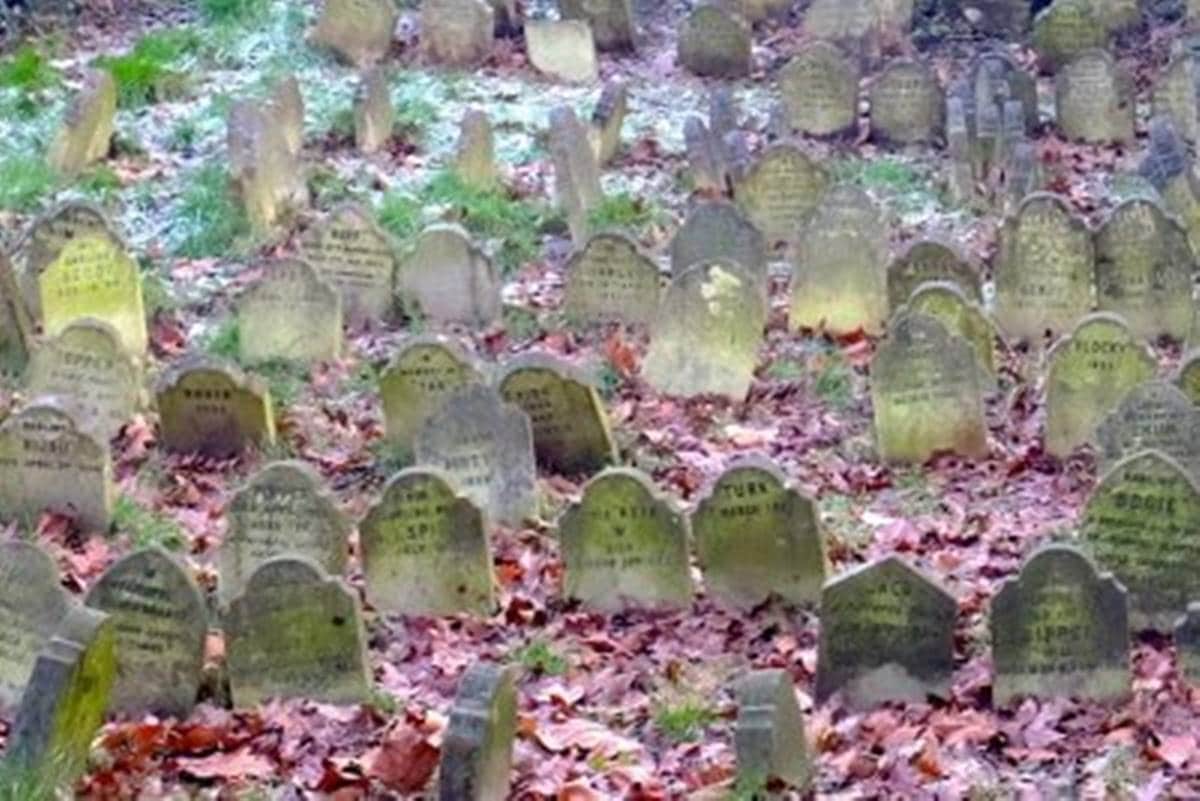
A pet cemetery at the Lisbon Zoo, Portugal. (Photo: Wikimedia Commons)
“Could I think we’d meet again, it would lighten half my pain,” reads the inscription on a tombstone. Another says, “God bless until we meet again”. These are from the graves of dogs in the UK, erected by grieving owners and indicating, according to a new study, that an increasing number of pet owners cling to a belief in a heaven or an afterlife for their pets, and, that they will eventually be reunited.
The study was conducted by Eric Tourigny, a researcher from the Department of History, Classics and Archaeology, Newcastle University, UK. The paper, titled “Do all dogs go to heaven? Tracking human-animal relationships through the archaeological survey of pet cemeteries”, was published in the journal Antiquity by Cambridge University on October 27.
You’ve Read Your Free Stories For Now
Sign up and keep reading more stories that matter to you.
In a year when the pandemic has made death ubiquitous, the study sheds light on the ritual of mourning in the intimate but undefined relationship between humans and animals. Tourigny walked among tombstones that have been erected since the Victorian period in four major pet cemeteries in England, for this project on how one has let go of a beloved animal over the eras.
“I had been working on an archaeological collection from 19th century Toronto, which contained a back-garden dog burial that intrigued me. As a zooarchaeologist (combination zoology and archaeology), I study animal bones recovered from archaeological sites to reconstruct past human-animal relationships. After coming across this dog, I started researching the different ways people buried their pets in the 19th century and that’s when I first stumbled upon the fact that the first public pet cemeteries appeared in the late 1800s.
I was surprised by how recent this was and how many of the gravestones still survive,” he says to The Indian Express in an email interview. Here’s what his research says about the changing dynamics of human-animal relationships snipped by death:
A quick departure
Tourigny writes that, for as long as people lived with animals, they had to deal with bodies of dead animals. “Although dog burials are commonly recovered from prehistoric and Roman sites in Britain, fewer are found in medieval contexts, when dog and cat skeletons are more likely to be recovered from refuse deposits. Not all animal bodies were buried in the post-medieval period: sometimes, dogs and horses were sold to knackers’ yards, where carcasses could be rendered down to produce useful materials, such as skins, and meat for animal consumption.
Such post-medieval disposal practices do not necessarily reflect a lack of care for the animals in life, but rather the influence of Christian doctrine on appropriate burial practice, and hygiene concerns related to body disposal,” he writes in the paper.
In the 18th century, epitaphs and elegies for pets began to be published in local newspapers, but the tone was satirical and humorous except in a. few that reflected contemporary discussions on subjects such as whether animals had souls.
The few pets that received a ceremonial farewell belonged to affluent households that erected memorials in private gardens. Then, in 1881, a Maltese Terrier called Cherry passed away at a ripe, old age. He used to be a regular at Hyde Park in London, so his owners approached a gatekeeper with a request that was strange for the time — could Cherry be interred at his favourite spot?
The pet cemetery in Hyde Park, London. (Photo: historic-uk.com)
The gatekeeper cleared a patch and Cherry became the first pet in the history of the UK to get a public grave. It stood for several years, with a little headstone reading, “Poor Cherry. Died April 28. 1881”. That opened the floodgates, with hundreds of elite dog owners, such as the then Duke of Cambridge, burying their canines at Hyde Park pet cemetery.
A Family Affair
Story continues below this ad
By mid-20th centuries, dogs and other pets began to be treated as members of the family, as inscriptions on their gravestones suggest that ‘Mummy’, ‘Dad’, ‘Nan’ or ‘Auntie’ were mourning them.
“Some gravestone texts explicitly describe the relationship, either with introductory statements such as ‘In memory of my dear pet’, or through epitaphs like ‘A faithful friend and constant companion’. The relationships described in the texts sometimes conflict with the commemorator’s self-reference. Cooch’s (d. 1952, Ilford) epitaph, for eg, reads ‘Our faithful pet and companion’, but the commemorator identifies themself as ‘Mummy’,” writes Tourigny in the paper.
After World War II, dogs seem to become an even greater part of the family, and tombstones from the era identify them with the familial surname. 📣 Express Explained is now on Telegram
The Hand of Faith
Victorian ideas of heaven affected the way people began to see the afterlife as “a home in which the dog played a prominent role”. One can find graves with Biblical references such as ‘Not one of them is forgotten before God’ and ‘Every beast in the forest is mine, saith the Lord’.
Story continues below this ad
This was also the time when people felt the need to express grief following the loss of a beloved animal. “This was, however, at odds with socially acceptable beliefs of the time, as a disbelief in animal souls conflicted with the need to mourn a beloved individual’s death,” writes the researcher.
He found that the establishment of the first public pet cemeteries powered human desire for an animal afterlife. “While only a few early gravestones mention the desire for reunification specifically, the symbolism apparent in many of the gravestone forms and designs suggests that people conceptualised animal death in the same way as human death, through the metaphor of sleep,” he says.
“Today, people continue to struggle to find an appropriate outlet to express the deep emotional pain that they suffer following the loss of a beloved animal, fearing social repercussions for either anthropomorphising their relationships and being too sentimental, or for being disrespectful of people and religious beliefs,” writes Tourigny.
Story continues below this ad
He has observed that, since the late 20th century, pet cremations have become increasingly popular and now most animals are cremated after their death. “Many opt to spread the ashes in an outdoor space or keep them in special urns inside their house, perhaps as a way of keeping their loved one’s presence.
Pet cemeteries are also changing, new laws in many countries, including Britain, are now allowing people and animals to be buried together in the same cemetery and share the same gravestones. While the burial forms might change, they continue to reveal the important role of animals in people’s lives,” he says.
Dipanita Nath is a Senior Assistant Editor at The Indian Express, based in Pune. She is a versatile journalist with a deep interest in the intersection of culture, sustainability, and urban life.
Professional Background
Experience: Before joining The Indian Express, she worked with other major news organizations including Hindustan Times, The Times of India, and Mint.
Core Specializations: She is widely recognized for her coverage of the climate crisis, theatre and performing arts, heritage conservation, and the startup ecosystem (often through her "Pune Inc" series).
Storytelling Focus: Her work often unearths "hidden stories" of Pune—focusing on historical institutes, local traditions, and the personal journeys of social innovators.
Recent Notable Articles (December 2025)
Her recent reporting highlights Pune’s cultural pulse and the environmental challenges facing the city during the winter season:
1. Climate & Environment
"Pune shivers on coldest morning of the season; minimum temperature plunges to 6.9°C" (Dec 20, 2025): Reporting on the record-breaking cold wave in Pune and the IMD's forecast for the week.
"How a heritage tree-mapping event at Ganeshkhind Garden highlights rising interest in Pune’s green legacy" (Dec 20, 2025): Covering a citizen-led initiative where Gen Z and millennials gathered to document and protect ancient trees at a Biodiversity Heritage Site.
"Right to breathe: Landmark NGT order directs PMC to frame norms for pollution from construction sites" (Dec 8, 2025): Reporting on a significant legal victory for residents fighting dust and air pollution in urban neighborhoods like Baner.
2. "Hidden Stories" & Heritage
"Inside Pune library that’s nourished minds of entrepreneurs for 17 years" (Dec 21, 2025): A feature on the Venture Center Library, detailing how a collection of 3,500 specialized books helps tech startups navigate the product life cycle.
"Before he died, Ram Sutar gave Pune a lasting gift" (Dec 18, 2025): A tribute to the legendary sculptor Ram Sutar (creator of the Statue of Unity), focusing on his local works like the Chhatrapati Shivaji statue at Pune airport.
"The Pune institute where MA Jinnah was once chief guest" (Dec 6, 2025): An archival exploration of the College of Agriculture, established in 1907, and its historical role in India's freedom struggle.
3. Arts, Theatre & "Pune Inc"
"Satyajit Ray, Ritwik Ghatak were not rivals but close friends, says veteran filmmaker" (Dec 17, 2025): A deep-dive interview ahead of the Pune International Film Festival (PIFF) exploring the camaraderie between legends of Indian cinema.
"Meet the Pune entrepreneur helping women build and scale businesses" (Dec 16, 2025): Part of her "Pune Inc" series, profiling Nikita Vora’s efforts to empower female-led startups.
"How women drone pilots in rural Maharashtra are cultivating a green habit" (Dec 12, 2025): Exploring how technology is being used by women in agriculture to reduce chemical use and labor.
Signature Style
Dipanita Nath is known for intellectual curiosity and a narrative-driven approach. Whether she is writing about a 110-year-old eatery or the intricacies of the climate crisis, she focuses on the human element and the historical context. Her columns are often a blend of reportage and cultural commentary, making them a staple for readers interested in the "soul" of Pune.
X (Twitter): @dipanitanath ... Read More