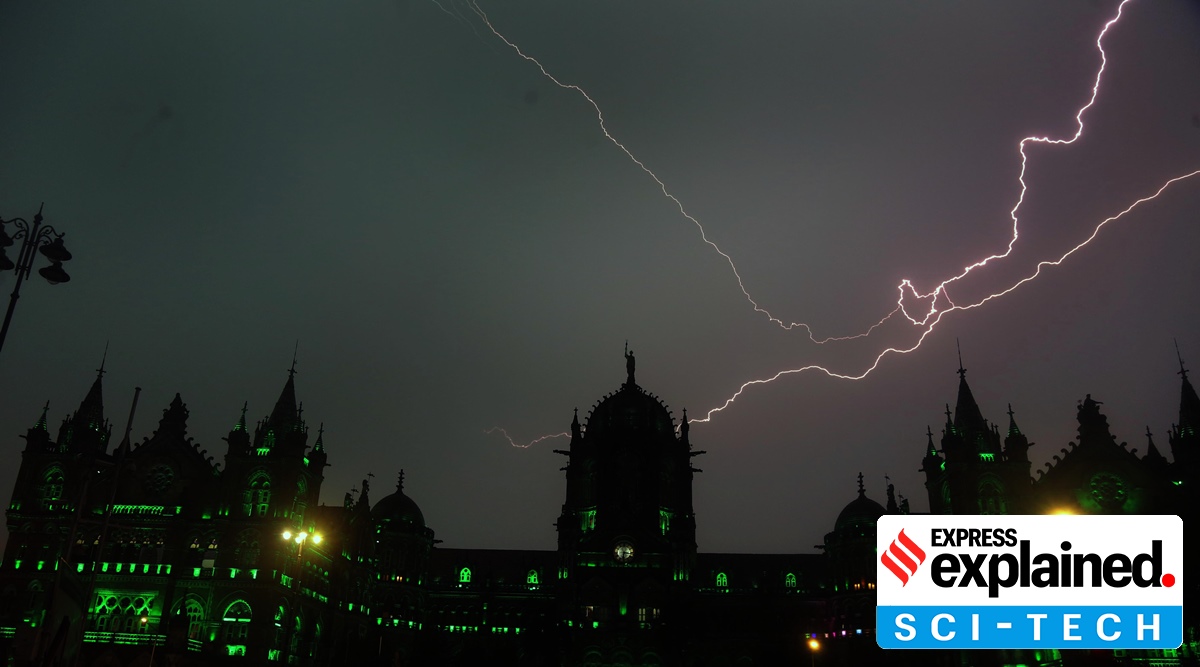
Brazilian researchers recently succeeded in taking pictures of positive upward discharges of electricity from lightning conductor rods, travelling to connect with the negative discharge from lightning in the clouds. The event, known as “upward lightning” or upward flashes, has been known for long, but the researchers succeeded in photographing it with high-speed video cameras at very high resolution, The New York Times reported.
The researchers captured the electric action in São José dos Campos, a city northeast of São Paulo in Brazil. They published their research and photos in the open-access journal Geophysical Research Letters in December last year.

The phenomenon of upward lightning
Upward lightning is a phenomenon whereby a self-initiated lightning streak develops from a tall object that travels upward toward an overlaying electrified storm cloud.
For this to happen, storm electrification and the resulting presence of a cloud charge region are enabling factors. The vertical elevation of a tall object accentuates the electric field locally on the ground, resulting in conditions favourable for the initiation of an upward streak (called a leader) from a tall object, which can also develop in response to an electric field change created by a nearby preceding lightning flash.
Multiple studies and observations
According to a paper in Nature on the triggering mechanisms of upward lightning by Carina Schumann and others (July 2019), there have been multiple upward lightning studies that were done in Rapid City, South Dakota, USA and Sao Paulo, Brazil during the summer thunderstorm seasons between 2011 and 2016.
One of the key objectives of these studies was to characterise the triggering of upward positive leaders from tall objects due to preceding nearby flash activity. As part of this, a total of 110 upward flashes were observed with a combination of high- and standard-speed video and digital still cameras, electric field metres, fast electric-field antenna systems, and also lightning mapping arrays.
Story continues below this ad
These data sets were analysed, along with correlated lightning location system data, to determine the triggering flash type responsible for the initiation of upward leaders from towers. The paper concluded that the most effective triggering component is “the propagation of the in-cloud negative leader during the continuing current that follows a positive return stroke”.
Process: Stepped ladder trigger
Simply put, this process is triggered by the development of the stepped leader (essentially a channel of negative charge that travels downward in a zigzag pattern from a cloud, nearly invisible to the human eye) travelling to the ground in a millisecond, leading to an intensification of the positive charge on the ground.
As the streaks of the stepped leader keep streaking towards the ground, the electrical charges between the leader tips and the tops of tall objects on the ground keep on increasing. In due course, these forces cause the air above these tall buildings or towers to ionise and thereby turn more conductive.
With the negative charge repeatedly moving toward the ground, the channel of air just above the tall objects turns positively charged, which starts streaking upwards and is called an upward streamer. In due course, the negatively-charged, downward-moving stepped leader makes contact with one of the developing positively-charged upwards streamers.
Story continues below this ad
According to the US Department of Commerce’s National Oceanic and Atmospheric Administration (NOAA), when contact is eventually made, the lightning channel is complete and charges can flow rapidly from the cloud toward the ground, and it takes just a fraction of a second to go from the stepped leader initiation to the final connection being made with an upwards streamer.


 4 min read