8 min read
© The Indian Express Pvt Ltd



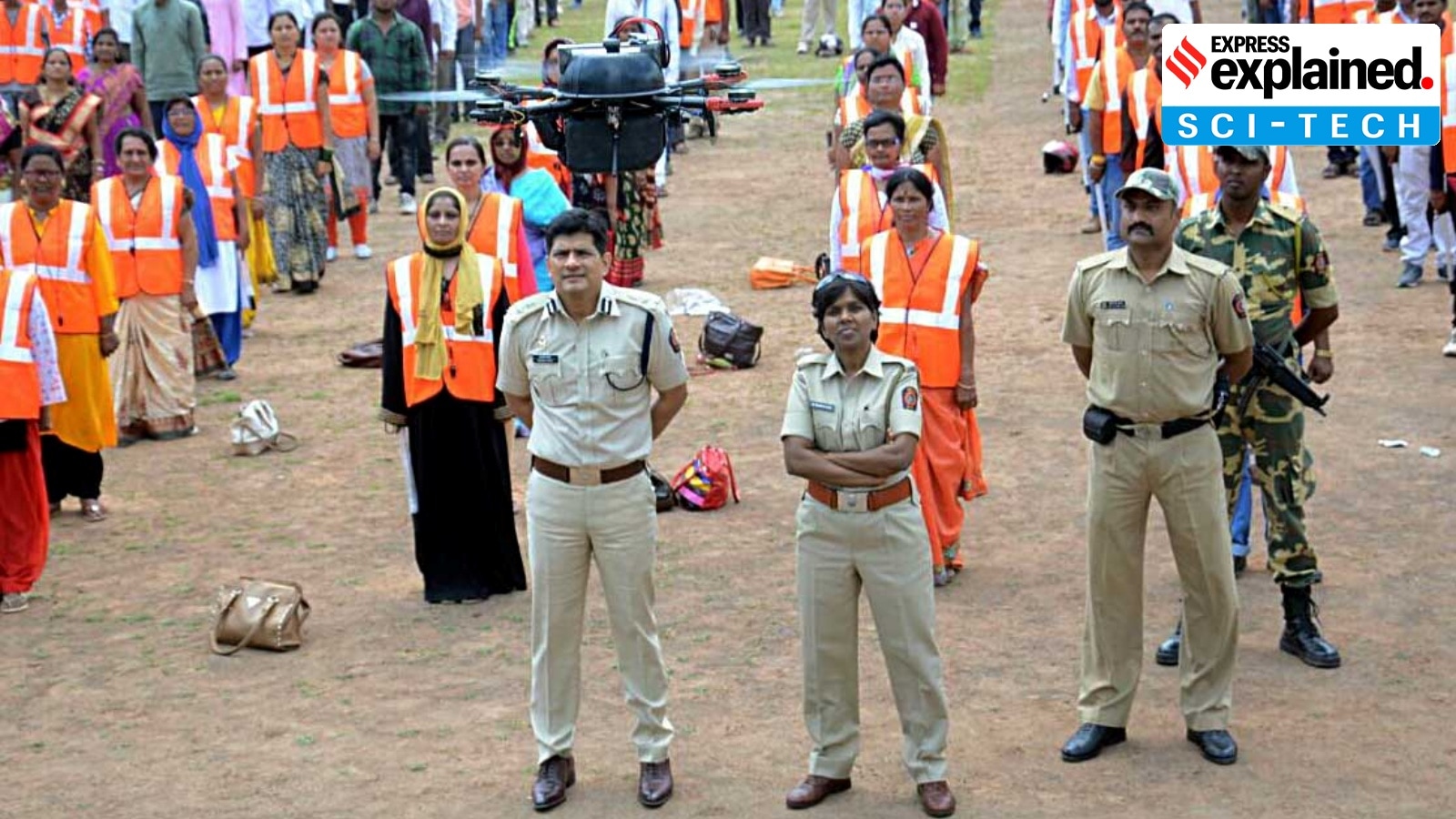 Experts are concerned that these AI tools can result in unfair and wrongful targeting of certain communities, as they are trained on historical police data, which can be inherently biased. (Representational image/File)
The Delhi police last month announced that under the ‘Safe City Project’, they would install 10,000 artificial intelligence-enabled cameras across the national capital. The cameras would be equipped with features such as a face recognition system and distress detection technologies, capable of identifying sounds and facial expressions associated with emergencies.
The development came just days after the Maharashtra government rolled out the AI-powered investigation platform — known as MahaCrime OS AI — for the state police. The software aims to process complaints faster, analyse complex data, and follow investigative procedures more efficiently.
These are only two of the long list of AI-driven initiatives that have been integrated into police operations in recent years. While the police have said the use of AI would help them increase their efficiency and better handle manpower, experts have raised several concerns about the new technology.
How are the police currently integrating AI in their operations?
Srinivas Kodali, an interdisciplinary researcher working on data, cities and the Internet, told The Indian Express, “The police are using AI by integrating semi-automated — not entirely automated — systems in their operations. For instance, they are using a surveillance agent through CCTV cameras to semi-automate the task of patrolling the streets and ensuring their safety. While a CCTV camera can be on a street, a cop can be at a centralised data centre, known as a command and control centre, getting a top-down view of what is happening in the city.”
Apart from deploying CCTV cameras for surveillance and recognition, the police are using AI-driven tools for other operations, such as curbing the crime rate, communication, and exploration, as well.
For example, in November 2025, the Delhi police received 75 drones from the Indira Gandhi Delhi Technical University for Women for tasks like crowd control and traffic control.
The MahaCrime OS AI has been launched to do predictive policing, which involves the use of algorithms to “detect crime patterns, suspicious anomalies, predict future crime spots,” according to the Bureau of Police Research and Development’s (BPRD’s) 2022 document, ‘AI in the Service of Law Enforcement — An Introduction’.
The police are also deploying AI tools for social media monitoring. In May 2025, Bengaluru police said they would launch an AI-powered platform to track misleading content on social media.
All of these systems need data to be trained on. One of the sources for the data is the Criminal Tracking Network and Systems (CCTNS). It was launched in 2009 by then Home Minister P Chidambaram in the aftermath of the 2008 Mumbai attacks. The project was envisaged as a system to facilitate the collection, storage, retrieval, analysis, transfer and sharing of data and information among all the police stations and other police organisations across the country.
What are some of the major concerns about the rising use of AI in policing?
Experts are concerned that these AI tools can result in unfair and wrongful targeting of certain communities, as they are trained on historical police data, which can be inherently biased.
However, Kodali said, “This is an individualistic view. There is a need to see the impact on society as a whole. For instance, the integration of AI in policing will lead to the centralisation of power. AI essentially means that the local cop is not the one who will carry out an operation. It will take place through information, which is centralised in a big data centre somewhere, coming from the top to the bottom. This can make it difficult for people to navigate policing systems.”
The researcher also highlighted that even within the policing establishment, the centralisation of power — which has historically existed — will become harder and more codified. For instance, a beat cop would be under constant supervision of their seniors through CCTV cameras and geotagging.
The use of AI tools can also lead to excessive policing. For example, according to another document by BPRD, one CCTV camera is equivalent to 100 policemen. This means that in a city like Hyderabad, where there are around one million such cameras, 100 million police personnel are policing a population, according to the 2024 UN World Urbanisation Prospects, of around 11 million residents.
Excessive policing can undermine fundamental rights of citizens, such as the right to protest, as the police can easily track and detain the protestors using AI tools, according to experts.
Dr Shivangi Narayan, assistant professor at Thapar School of Liberal Arts and Sciences, told The Indian Express, “Historically, the police used to take preventative measures like detaining history sheeters, which is problematic too, but in terms of scale, it was still a limited operation. Currently, the premise is that everyone is guilty, everything is suspicious”
Also, putting lakhs of cameras across a city does not give a sense of safety to citizens, as they are always under watch or suspicion. There will be a lack of human connection, and citizens would feel that if something goes wrong with them, there would be no one around them to help. By using these AI tools, authorities are not creating a safer world but rather imprisoning citizens.”
Deploying AI tools for policing can result in a lack of transparency. Unlike police manuals, which have historically been used to train police personnel, there has so far been no rulebook for the working AI systems.
Some of these fallouts are already unfolding in Tengana, where most of these AI systems used in policing are being developed — for example, MahaCrimeOS AI has been built by a company called CyberEye, which is based in Hyderabad.
In 2023, a man named Mohammed Khadeer Khan was detained in Telangana’s Medak by the police, as his facial features resembled those of a suspect in a chain-snatching incident, which had been captured in a CCTV camera. Khan suffered serious injuries due to alleged police brutality during his detention, and later died. A fact-finding committee in Telangana subsequently found that the CCTV footage only showed a masked thief. The police had used Khan’s call record data to locate and detain him, all without a warrant.
What kind of guardrails are required to regulate the use of AI in policing?
There have been calls for enacting a legal framework to regulate the use of AI in policing. This framework can take cues from, for example, the executive order signed by then United States President Joe Biden in 2023, which directed AI companies to put their tools through safety tests and submit results to the government before their public release.
However, according to Dr Narayan, author of Predictive Policing and the Construction of the Criminal: An Ethnographic Study of Delhi Police (2023), legal compliance will be easy to subvert. “The regulation needs to look beyond laws and compliance… There should be a focus on building a safer society by, let’s say, providing employment and resources to everyone. While policing and surveillance are fine to an extent for controlling crime, there cannot be long-term investments only in technology and not in institutions, which make a better society. “
According to Kodali, there is a need for police reforms rather than regulating AI. The researcher said that, like in the case of previous technologies, such as fingerprint matching, there will be instances of police misusing AI. Therefore, current laws need to be reformed to reduce the risk of exploiting AI.
“Take, for example, the Criminal Procedure (Identification) Act, 2022, which allows the police to collect data, such as fingerprints, retina scans, and biological samples, of any accused — not convicts. So, if someone was just present at the scene of the crime and the CCTV camera captured their image, the police can collect information about them to determine if they were involved in the crime or not. This needs to change, as the right to privacy is a fundamental right, and the police cannot collect someone’s data without their knowledge,” said Kodali.