4 min read


© The Indian Express Pvt Ltd



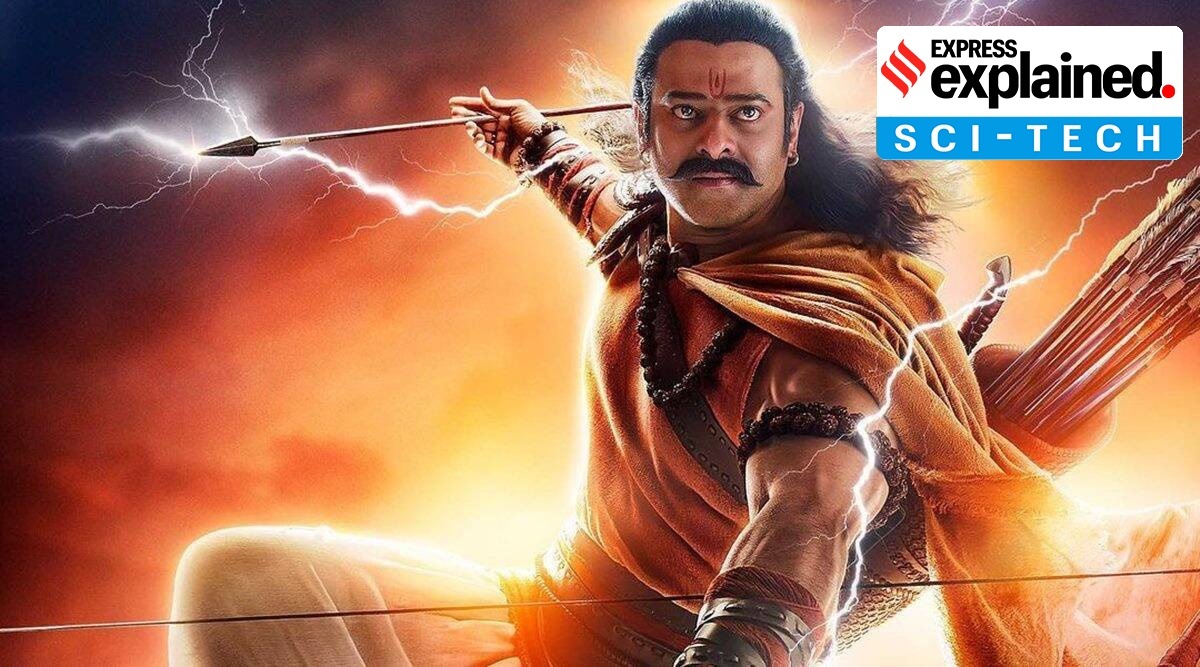 Although Adipurush aims to surpass Pathaan's record this year, initial reactions to the film have been somewhat divided, with The Indian Express' Shubhra Gupta pointing out that the film features a series of clunky computer graphics. (File)
 Riding high on a wave of anticipation, director Om Raut’s mythological film Adipurush hit theatres across the world on Friday (June 16). Made on a staggering budget of Rs 500 crore, Adipurush stars Prabhas, Kriti Sanon and Saif Ali Khan in the lead roles.
Despite being embroiled in consecutive controversies since the release of its teaser on October 2 last year, Adipurush surprised many by earning around Rs 12 crore from advance bookings alone.
Although the movie aims to surpass Pathaan’s record this year, initial reactions to the film have been somewhat divided, with The Indian Express’ Shubhra Gupta pointing out that the film features a series of clunky computer graphics.
Whether it yielded positive results or not, the creators utilised motion capture technology and computer-generated imagery (CGI) to construct the universe of Adipurush. But, what do these terms actually mean? Let’s take a look.
Motion capture technology
Motion capture, or mo-cap, is the name for the technology that records the movement of people or objects. The data thus captured will be transferred to a computer programme and can in turn be translated to a CGI character. Mo-cap, in detail, tracks specific motions such as facial expressions and body movements, so that the features can be provided to the computer-generated 3D character on screen.
According to StudioBinder, the technology works with the help of components such as a mo-cap suit, a head-mounted camera and the software required to create the digital character. While the mo-cap suit captures the body movements of an actor, the head-mounted camera tracks their facial expressions, including the minute ones.
Once these two components capture all that’s necessary, the data is then transferred to computer software to create a fully realised digital character.
According to software giant Adobe, motion capture, as we know it today, was first used in the film The Lord of the Rings: The Two Towers, in which Andy Serkis, as Gollum, wore a mo-cap suit on location, with special cameras recording his movements and facial expressions. But it was James Cameron’s Avatar that popularised the technology across the globe.
Characters such as Thanos (Josh Brolin) in the Avengers series, Smaug (Benedict Cumberbatch) in The Hobbit: The Desolation of Smaug and Caesar (Andy Serkis) in Rise of the Planet of the Apes were created using this cutting-edge technology.
Fantastic Four, Guardians of the Galaxy, A Quiet Place, The Lion King and Ghostbusters: Afterlife are some recent films that utilised this technology.
Soundarya Rajinikanth’s Kochadaiiyaan was India’s first photorealistic motion capture film.
Computer-generated Imagery (CGI)
In basic terms, Computer-generated Imagery, or CGI, refers to the utilisation of computers to create pictures or characters in film and television. It can also be defined as the process of creating and manipulating images that do not exist in the physical environment for being captured on film or video, according to MasterClass. These images can be either static or dynamic and are utilised in both 2D and 3D movies.
Due to its increased affordability compared to the past, CGI is now extensively used to generate specific elements of a shot or a scene, or even a substantial portion of an entire sequence.
Today, CGI is utilised in a wide range of films, including period/epic or sci-fi genres, to create specific elements, objects, or even entire background environments. Interestingly, even makers working on films that are outside of these genres embrace CGI technology to enhance the overall choreography of scenes or the film as a whole by incorporating intricate details.
SS Rajamouli’s Eega and the Baahubali series, S Shankar’s Jeans, Enthiran, and 2.0, and Anubhav Sinha’s Ra One are notable examples of Indian movies that extensively employed CGI. These films received much appreciation for their exceptional execution and proficiency in incorporating CGI effects.