6 min read


© The Indian Express Pvt Ltd



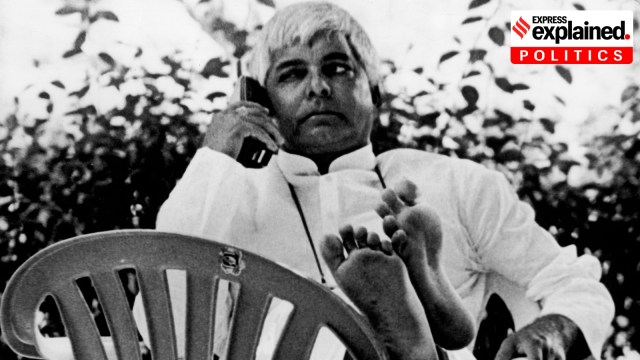 Lalu Prasad’s coming to the CM post in 1990 marked the first real transfer of power to OBCs in Bihar. Yet, inextricable from his social justice legacy are the charges of ‘criminalisation of politics’. (Express Archive)
When the RJD lost power in Bihar in 2005, Tejashwi Yadav, the current Chief Minister face of the Opposition, was barely 16 years old. Yet, over every election Tejashwi fights, the shadow of the RJD’s ‘jungle raj’ looms large. This time too, everyone from Prime Minister Narendra Modi to Home Minister Amit Shah has used ‘jungle raj’ to attack the RJD.
Many young people voting in these polls were not even born when the RJD was in power. Yet, if NDA leaders are to be believed, tales of the dreaded ‘jungle raj’ are being passed down to the new generation almost like folklore, of misrule and lawlessness, of Bihar as the ‘badland’.
‘Jungle raj’ was first used in 1997, in a context very different from the one in which it has such evocative power now. This was the time when Lalu Prasad, implicated in the fodder scam, had resigned as the CM and Rabri Devi had just been sworn in. The Patna High Court, hearing a petition about waterlogging and poor drainage, said in an oral observation that the condition in Patna was ‘worse than jungle raj’. The political opposition picked up the term, and soon it became associated with the 15-year rule of the RJD.
So, what was ‘jungle raj’? Was it lack of administrative foresight, the poor GDP rate, allegations of booth-capturing, rampant kidnapping for ransom, road robberies, and a chain of massacres? Or a combination of all?
Watch Express Cafe Podcast:
The RJD’s time in power can be divided into three phases — the Mandalisation of politics, the secularisation of politics, and the Yadavisation of politics.
The first two phases saw Lalu Prasad, a man of modest means from Phulwaria village in Gopalganj, become the CM, and marked the first real shift of power from the upper caste hegemony under the Congress to an OBC-centric politics. In the 35 years since Lalu came to power in 1990, upper castes have not dominated Bihar politics.
Lalu rode the Mandal movement to consolidate the OBC/EBC/Dalit vote. The 1989 Bhagalpur riots ensured he became the first choice for the 17 per cent Muslim votes, at the Congress’ expense. Lalu Prasad stopping the rath (chariot) of BJP leader LK Advani in Samastipur in 1990 made him the hero of secular voters.
The third phase, the Yadavisation of politics, saw Lalu focussing too much on the empowerment of fellow Yadavs, which slowly alienated non-Yadav OBCs, EBCs and Dalits. This paved the way for the Nitish Kumar-led NDA to take the reins of Bihar in 2005.
But what has stuck with Lalu is the “criminalisation of politics”.
Sample these comparative figures of kidnapping for ransom: Between 2001 and 2004 (under Rabri Devi rule), the Bihar Police registered 1,527 cases, as against 429 cases between 2006 to 2009. The 2005 kidnapping of a Patna schoolboy, Kislay, dominated headlines nationwide when former Prime Minister AB Vajpayee, at a Chhapra meeting, said, “Mera Kislay lauta do (bring back my Kislay).” Kislay did return home, but this was one of the few instances of a happy ending for a kidnapping case in Bihar.
Then were the caste-based massacres. From the 1976 Akodi (Bhojpur) massacre to the Kariambura massacre (Jehanabad) in 2001, 737 people, including several policemen, were killed between 1977 and 2001. The maximum number of killings — 337, including 50 Left wing extremists, took place between 1994 and 2000.
As many as 58 massacres took place between 1991 and 2001, killing 566 people, including 343 SC/OBC agricultural labourers and 128 upper caste landlords.
The year 1997 saw 12 massacres, killing 130 people. During the preceding year, there were 11 massacres, killing 76 people. The year 1999 saw 108 people losing their lives in seven massacres, followed by 69 killings in five massacres in 2000. The year 2001 had two massacres, in which 11 people were killed.
The most infamous massacres of the Lalu-Rabri period were in Bara (Gaya) in 1992, in which 34 upper caste landlords were killed; Bathanitola (Bhojpur) of 1996, in which 22 scheduled caste and Muslim agricultural workers were killed; the 1997 Laxmanpur Bathe (Arwal) massacre, killing 58 scheduled caste agriculture workers; the 1998 Shankarbigha (Jehanabad) massacre, in which 23 SC people were killed; and the 1999 Senari (Jehanabad) massacre, in which 35 upper caste were killed.
Mrityunjay Sharma, author of the book Broken Promises: Caste, Crime and Politics in Bihar, said, “Beneath the veneer of social justice, state institutions were systematically hollowed out. The fact that 144 out of 384 IAS officers sought central deputation in 1992 reflects the grim reality of that time. The police became an instrument of political assertion, often complicit in crimes… In the name of empowering the marginalised, Bihar witnessed the rise of new power hierarchies that mirrored the very exclusions they claimed to resist.”
Sharma added that by the late 1990s, migration had become the only form of mobility for millions. “An entire generation grew up believing that progress lay beyond Bihar’s borders. A state already known for supplying labour saw a 200% surge in migration between 1991 and 2001,” he said.
The RJD, however, claims that the term ‘jungle raj’ is used to turn focus away from the social justice achievements under Lalu-Rabri. Over the last few years, it has sought to turn the heat on the NDA over the crime figures under Nitish.
RJD national spokesperson Subodh Kumar said: “It has become fashionable to chant ‘jungle raj’ and escape questions over the 60,000 murders in the last 20 years. A CAG audit report in July said the Nitish government had not submitted utilisation certificates for funds amounting to Rs 70,877.61 crore. The government is yet to account for this.”
Subodh Kumar added that Lalu Prasad had always championed “the poor and the oppressed”.
“As Union railways minister, he brought about a turnaround of the railways. Tejashwi Prasad as deputy CM was instrumental in giving 5 lakh jobs. When the NDA has nothing to say, it invokes jungle raj.” he said.