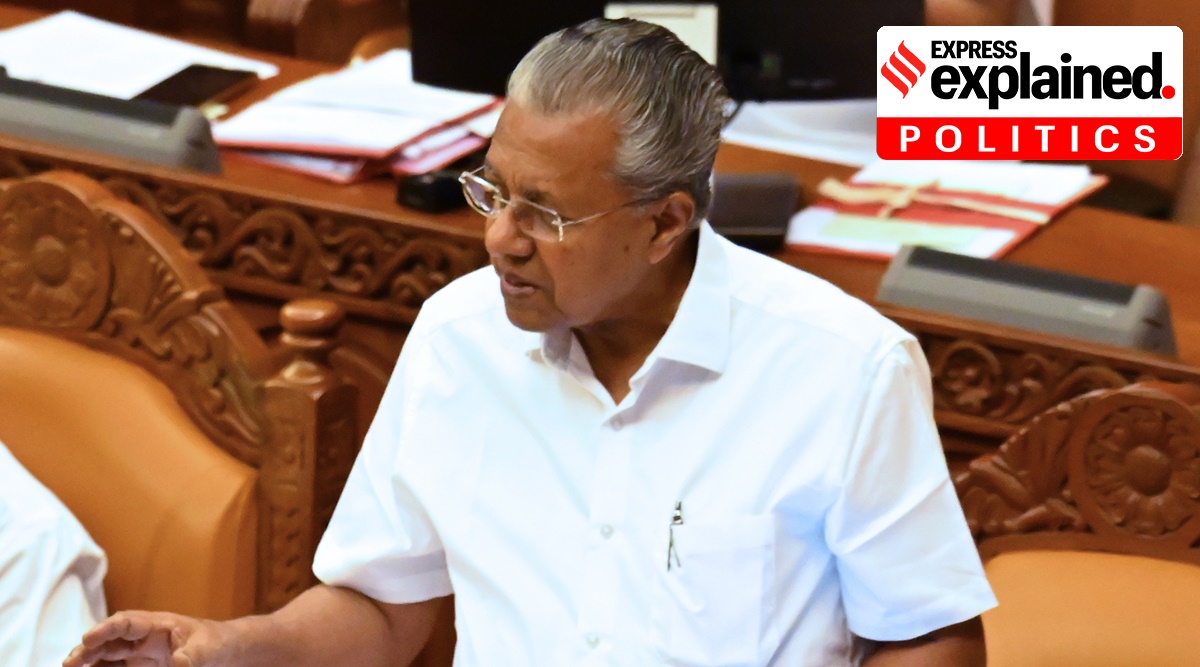
The Kerala government has raised concerns against the Centre’s recent interventions in the state’s co-operative sector. On Sunday, Chief Minister Pinarayi Vijayan claimed there was a bid to shatter the credibility of the state’s co-operative sector, and the destabilising attempts had begun during demonetisation.
The Vijayan government’s worries over the cooperative sector, which is controlled by the CPI(M), stem from a host of factors. Here is a look at what made the government raise an alarm and why

ED probe into a co-operative bank
Last month, the Enforcement Directorate (ED) launched a probe into a fund scandal at the CPI(M)-controlled Karuvannur Service Co-operative Bank in Thrissur. The case, registered under Prevention of Money Laundering Act, pertains to siphoning of funds to the tune of Rs 150 crore from the bank. The scam, which surfaced in 2021, involved functionaries of CPI (M). Hundreds of depositors are waiting for the recovery of their deposits with that bank. The ED alleged that a section of benami loans were disbursed at the behest of former minister and CPI(M) legislator A C Moideen.
Although reports of discrepancies in the state’s co-operative banks have surfaced earlier too — the government has admitted to anomalies in 49 institutions — this is the first time the central agency is looking into the sector, creating a flutter in the CPI(M). The party has claimed the ED’s involvement is part of “the Sangh Parivar agenda to weaken the co-operative sector”.
Multi-state cooperative societies
Last month, Parliament passed the Multi-State Co-operative Societies (Amendment) Bill 2023, aimed at strengthening multi-state cooperative societies, ensuring transparency in their functioning, and regular democratic elections at bodies to prevent nepotism in appointments. The multi-state cooperative societies are formed and guided by the Multi-State Cooperative Act of 2002. The amendment to the Act envisages merger of the existing state co-operative societies with the multi-state bodies.
Last month, the Ministry of Cooperation had formed three new multi-state bodies: National Co-operative Export Limited, Bharatya Beej Sahkari Samiti Limited, and National Cooperative Organic Limited. The Union Ministry had recommended that the state cooperative societies can take membership in these multi-state cooperative bodies.
Why Kerala is against multi-state co-operative bodies
At present, 10 registered offices of multi-state cooperative bodies and 109 branches of such bodies are functioning in Kerala. But, with the amendment, the Kerala government fears expansion of multi-state co-operative bodies, leading to the formation of a parallel co-operative movement.
Story continues below this ad
The government is of the view that the multi-state cooperative societies would pose a big challenge for the state’s existing cooperative system. These multi-state bodies can offer higher interest than the cooperative societies in Kerala, which may bring down deposits in the state co-operative sector. Kerala is of the view that dwindling deposits and business would impact the “socially committed interventions of the co-operative sector in the state”.
Besides, the state cooperative department has no control or administrative roles in these bodies, except the state co-operative registrar entitled to inspect.
The Union Ministry of Cooperation
Kerala had protested as far back as in 2021, when the Union Cooperation Ministry was formed under Amit Shah. The state government had then stated its opposition to the new ministry in the Assembly, terming it an infringement upon the constitutional rights of the state as well as a violation of federal principles.
Story continues below this ad
After the formation of the new ministry, the Centre had directed the state cooperative department to hand over all details about the societies in Kerala for a centralised software. Besides, a unified bylaw was envisaged for all cooperatives, whereas in Kerala, a cooperative society can act only as per a bylaw of the Kerala Cooperative Act 1969.
Another initiative was to prepare a national cooperative database. The state was of the view that these steps were meant only for helping the Union Government take control of the cooperative system in the state.
Robust cooperative movement in Kerala
Kerala has a strong cooperative movement, with footprints in various socio-economic aspects of life. When this government assumed office in May 2021, the number of cooperatives was 1,6062 and of them, 4,107 were running profitably. Last year, the department had found that as many as 164 cooperative societies/banks were in losses and were finding it difficult to give back deposits due to erosion of the capital and mismanagement of the bodies.
In the wake of the scandal at Karuvannur co-operative bank, the cooperative department has decided to launch a team audit in all districts.
Story continues below this ad
Anomalies in cooperative banks in Kerala are not new. Assembly documents show that financial misappropriations had been reported in several cooperative banks even in 1959.


 5 min read