© IE Online Media Services Pvt Ltd
 4 min read


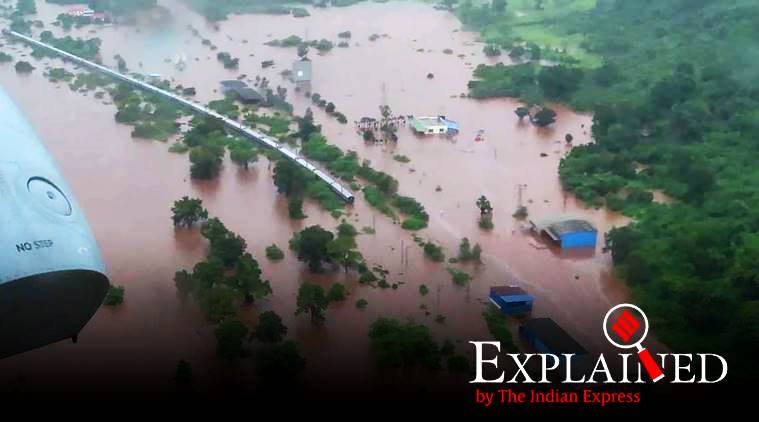 In the case of the Mahalaxmi Express, authorities were waiting for the water — which was initially four feet deep — to come down to one foot.
Around 1,000 passengers on board Mahalaxmi Express had a harrowing time Saturday after the train was stranded on the tracks due to flash floods. These situations are, however, not unusual for the Indian Railways, which has a set protocol for rescuing a train stuck in water.
SAFETY OF PASSENGERS
The first priority is to ensure that the passengers are well taken care of, since getting a train physically out of water may take time. The office of the Divisional Railway Manager (DRM) concerned takes care of the train.
COORDINATION WITH DISTRICT AUTHORITIES
The DRM gets in touch with the district authorities to get the civil disaster management apparatus activated. In these situations, the DRM is empowered to sanction emergency expenditure for material like water bottles, food packets and even medical assistance quickly. Coordination with district authorities is ensured for divisional teams to physically reach the train with relief material, while at the same time keeping in constant touch with onboard staff through wireless sets (mobile phones etc).
At least 700 passengers are stranded as Mahalaxmi Express was held up between Badlapur and Vangani station in Mumbai due to heavy rains Saturday morning.
Read more: https://t.co/taFabClQn8 pic.twitter.com/G281pG4i2r
— The Indian Express (@IndianExpress) July 27, 2019
RESCUING THE STRANDED TRAIN
Simultaneously, work gets under way to haul the train to the nearest station. Modern locomotives can, under most circumstances, run in water up to a certain level, like one foot deep — although with extreme caution. However, deeper water poses the risk of water getting into the underslung of the engine, which might cause a breakdown, rendering the engine idle.
Explained | Why townships in Thane district witnessed flooding today
In the case of the Mahalaxmi Express, authorities were waiting for the water — which was initially four feet deep — to come down to one foot. After the water level is down to around a foot, an engine is pressed into service to reach the stranded train and haul it out of the affected area. Taking the train out to clear the track is also essential to maintain the “path” for other trains, because one breakdown has a cascading effect on the railway timetable.
BETTER SIGNALLING SYSTEM HELPS
Operations in a flood are easier these days because of the evolution of the signalling system. Earlier, especially in suburban networks like in Mumbai, signalling used to be through track circuiting. Any waterlogging on the tracks, even of a few inches, would cause the circuits to trip, for safety, and bring services to that section to a halt. Over the years, track circuiting has been replaced with sensor-based axle counter-signalling, which does not get affected by flooding.
A MANUAL TO REFER TO
However, running of trains on submerged or water-affected tracks is tricky. That is why every train driver has a manual to refer to during the monsoon, especially on the Mumbai suburban network. The manual essentially tells the drivers at what speed to run the train when the water level on the tracks reaches a certain point. It also tells them what to do, and what apparatus within the railway ecosystem to activate when the water level is beyond a threshold of technical tolerance, as far as safe operations are concerned.