6 min read
© The Indian Express Pvt Ltd



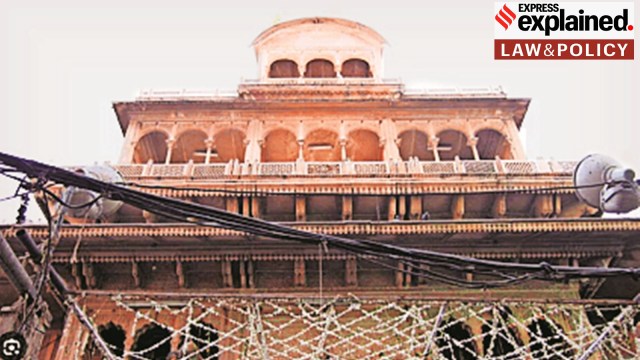 The Shri Bankey Bihari Ji Maharaj Temple has been managed since the 1500s by Goswamis, also known as Sevayats. (Express photo)
Less than five months after the Supreme Court stepped in to manage the affairs of the Shri Bankey Bihari Ji Maharaj Temple in Vrindavan, the dispute is back in court. Earlier this month, the temple’s management committee and a Sevayat, Rajat Goswami, filed a fresh writ petition questioning the functioning of the high-powered temple management committee, which the court had constituted in August.
The petition does not challenge the creation of the committee; instead, it asks the court to clarify the limits of its authority. It argues that an interim arrangement meant to ensure safety and order has begun to affect religious practices and internal management, areas protected by Articles 25 and 26 of the Constitution.
The Shri Bankey Bihari Ji Maharaj Temple has been managed since the 1500s by Goswamis, also known as Sevayats. These are the hereditary administrators and priests of the temple, responsible for worship, management, and rituals. The goswamis later constructed the present temple structures, completing and consecrating them in 1864.
Disputes over management first reached the courts in 1938 when disagreements between two goswami groups, Raj Bhog and Shayan Bhog, led to a civil suit in Mathura. The case was decided in March 1939, resulting in a court-approved management scheme. A 7-member committee was created, with goswamis retaining control over temple affairs. This scheme governed the temple for decades.
How the litigation has evolved
An attempt to alter this position came in 2004, when a writ petition sought to declare the temple a public autonomous religious institution. The Supreme Court dismissed the plea in 2010, holding that it raised disputed questions of fact and title.
Internal disagreements resurfaced in 2016 over appointments under the 1939 scheme. The Allahabad High Court directed that the Civil Judge (Junior Division), Mathura, would oversee management or appoint someone to do so until the dispute was settled. This arrangement continued for years, leaving the temple supervision under ad hoc judicial authorities.
In August 2022, a PIL was filed before the HC, citing a lack of facilities to manage massive crowds and the absence of a functioning management body. During Janmashtami that year, a stampede occurred on the temple premises, resulting in deaths and injuries. From that point, crowd management and access became central to the litigation.
The state government proposed developing the area around the temple, including acquiring land for a corridor. While allowing the project to move forward, the Allahabad High Court drew a clear line on finances, rejecting the State’s argument that money lying in the deity’s bank account could be used. The court directed that the Rs 262.50 crore lying in the account “shall remain untouched”, and clarified that the state was free to fund the project from its own resources. The state did not challenge this order.
That position briefly shifted in May. The Supreme Court modified the High Court’s order and permitted the state to use the fixed deposit amount for land acquisition, provided the land was vested in the name of the deity or trust. The direction was issued in a different case, relating to a dispute at the Giriraj Temple in Govardhan. Bankey Bihari Temple was not the subject of that case. The state intervened, and the court referred to safety concerns in the Braj region.
The modification did not stand for long. In August, while hearing challenges to the Bankey Bihari ordinance and the Act, the Supreme Court accepted the argument that parties directly affected had not been heard. The court noted that the administration of the Bankey Bihari Temple was never in issue in the Govardhan case. It expunged the relevant portions of the May order, restoring the High Court’s November 2023 position on temple funds.
Around this time, the Uttar Pradesh government had promulgated the Bankey Bihari Temple Ordinance, later replaced by legislation. The temple management and Sevayats challenged the law before the Supreme Court, arguing that it sought to alter a court-approved arrangement while related disputes were still pending.
In August, the Supreme Court stayed provisions dealing with the constitution of the statutory trust. Citing safety concerns and administrative deadlock, it also constituted a High-Powered Temple Management Committee as an interim measure. The committee included retired judges, district officials, police authorities, and four Goswami representatives. The court made it clear that religious rituals and practices were to remain with the Goswamis.
Why the committee’s role is now under challenge
According to the petitioners, problems arose soon after the committee began functioning. One of the main issues concerns the selection of the four Goswami representatives. The Supreme Court had asked Goswami groups to nominate members, but the committee later invited applications, held interviews, and appointed a different set of representatives. The petitioners say this departed from collective decision-making within the Goswami community.
The petitioners also challenge a series of decisions taken by the committee. These include an office memorandum issued in September, increasing darshan timings and discontinuing certain access arrangements, and an order of November, closing the staircase leading to the Jagmohan area, which is linked to the practice of Dehri Pooja. It says that, “changing of temple timing is not only against the age-old rituals followed by the temple but also against earlier court orders which restricted change in timing of temple.”
The immediate trigger for the December petition was an order passed by the High Court in a related contempt matter, where parties were given time to seek clarification from the Supreme Court on the committee’s jurisdiction. The petitioners are now asking the court to set limits on the HPTMC’s powers, set aside specific orders, and reaffirm that interim administrative control cannot extend into religious functioning.