6 min read
© The Indian Express Pvt Ltd



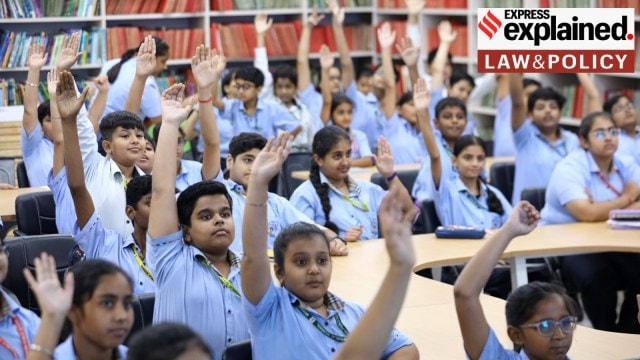 The constitutional validity of these state laws has been repeatedly challenged by private school associations. (Photo: Abhinav Saha)
With Lieutenant-Governor V K Saxena notifying the Delhi School Education (Transparency in Fixation and Regulation of Fees) Act, 2025, last week, the national capital has entered a new regime of fee regulation. The law, which mandates a three-tier committee structure to audit fee hikes, comes after years of friction between parent associations and private schools over arbitrary charges.
A key provision of the new Act – requiring at least 15 per cent of affected parents to back a complaint before the District Committee intervenes – has already sparked debate, with parent associations arguing that mobilising such support against school managements can be practically difficult.
Delhi is not the first government to attempt to cap or regulate private school fees. From Tamil Nadu’s fee-fixation model to Gujarat’s hard caps, states across India have experimented with various legal frameworks to curb commercialisation in education.
Here is a look at how different states regulate school fees, the challenges they face, and what the courts have ruled regarding the state’s power to intervene in the administration of private schools.
Autonomy vs profiteering
Regulation of private school fees in India must balance between two Supreme Court judgements. In the landmark TMA Pai Foundation (2002) case, the Supreme Court held that private unaided schools have the autonomy to determine their own fee structures. However, the court also ruled that this autonomy is not absolute: schools are entitled to a “reasonable surplus” for development, but “profiteering” and “capitation fees” are strictly prohibited. This surplus is intended for the expansion of the institution and the improvement of its facilities, thereby distinguishing education from purely commercial activity.
The court subsequently clarified in Modern School v. Union of India (2004) that state governments have the authority to regulate fees to prevent the commercialisation of education. It is within this legal window that states have enacted their laws.
Tamil Nadu’s state-fixation model
Tamil Nadu was an early mover, enacting the Tamil Nadu Schools (Regulation of Collection of Fee) Act in 2009. This model is perhaps the most rigid. Instead of waiting for complaints, a state-appointed committee headed by a retired High Court judge proactively fixes the fee for every private school in the state, valid for three years.
While this offers total state control, it has been mired in litigation. Private schools have argued that the committee often ignores ground realities, such as teacher salary hikes. The large number of schools whose fees must be assessed leads to bureaucratic logjams.
CBSE-affiliated schools in the state secured an interim order from the Supreme Court in 2012, effectively staying the committee’s power to fix their fees. As a result, while state board schools are regulated, many central board schools operate with relative freedom, leading to disparities that the state government is currently unable to bridge.
Gujarat’s ‘hard cap’ model
In 2017, Gujarat introduced the Gujarat Self-Financed Schools (Regulation of Fees) Act, which imposed a monetary ceiling on fees. The Act set specific caps – such as Rs 15,000 for primary, Rs 25,000 for secondary, and Rs 27,000 for higher secondary schools.
Schools that wish to charge fees higher than these caps must approach a Fee Regulatory Committee with audited accounts to justify their costs.
While the Gujarat High Court upheld the constitutionality of the act upon challenge by private schools in December 2017, implementation has been rocky. Earlier this year, the Gujarat government faced backlash over a proposed “School of Excellence” scheme, which sought to exempt top-performing private schools from these fee regulations. Following negative feedback from the public, the government was forced to stall the move.
Maharashtra and Rajasthan’s consensus model
Maharashtra and Rajasthan follow a fee regulation model that relies heavily on internal consensus before state intervention.
Under the Maharashtra Educational Institutions (Regulation of Fee) Act, 2011, the school management proposes a fee structure which must be approved by an executive committee of the Parent-Teacher Association (PTA). If the difference between the school’s proposal and the PTA’s approval is less than 15 per cent, the school’s decision prevails. For the government’s divisional fee regulatory committee to intervene, at least 25 per cent of the total parents must file a complaint.
The new Delhi law appears to have borrowed from this logic but lowered the threshold. While Maharashtra requires 25 per cent of parents to object, Delhi requires only 15 per cent.
Rajasthan’s 2016 Act operates similarly, with a school-level fee committee comprising parents and teachers. However, implementation has been sluggish. The Rajasthan High Court in May this year pulled up the state government for failing to constitute a Revision Committee – the appellate body for fee disputes – even nine years after the Act was passed.
Judicial precedents
The constitutional validity of these state laws has been repeatedly challenged by private school associations, primarily on the grounds that they violate the fundamental right to practice any occupation, guaranteed by Article 19(1)(g) of the Constitution.
In 2021, the Supreme Court upheld the validity of the Rajasthan Act, ruling that the state is empowered to regulate fees to ensure they are “reasonable”. The court read down certain sections of the act to ensure school autonomy was respected in terms of setting their own fee structures – reasoning that the government cannot dictate the exact fee but can verify if the procedure was followed and if profiteering occurred.
Following this precedent, High Courts in other states have upheld similar laws. In February 2024, the Patna High Court upheld the Bihar Private Schools (Fee Regulation) Act, 2019, which caps annual fee hikes at 7 per cent. Similarly, the Chhattisgarh High Court in August this year upheld Chhattisgarh’s 2020 fee regulation law, dismissing pleas from private schools and stating that “individual hardship” to a school is no ground to strike down a law meant for the general public good.
For Delhi, the immediate challenge will not just be defending the law in court but ensuring the new District and Revision Committees are staffed and functional. In Maharashtra, the Bombay High Court in August barred a school from collecting hiked fees because the divisional fee regulatory committee was non-existent – showing that the lack of active enforcement renders such laws ineffective.