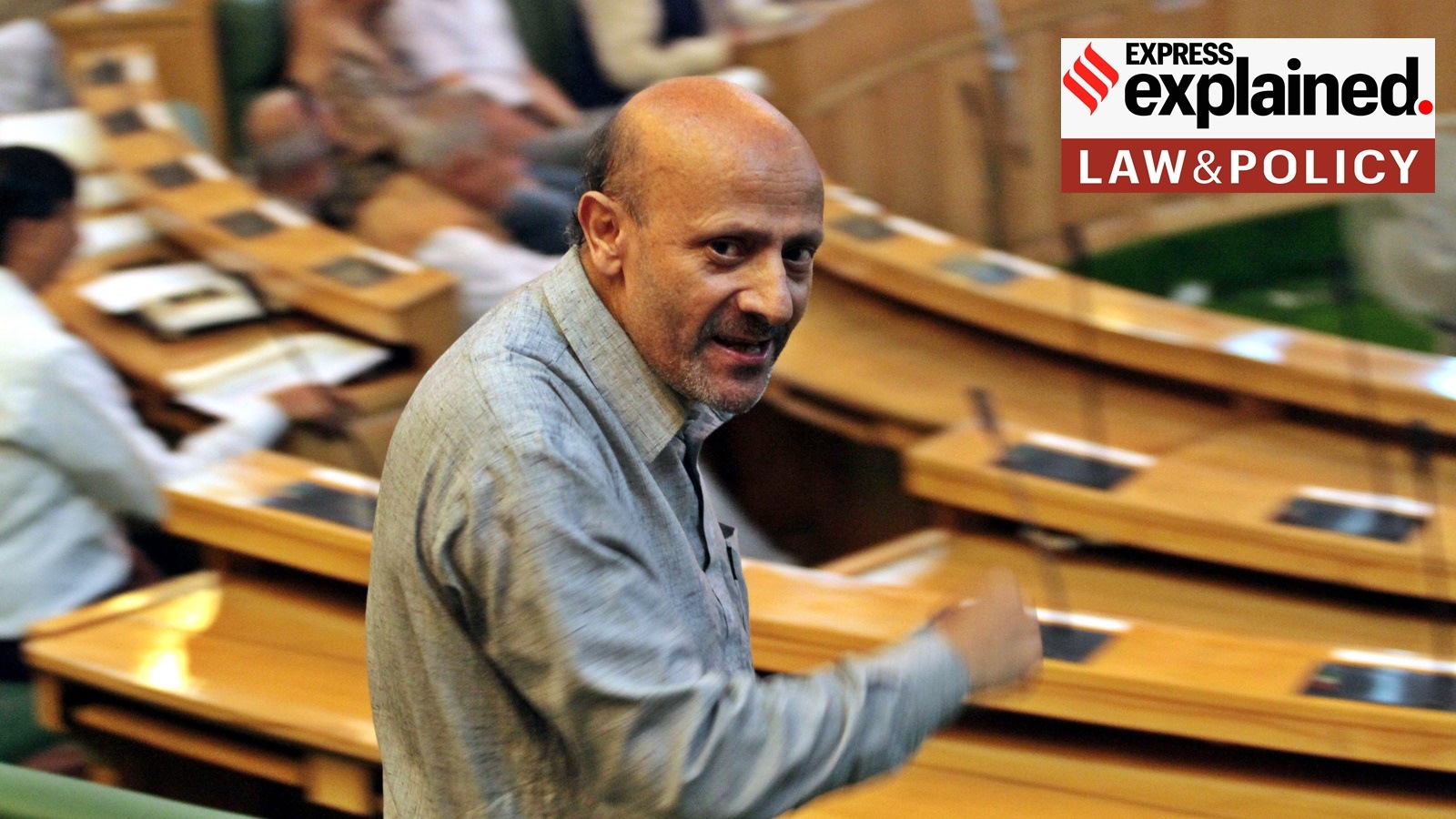
A Delhi court on Tuesday (September 10) granted interim bail until October 2 to Lok Sabha MP Sheikh Abdul Rashid, popularly known as Engineer Rashid, to campaign for the Assembly elections in Jammu and Kashmir. Engineer Rashid has been lodged in Delhi’s Tihar Jail in a case of alleged terror funding since 2019.
Rashid, who contested the Lok Sabha election as an Independent, defeated National Conference vice president Omar Abdullah at the Baramulla seat, and was released from Tihar on July 5 to take oath as MP. Additional Sessions Judge Chander Jit Singh reserved the order on his plea for bail on August 28.
Omar has suggested that the BJP could try to form the government with Rashid’s Awami Ittehad Party (AIP), and Peoples Democratic Party (PDP) chief Mehbooba Mufti has described the AIP as a proxy of the BJP, which aims to divide the Kashmiri vote.
NIA’s ‘terror’ case file
On May 30, 2017, the National Investigation Agency (NIA) registered a case under IPC Section 120B (criminal conspiracy) and various sections of the Unlawful Activities (Prevention) Act, 1967 (UAPA) against Lashkar-e-Taiba founder Hafiz Saeed and other “secessionist and separatist” leaders who, according to the NIA, “received and collected” funds through hawala channels in “connivance with active militants of…terrorist organizations Hizb-ul-Mujahideen, Dukhtaran-e-Millat, Lashkar-e-Toiba” to fund “terrorist activities” in Jammu and Kashmir.
Rashid was not named in the case at the time, and he was not among the 12 accused in the NIA’s first chargesheet filed on January 18, 2018, or in the first supplementary chargesheet naming one accused that was filed on January 22, 2019.
Rashid was arrested on August 9, 2019, four days after the abrogation of Article 370 and removal of J&K’s special status. Almost the entire political leadership of Kashmir, including three former Chief Ministers, too, were put under detention.
Rashid was named as accused in the second supplementary chargesheet filed on October 4, 2019. Four others were also named: Yasin Malik of the Jammu and Kashmir Liberation Front (JKLF), Shabir Shah of the Jammu Kashmir Democratic Freedom Party (JKDFP), Masrat Alam, of the Jammu & Kashmir Muslim League, and Dukhtaran-e-Millat leader Aasiya Andrabi.
Story continues below this ad
Of the total 16 persons arrested in the case, three, including Aasiya Andrabi and photojournalist Kamran Yousuf, have been discharged. One, 66-year-old Altaf Ahmad Shah, son-in-law of the late Hurriyat leader Syed Ali Shah Geelani, passed away on October 11, 2022.
Accusations against Engineer Rashid
According to the NIA, Rashid used various public platforms to “propagate the ideology of separatism and secessionism”, was closely associated with various terrorist organisations, and wanted to “legitimise” the United Jihad Council (UJC), a platform of anti-India militant groups in J&K.
AN EMAIL: The NIA referred to an email sent by one Khawaja Manzoor Ahmed Chishti to Yasin Malik, asking for a packet to be handed to “Shaikh Rasheed Sahib”. However, Chishti was not arrested — which was a defence used by Rashid in court.
According to the NIA, the email shows Rashid was accumulating funds through JKLF, which were being remitted through cash couriers to “foment anti national activities” in the Valley. The NIA relied on the alleged statement of a witness who claimed to have worked for Rashid from 2011 to 2014, and seen alleged hawala dealer Zahoor Ahmad Shah Watali give an envelope with money to Rashid.
Story continues below this ad
FACEBOOK POST: The NIA relied on a post on Rashid’s Facebook page where he was allegedly “trying to defend” Hafiz Saeed. “Hafeez Saeed ki siyasat se differences ho sakte hain, unke tareeke se difference ho sakta hai, but at the end of the day he is fighting for a political cause, uska koi global agenda nahi hai,” Rashid allegedly said.
‘CLOSE TO WATALI’: The NIA relied on Rashid’s “close relationship” with Watali, a “conduit who transmitted money from Pakistani establishment to the secessionist elements”. This was based on the statements of two protected witnesses. “…Watali was exploiting the position of the accused (Rashid) as an MLA (from 2008-18) to get people involved in unlawful activities,” the witness allegedly said.
Watali was given bail by the Delhi High Court in 2018, a decision that was overruled by the Supreme Court in 2019. A two-judge bench headed by Justice A M Khanwilkar ruled that, at the stage of bail, the court must only consider if the accused has prima facie (at face value) committed the offence based on the evidence before it, without conducting a detailed examination. The judgment made it extremely difficult to obtain bail under UAPA (Zahoor Ahmad Shah Watali v NIA).
Engineer Rashid’s defence
Rashid has said that the NIA has only produced an old Facebook post, and statements of two protected witnesses. He has submitted that the “Shaikh Rasheed Sahib” in the email was not him.
Story continues below this ad
Rashid has argued that he has already been discharged under Sections 20, 38, and 39 of the UAPA, which pertain to being part of a terrorist organisation, and giving support to it. He has also said that the grounds of arrest were not furnished to him in writing.
Rashid has cited judgments in the Angela Harish Sontakke case, the Javed Gulam Nabi Shaikh case, and other judgments to draw attention to his long period in custody as the case proceeds slowly.
In February 2020, a special court in Delhi dismissed Rashid’s first bail plea. Charges were framed against Rashid and 14 others on March 16, 2022. The examination of witnesses began on November 1 that year, and 20 witnesses have been examined so far. There are 375 witnesses in the case.


 6 min read