Day-to-day Supreme Court hearings from Aug 2: The issues in challenge to Centre’s 2019 Jammu & Kashmir decisions
The legal challenge to the changes in Art 370 and removal of J&K's special status involves questions on whether the President can substitute for an elected state government, and if Parliament can represent the 'political aspiration' of the people of a state.
The move to abolish the J&K Constitution has been challenged because the Legislative Assembly of J&K had no power under the J&K Constitution to recommend any amendment to any provision of the Constitution of India.
Listen to this articleYour browser does not support the audio element.
The Supreme Court on Tuesday (July 11) said it will begin hearing petitions challenging the changes to Article 370 and downgrading of Jammu & Kashmir state into two Union Territories on August 2, and will then proceed on a day-to-day basis.
Earlier on Monday, the Centre told the SC in its afidavit that they have “brought unprecedented development, progress, security and stability to the region, which was often missing during the old Article 370 regime” and that this is “testament to the fact that Parliamentary wisdom…” was “exercised prudently”. Chief Justice of India DY Chandrachud said that the affidavit on the present status of Jammu and Kashmir would not have any bearing on the constitutional issues raised in the petitions “and shall not be relied upon for that purpose”.
You’ve Read Your Free Stories For Now
Sign up and keep reading more stories that matter to you.
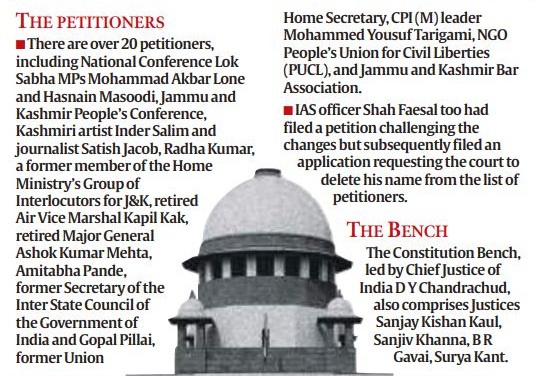
The petitions, involving important legal and constitutional questions, will be taken up by a Bench led by CJI Chandrachud, also comprising Justices Sanjay Kishan Kaul, Sanjiv Khanna, B R Gavai, and Surya Kant.
Road to the changes
Governor’s Rule was imposed in J&Kon June 19, 2018, after the BJP withdrew support to the coalition government led by Chief Minister Mehbooba Mufti. Under Article 92 of the J&K Constitution, six months of Governor’s Rule was mandatory before the state could be put under President’s Rule.
The Legislative Assembly was dissolvedon November 21 and, on December 12, before the end of six months, President’s rule was imposed on J&K. President’s Rule was subsequently approved by both Houses of the Parliament.
On June 12, 2019, President’s Rule was extended for another six months with effect from July 3 of that year.
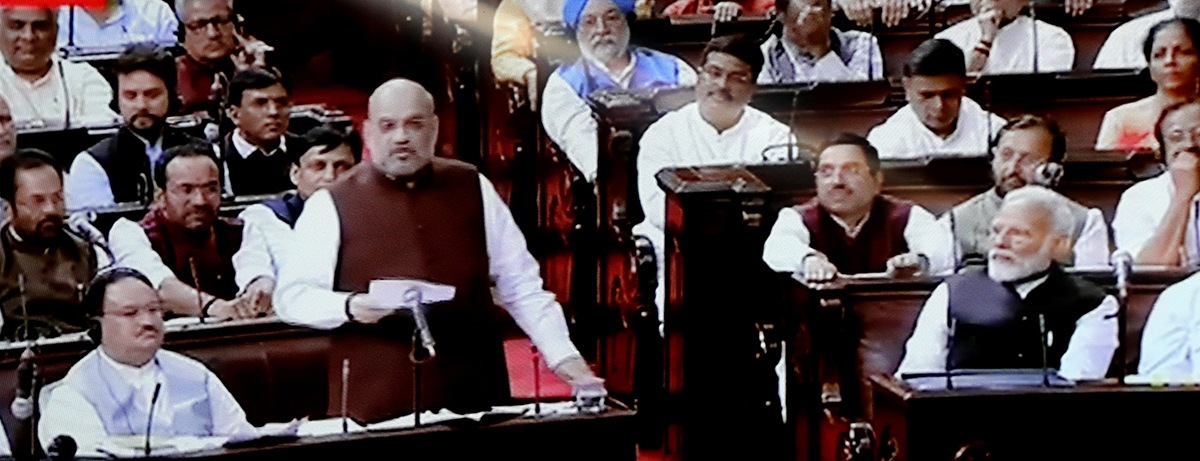
Home Minister Amit Shah speaks in Parliament on Article 370, on Aug 5, 2019. (PTI)
Constitutional changes
Story continues below this ad
On August 5, the Centre issued an order amending The Constitution (Application to Jammu and Kashmir) Order, 1954, and superseding it with The Constitution (Application to Jammu and Kashmir) Order, 2019. The new order made “all the provisions of the Constitution” applicable to J&K state. The government also amended Article 367 to add a new Clause (4), making the Constitution of India directly applicable to J&K.
On August 6, the President issued a declaration under Article 370(3) making all its clauses inoperative except the provision that all articles of the Constitution shall apply to J&K.
Change to Article 370
Article 370 provided for application of only Article 1 and Article 370 to Jammu & Kashmir. Other provisions of the Constitution did not automatically extend to J&K, but clause (1)(d) of Article 370 empowered the President of India to extend them through an executive order with the concurrence of the government of J&K.
Clause 3 of Article 370 empowered the President to “declare that this article shall cease to be operative” completely or partially but only if the Constituent Assembly of J&K recommended such an action. Since the Constituent Assembly of J&K no longer existed, having dispersed in 1957, this power of the President had ceased, unless a new Constituent Assembly came into being.
Story continues below this ad
Article 370 explained that “for the purpose of this article”, the state government meant the Maharaja (later changed to Sadr-e-Riyasat) of J&K, acting on the advice of the council of ministers. But there was no state government either in J&K, so the President had no way to acquire the concurrence of the state government.
This meant there was no constitutional and legal mechanism available for the Centre to abrogate or amend Article 370.
The Centre, however, used the President’s powers under Article 370(1)(d) to amend Article 367, which provides guidelines to interpret the Constitution. A new clause was added to Article 367, replacing “Constituent Assembly of the State” referred to in Article 370(3) by “Legislative Assembly of the State”.
Thus, the presidential order route under Article 370(1)(d) was used to amend Article 370 itself, whereas Article 370 could have been amended only upon the recommendation of the Constituent Assembly under Article 370(3), not through Article 370(1)(d).
Parliament = state govt?
Story continues below this ad
The President, while imposing his direct rule in J&K, had assumed all functions of the J&K government, taken over all the powers of the Governor under both the Indian Constitution and the J&K Constitution, and extended the powers of the state legislature to Parliament.
This meant that the President of India was in effect the J&K state government, and Parliament was in effect the state legislature. The powers of the J&K Constituent Assembly were passed on to the state legislature and, in this scheme of things, when the “state government” gave its concurrence to these monumental changes, it was, in fact, the President giving concurrence to his own decision.
It has been argued that since President’s Rule in a state is in the nature of an interim arrangement until an elected government is put in place, the administration under President’s Rule cannot take decisions that change the very constitutional structure of the state.
J&K Constitution
The move to abolish the J&K Constitution has been challenged because the Legislative Assembly of J&K had no power under the J&K Constitution to recommend any amendment to any provision of the Constitution of India.
Story continues below this ad
Article 147 of the J&K Constitution barred the J&K Legislative Assembly from “seeking to make any change in provisions of the Constitution of India as applicable in relation to the State”. It has been argued that this means even the J&K Legislative Assembly wasn’t legally competent to give consent to the President’s order.
Downgrading to UT
The Jammu and Kashmir (Reorganisation) Act, 2019 bifurcated J&K into two Union Territories — J&K was an UT with a Legislative Assembly; Ladakh was without an Assembly.
There is no other instance in India’s constitutional history of a state being demoted to a UT, even though Parliament can under Article 3 create a new state by carving out territory from any state, uniting two or more states, or portions of different states. Parliament is also empowered to add area to an existing state, or change the existing boundaries of a state.
The Centre’s decision has been challenged on the ground that it violates Article 3. Also, the proviso to this article makes it incumbent on the President to refer any Bill proposing the reorganisation of a state to its legislature if the Bill “affects the area, boundaries or name of any of the states”.
Story continues below this ad
It is argued that the view of Parliament on such a Bill cannot replace the view of the state legislature. Under President’s Rule, only those powers of a state legislature can be exercised as are essential to run the day-to-day affairs of the state. Parliament cannot provide the view of a particular state legislature which in essence is the opinion of the people of that state.
Colourable legislation
The challenge is also based on the argument that the constitutional changes are “colourable legislation” and thus legally untenable. The doctrine of colourable legislation is the legal principle that says what cannot be done directly cannot be done indirectly.
This doctrine has been reiterated by the Supreme Court, as well as constitutional courts in other countries.
Muzamil Jaleel is a Deputy Editor at The Indian Express and is widely recognized as one of India’s most authoritative voices on Jammu & Kashmir, national security, and internal affairs. With a career spanning over 30 years, he has provided definitive on-the-ground reportage from the heart of the Kashmir conflict, bearing witness to historic political transitions and constitutional shifts.
Expertise and Investigative Depth
Muzamil’s work is characterized by a rare combination of ground-level immersion and high-level constitutional analysis. His expertise includes:
Conflict & Geopolitics: Decades of reporting on the evolution of the Kashmir conflict, the Indo-Pak peace process, and the socio-political dynamics of the Himalayan region.
Constitutional Law: Deep-dive analysis of Article 370 and Article 35A, providing clarity on the legal and demographic implications of their abrogation in 2019.
Human Rights & Accountability: A relentless investigator of state and non-state actors, uncovering systemic abuses including fake encounters and the custodial death of political workers.
International War Reporting: Beyond South Asia, he provided on-the-spot coverage of the final, decisive phase of the Sri Lankan Civil War in 2009.
Landmark Exposés & Impact
Muzamil’s reporting has repeatedly forced institutional accountability and shaped national discourse:
The Kashmir Sex Scandal (2006): His investigative series exposed a high-profile exploitation nexus involving top politicians, bureaucrats, and police officers, leading to the sacking and arrest of several senior officials.
Fake Encounters: His reports blew the lid off cases where innocent civilians were passed off as "foreign terrorists" by security forces for gallantry awards.
SIMI Investigations: He conducted a massive deep-dive into the arrests of SIMI members, using public records to show how innocuous religious gatherings were often labeled as incriminating activities by investigative agencies.
The Amarnath Land Row: Provided critical context to the 2008 agitation that polarized the region and altered its political trajectory.
Over the years, Muzamil has also covered 2002 Gujarat riots, Bhuj earthquake, assembly elections in Bihar for Indian Express. He has also reported the peace process in Northern Ireland, war in Sri Lanka and national elections in Pakistan for the paper.
Awards and Fellowships
His "Journalism of Courage" has been honored with the industry's most prestigious accolades:
Four Ramnath Goenka Awards: Recognized for J&K Reportage (2007), On-the-Spot Reporting (2009), and Reporting on Politics and Government (2012, 2017).
Kurt Schork Award: From Columbia University for international journalism.
Sanskriti Award: For excellence in Indian journalism and literature.
IFJ Tolerance Prize: For his empathetic and nuanced reporting in South Asia.
International Fellowships: Served as a visiting scholar at UC Berkeley and worked with The Guardian, The Observer, and The Times in London. He has also received Chevening fellowship and a fellowship at the Institute of Social Studies, Hague, Netherlands.
Professional Presence
Current Location: New Delhi (formerly Bureau Chief, Srinagar).
Education: Master’s in Journalism from Kashmir University.
Social Media: Follow him for field insights and rigorous analysis on X (Twitter) @MuzamilJALEEL. ... Read More