7 min read

© The Indian Express Pvt Ltd



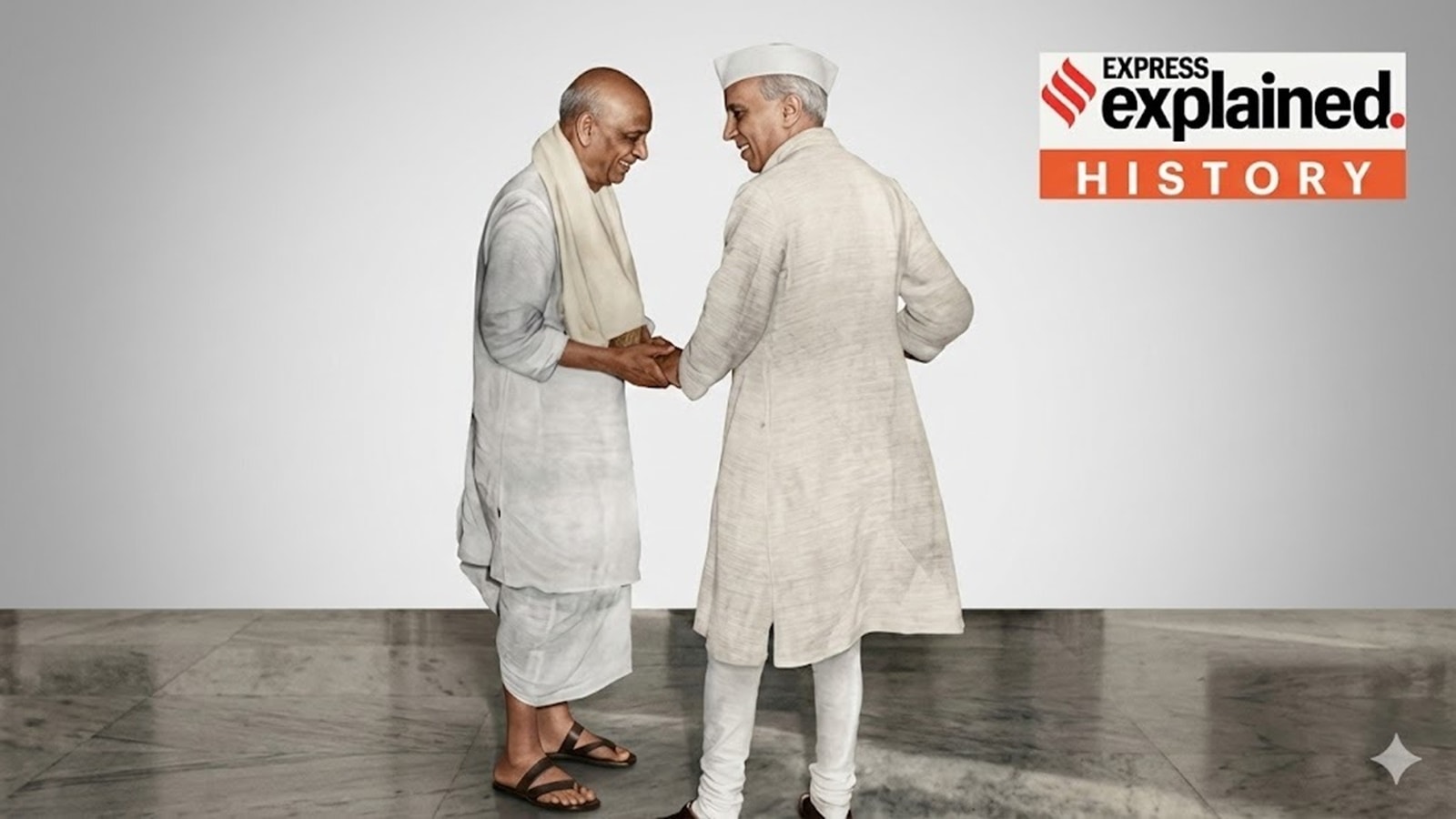 Rajnath Singh Babri claim: Jawaharlal Nehru with Sardar Vallabhbhai Patel after his escape from an air disaster, April 7 1949. (Image from Nehru Archive, refurbished using Gemini AI)
Rajnath Singh Babri claim: The Congress on Wednesday (December 3) hit back at Defence Minister Rajnath Singh’s claim that former Prime Minister Jawaharlal Nehru wanted to use government funds for the Babri Masjid, which was “opposed” by Sardar Vallabhbhai Patel. Party MP Manickam Tagore called Singh’s statement a “complete lie”.
Addressing a gathering in Vadodara’s Sadhli village, Rajnath Singh on Tuesday had said, “When Pandit Nehru raised the issue of spending money from the government treasury on the Babri Masjid, if anyone opposed this, it was Sardar Vallabhbhai Patel, born of a Gujarati mother. And at that time, he did not allow the Babri Masjid to be built with government funds.”
It is not clear which incident Rajnath Singh is referring to. In the publicly available letters and speeches of Nehru, a reference of him wanting to use government money on Babri is difficult to find. However, what is amply clear from his letters is that Nehru was staunchly against a communal dispute around the Babri mosque. In this, he was joined by Sardar Patel, who too wanted the issue “resolved amicably in a spirit of mutual toleration and goodwill between the two communities.”
Here is what Nehru and Patel wrote about the Babri mosque in their letters.
On the night of December 22, 1949, some people entered the Babri Mosque compound in Ayodhya and placed idols of Lord Ram and Goddess Sita underneath its central dome. Around the same time, there had been some other communal incidents in Ayodhya and Uttar Pradesh as a whole.
A deeply disturbed Nehru refers to the Babri and other incidents in letters to several leaders, including then Uttar Pradesh Chief Minister Govind Ballabh Pant. All the letters are available on The Nehru Archive.
From his letters, it is clear that Nehru was concerned about the increasing communal tendencies within his own party and saw danger ahead. He believed that the Ayodhya situation would have bearing on the Kashmir issue and on India’s dealing with Pakistan on the international stage. He was also upset with then Ayodhya district magistrate K K Nayar, who had refused to remove the idols.
On December 26, 1949, soon after the idols were kept inside Babri, Nehru sent Pant a telegram, “I am disturbed at developments at Ayodhya. Earnestly hope you will personally interest yourself in this matter. Dangerous example being set there which will have bad consequences.”
In February 1950, he followed this up with another letter to Pant, “I shall be glad if you will keep me informed of the Ayodhya situation. As you know, I attached great importance to it and to its repercussions on all-India affairs and more especially Kashmir.” He also asked if he should go to Ayodhya himself, to which Pant replied that “I would have myself requested you to visit Ayodhya if the time were ripe.”
A month later, in a letter to the Gandhian KG Mashruwala, he said, “You refer to the Ayodhya mosque. This event occurred two or three months ago and I have been very gravely perturbed over it. The UP Government put up a brave show, but actually did little… Pandit Govind Ballabh Pant condemned the act on several occasions, but refrained from taking definite action probably for fear of a big scale riot… I am quite convinced that if we on our side behaved properly, it would be far easier to deal with Pakistan.”
He also expressed helplessness: “I just do not know what we can do to create a better atmosphere in the country. Merely to preach goodwill irritates people when they are excited. Bapu might have done it, but we are too small for this kind of thing.”
In July 1950, he wrote to Lal Bahadur Shastri, expressing fears that “we are heading again for some kind of disaster.” “As you know, the Babri Mosque affair in Ayodhya is considered by us a major issue and one affecting deeply our whole policy and prestige. But apart from this, it appears that conditions in Ayodhya have become worse and worse. It is quite likely that this kind of trouble may spread to Mathura and other places,” Nehru wrote.
Before this, in April, he wrote another long letter to Pant, saying, “I have felt for a long time that the whole atmosphere of the UP has been changing for the worse from the communal point of view. Indeed the UP is becoming almost a foreign land for me. I do not fit in there…The UP Congress Committee, with which I have been associated for 35 years, now functions in a manner which amazes me… members, like Vishambhar Dayal Tripathi, have the presumption to write and speak in a manner which would be objectionable in a member of the Hindu Mahasabha. We talk a great deal of disciplinary action. But these major distortions of the Congress policy are continually being made and accepted.”
Just like Nehru, Patel too shot off a letter to Pant after the idols were placed in the Babri mosque (Sardar Patel’s Correspondence, Volume 9. Edited by Durga Das).
“The Prime Minister has already sent to you a telegram expressing his concern over the developments in Ayodhya. I spoke to you about it in Lucknow. I feel that the controversy has been raised at a most inopportune time… The wider communal issues have only been recently resolved to the mutual satisfaction of the various communities. So far as Muslims are concerned, they are just settling down to their new loyalties. We can reasonably say that the first shock of partition and the resultant uncertainties are just beginning to be over and that it is unlikely that there would be any transfer of loyalties on a mass scale,” he wrote.
Insisting that peace had to be maintained, he continued “…I feel that the issue is one which should be resolved amicably in a spirit of mutual toleration and goodwill between the two communities. I realise there is a great deal of sentiment behind the move which has taken place. At the same time, such matters can only be resolved peacefully if we take the willing consent of the Muslim community with us. There can be no question of resolving such disputes by force. In that case, the forces of law and order will have to maintain peace at all costs.”
“If, therefore, peaceful and persuasive methods are to be followed, any unilateral action based on an attitude of aggression or coercion cannot be countenanced. I am therefore quite convinced that the matter should not be made such a live issue and that the present inopportune controversies should be resolved by peaceful [methods] and accomplished facts should not be allowed to stand in the way of an amicable settlement.”