5 min read
© The Indian Express Pvt Ltd



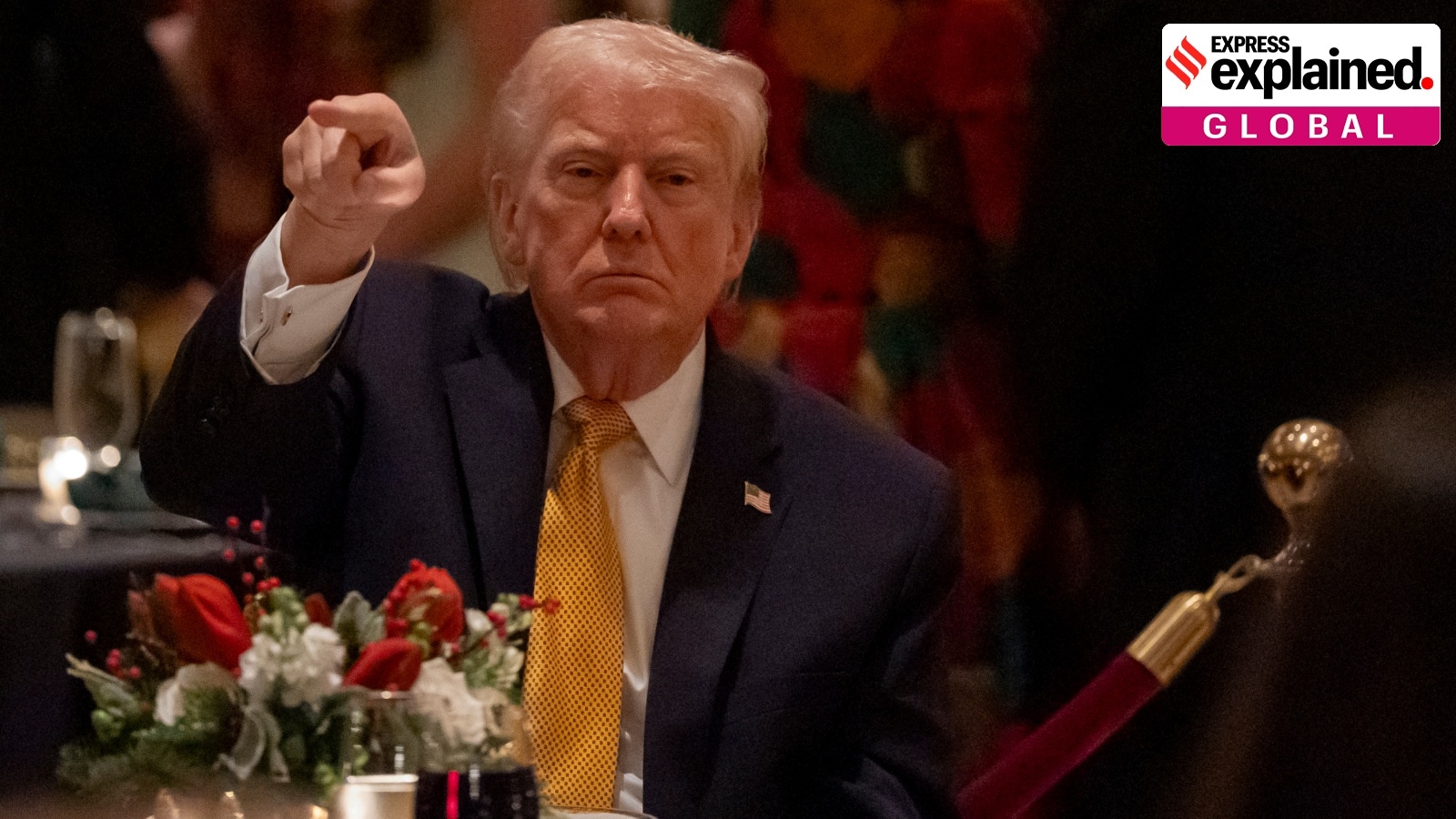 President Donald Trump gestures at Christmas Eve dinner at his Mar-a-Lago club, on Wednesday, in Palm Beach, Florida. (Photo: AP)
United States President Donald Trump on Thursday (December 25) announced a series of strikes on Nigeria, accusing the African country of persecuting Christians. The strikes, which were aimed at Islamic State militants in Nigeria’s north, were the latest overseas military intervention from Trump, who had promised to extricate the US from decades of “endless wars” during his 2024 presidential campaign.
In a post on his social media platform, Truth Social, Trump said, “The United States launched a powerful and deadly strike against ISIS Terrorist Scum in Northwest Nigeria, who have been targeting and viciously killing, primarily, innocent Christians at levels not seen for many years, and even Centuries!”
Christian evangelical groups and senior Republican leaders in the US have for months been amplifying allegations that Christians were being targeted in widespread violence in Nigeria. However, the country and numerous analysts have repeatedly called these claims baseless.
The allegations
The issue came into the limelight, especially after popular television host and comedian Bill Maher, in September, alleged that Nigeria was witnessing a “Christian genocide”. He said, “I’m not a Christian, but they are systematically killing the Christians in Nigeria. They’ve killed over 100,000 since 2009. They’ve burned 18,000 churches. These are the Islamists, Boko Haram.”
Soon after Maher’s statement, Republican Senator from Texas Ted Cruz also highlighted the issue. On October 7, he wrote in a post on X, “since 2009, over 50,000 Christians in Nigeria have been massacred, and over 18,000 churches and 2,000 Christian schools have been destroyed”. He also pushed to sanction Nigerian officials who “facilitate violence against Christians and other religious minorities, including by Islamist terrorist groups”.
The numbers quoted by Cruz and Maher came under criticism, as several experts said they were widely exaggerated (more on this later). However, this did not stop Trump from designating Nigeria as “a country of particular concern” in November for allegedly failing to rein in the persecution of Christians. The US President also said, “If the Nigerian Government continues to allow the killing of Christians, the USA will immediately stop all aid and assistance to Nigeria, and may very well go into that now disgraced country, ‘guns-a-blazing,’ to completely wipe out the Islamic Terrorists who are committing these horrible atrocities.”
The counter claims
While Nigeria is not officially at war, the country is facing various security crises, such as terrorism, banditry, land disputes, and ethnic rivalries. The two key groups, which are involved in terror activities within the country, are the Islamist militant group Boko Haram and its splinter organisation, the Islamic State West Africa Province (ISWAP). Most of their activities are concentrated in the north-east, which has a majority Muslim population. Meanwhile, in the north-west, heavily armed criminal gangs — often called “bandits” — carry out mass kidnappings and raids.
Although the Trump administration and parts of the US right have described much of this turmoil as a religious war between Muslims and Christians, several analysts have said the claim is too simplistic and ignores Nigeria’s internal dynamics.
Observers have repeatedly noted that the violence has affected people of many faiths, not just Christians, across the country. Gimba Kakanda, a senior special assistant to the President of Nigeria, wrote in an article published by Al Jazeera, “Nigeria’s conflicts are multi-faceted, driven by ethnic rivalries, land disputes and criminality, with religion often secondary. Boko Haram… positioned itself against the Nigerian state as an apostate entity, not against any single religious group. Most of its victims have been Muslims. Similarly, banditry in northern Nigeria often pits Fulani herders against Hausa communities, both predominantly Muslim, a stark example of Muslim-on-Muslim violence.”
Fulani herders are a mainly Muslim ethnic group who live across West Africa and have traditionally earned their living by raising cattle and sheep. They have been known to have conflicts with both Muslim and Christian communities. However, the disputes have mostly been about access to land and water, rather than about religion, according to analysts.
Analysts have also raised concerns over the figures quoted by Cruz and Maher. For instance, Ladd Serwat, a senior analyst at Acled, which closely monitors violence in West Africa, told the BBC, “The figure of 100,000 deaths, touted on social media, would include all acts of political violence in Nigeria, and so it would not be true to say this is the number of Christians who have been killed since 2009.”
Serwat estimated that under 53,000 civilians — Muslims and Christians — have been reportedly killed in targeted political violence since 2009.
Note that Nigeria is officially a secular country. It consists of Muslims (53%), Christians (45%), and a small population that practices African traditional religions.