9 min read


© The Indian Express Pvt Ltd



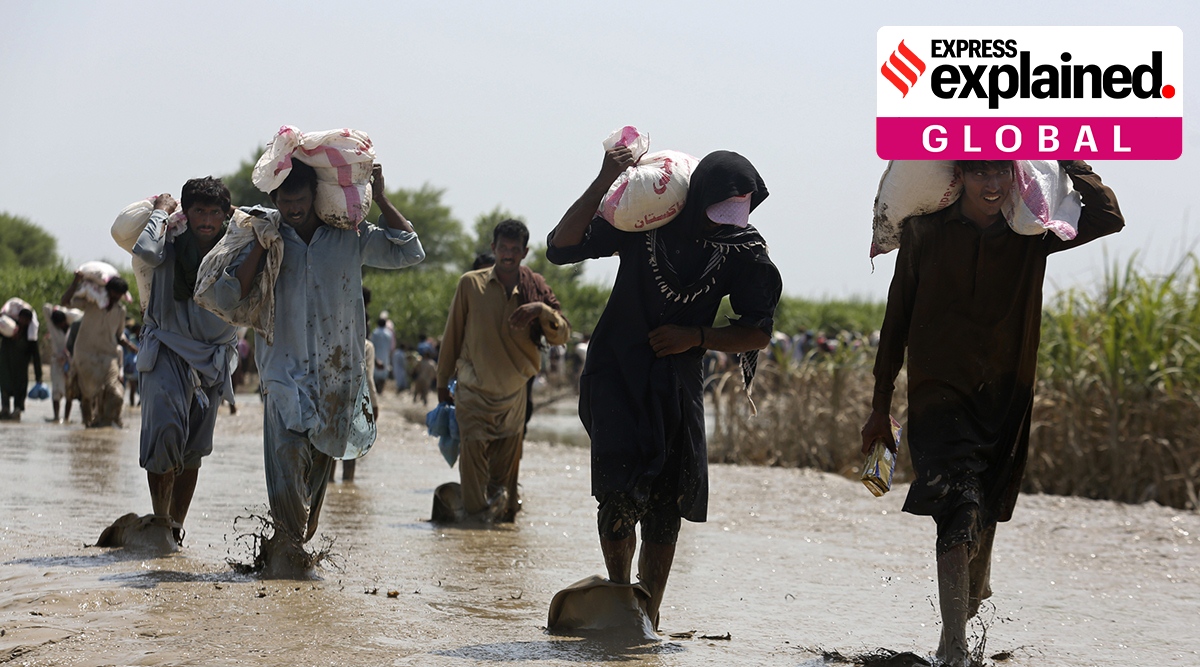 Victims of unprecedented flooding from monsoon rains receive relief aid organized by the Edhi Foundation, in the Ghotki District of Sindh Pakistan, Wednesday, Sept. 7, 2022. (AP Photo/Fareed Khan)
As a flood that has been described as one of Biblical proportions devastated Pakistan, Prime Minister Narendra Modi expressed his condolences and hoped “for an early restoration of normalcy”. “Saddened to see the devastation caused by the floods in Pakistan. We extend our heartfelt condolences to the families of the victims, the injured and all those affected by this natural calamity and hope for an early restoration of normalcy,” Modi said in a tweet on August 29.
This is the only statement that the Prime Minister has made on the floods that continue to wreak havoc across Pakistan. A total 1,355 people have been killed since June 14, and 33 million out of the country’s population of 220 million have been hit, according to official figures of Thursday. More than 3,500 people have been injured, and there are massive shortages of wheat and fuel. Preliminary estimates suggest a third of the country’s cultivated land — 7 million hectares out of the total 22 million — have been inundated, and about 2 million homes will have to be rebuilt from scratch.
Deterioration of ties
The statement by the Prime Minister last month came as a surprise to many, given the steady deterioration of India’s relationship with Pakistan over the last eight years since Modi came to power.
Modi had famously begun his tenure with an invitation to Pakistan’s then Prime Minister Nawaz Sharif for the swearing-in ceremony in May 2014. Sharif had come to India, along with the leaders of other SAARC nations.
Modi’s gesture, and the meeting between the two Prime Ministers had held the promise of a new beginning for the bilateral relationship that had suffered a severe setback after the 26/11 terrorist attacks in Mumbai in 2008.
However, a string of incidents that followed — India’s red line on the meeting between Pakistan’s diplomats and leaders of the separatist Hurriyat, the terrorist attacks in Pathankot and Uri — impacted the relationship negatively, and New Delhi made it clear that “talks and terror can’t go together”.
Ties have been hit further over the last few years, especially after the Pulwama terror attack in February 2019, and the abrogation of Article 370, which revoked the special status to Jammu and Kashmir, in August that year. That led to the downsizing of the High Commissions in both capitals; there are no full-time High Commissioners in either country now. The constitutional changes in J&K, and Pakistan’s response to them, took bilateral ties to a new low — and the subsequent controversy involving diplomats of both countries in 2020 have not helped the ties.
Change of PM in Pak
After the ouster of Imran Khan, and the coming to power of the new coalition government led by Prime Minister Shehbaz Sharif, some positive noises have emanated from Islamabad.
In April this year, hours after Prime Minister Sharif asked Modi to come forward to address the Kashmir issue so that the two countries could concentrate on tackling poverty and unemployment, the Indian Prime Minister congratulated the new leader of Pakistan, and said that India desired peace and stability in a region free of terrorism.
In a letter written to Modi, Sharif said Pakistan remained committed to “regional peace and security”, and sought “peaceful and cooperative” ties with India. Prime Minister Sharif, who is the younger brother of the three-time Pakistan Prime Minister Nawaz Sharif, also underlined in his letter that these peaceful and cooperative ties could be achieved through “meaningful dialogue”.
In his maiden address to the National Assembly as Prime Minister, Shehbaz, who was Chief Minister of Pakistan’s Punjab province when his brother, then Prime Minister Nawaz Sharif, visited India at Modi’s invitation in 2014, said: “We want good ties with India but durable peace is not possible until the Kashmir dispute is resolved.” He attacked his predecessor, Imran Khan, for not making “serious and diplomatic efforts” when India abrogated Article 370 in August 2019.
In New Delhi, officials read Sharif’s statement, and the exchange of greetings and missives within days of the swearing-in of the new Pakistan PM, as “positive”.
Responses to disasters
In the past, when natural disasters struck India and Pakistan, the two countries at times reached out to each other with offers of help.
For example, in January-February 2001, after the earthquake hit Bhuj in Gujarat, Pakistan had reached out with help, and had sent tents and blankets for the survivors. Then Prime Minister Atal Bihari Vajpayee had spoken to Pakistan’s military ruler, General Pervez Musharraf, to formally thank him for sending aid. It was not a big consignment, senior diplomats recall, but the gesture was important. Vajpayee and Musharraf had a brief conversation, the first since the general had seized power in a coup 15 months previously.
In 2005, when a powerful earthquake struck both India and Pakistan, India sent aircraft with relief supplies to Pakistan and pledged $ 25 million through the United Nations to support Pakistan’s relief efforts.
In 2010, when a “superflood” — the worst in recent decades until the deluge of 2022 — hit Pakistan, India offered $ 5 million in help, but Islamabad declined to accept it.
The case for help now
Though there has not been much follow-up activity, the Indian Prime Minister’s outreach by way of a message created a potential opening for “disaster diplomacy”.
That the ruling dispensation in Pakistan is well disposed towards a possible gesture of humanitarian support from India was indicated by Prime Minister Sharif, who tweeted: “I thank Indian PM Narendra Modi @narendramodi for condolences over the human & material losses caused by floods. With their characteristic resilience the people of Pakistan shall, InshaAllah, overcome the adverse effects of this natural calamity & rebuild their lives and communities.”
Pakistan’s Finance Minister Miftah Ismail has said that the government can consider importing vegetables and other edible items from India following the destruction of standing crops due to the floods. Prices of vegetables and fruit have gone through the roof as supplies from Balochistan, Sindh, and south Punjab especially, have been badly affected.
The two major partners in Pakistan’s ruling coalition, the PPP led by Foreign Minister Bilawal Bhutto, and the PML(N) led by the Sharifs, are waiting for further gestures from New Delhi. On the Pakistani side, Army Chief Gen Qamar Javed Bajwa has earlier spoken in favour of improving ties. But the PTI under Imran Khan has been opposing reconciliatory moves, pushing the other political actors into a corner.
For the Indian government, the case for extending humanitarian help ties in well with its desire to project itself as the “first responder” in times of disaster and crisis in the neighbourhood. Vaccine diplomacy and the efforts to brand India as the “pharmacy to the world” have been billed as major achievements of the government. In recent months and years, India has extended its hand of help and cooperation to the Maldives, Bangladesh, Sri Lanka, Myanmar, Nepal, Bhutan, and Afghanistan. Trucks filled with Indian grain have travelled to Taliban-ruled Afghanistan via Pakistan.
Pakistan’s establishment has discussed the possibility of getting food grains through international organisations, who want to send relief material from India. The help from India can be at the micro and short-term level: food, fuel, tents, medicines, and emergency essential supplies. At the macro and medium-to-long-term, it could involve help in the reconstruction of damaged homes and properties, and the archaeological site of Mohenjo Daro, part of the cultural heritage of both countries. India’s expertise in healthcare can be of help in the post-floods scenario — dengue is already on the rise, and diseases such as typhoid are expected to spike sharply.
However, some in the Indian establishment believe that the government’s stated policy of “talks and terror can’t go together”, and the extending of help to Pakistan are at odds with each other. For New Delhi, the decision is as much about projecting power as a global responder as with managing the ruling party’s domestic political base.