

Journalism of Courage

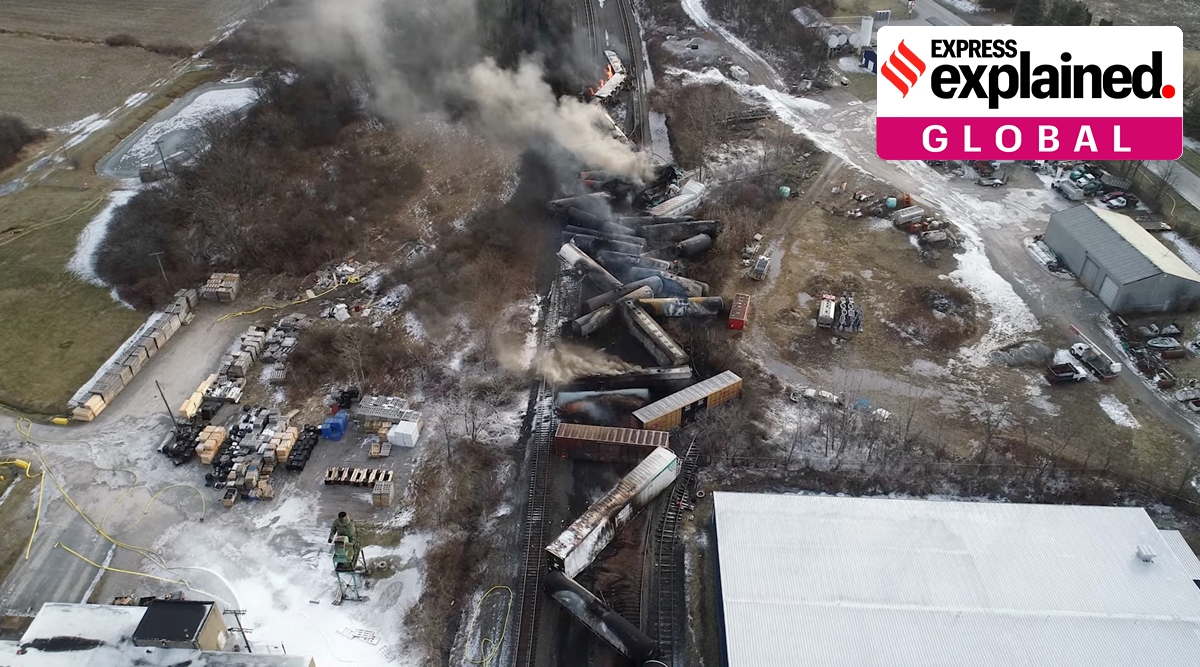
Hundreds of people were forced to evacuate the town of East Palestine, Ohio, after a freight train carrying hazardous chemicals derailed on February 3. Following the incident, the train company, Norfolk Southern, decided to vent and burn carcinogenic chemicals from the crashed cars, releasing a plume of toxic smoke in the region.
While officials have reassured residents that the fallout of the disaster has been limited, with air and water sampling showing only trace amounts of contaminants, residents have complained of a variety of symptoms from nausea to headaches, reported Reuters. The full extent of the damage is yet to be ascertained.


On the night of February 3, at least 50 out of 150 train cars of a train heading from Conway, Pennsylvania, to Madison, Illinois, derailed in the small town of East Palestine, Ohio. A mechanical issue with an axle of one of the 150 cars is believed to be the cause behind the derailment, reported Axios.
The National Transportation Safety Board (NTSB)’s statement on February 14 said that “investigators have identified and examined the rail car that initiated the derailment. Surveillance video from a residence showed what appears to be a wheel bearing in the final stage of overheat failure moments before the derailment. The wheelset from the suspected railcar has been collected as evidence for metallurgical examination.”
Upon derailment, a huge fire erupted across the derailed cars though no immediate injuries or deaths were reported.
However, many of the tankers that were derailed carried toxic chemicals, which could be potentially harmful to residents, Ohio Governor Mike DeWine said in a press conference after the accident. Of specific danger was vinyl chloride – a colourless, hazardous gas that is used to make PVC plastic and vinyl products.
There was not only danger of exposure to toxic chemicals but also a danger of massive explosion since many of the coaches carrying chemicals had caught fire. On February 6, officials enacted a mandatory evacuation, threatening to arrest residents who refused to evacuate, as fear of an explosion rose. Governor Mike DeWine told residents that leaving was “a matter of life and death”.
After the evacuation, crews from the train operator Norfolk Southern and government officials decided to conduct a controlled burn of vinyl chloride – they drilled small holes in the side of the tanker and let the chemical collect in pits before setting it on fire. This was deemed safer than a potential explosion which would have been hard to predict and would send shrapnel flying throughout the area. Governor DeWine called it a choice between “two bad options”.
The burning of vinyl chloride sent up huge plumes of black smoke high into the sky, casting an ominous shadow over the whole town. Images went viral on social media with many terming the disaster as “America’s Chernobyl”.
Officials gave residents the all-clear to return on February 8.
There are multiple risks associated with vinyl chloride. First, it is highly flammable. If any of the vinyl chlorides had caught fire, the resulting explosion would not only have claimed the lives of all the crew and other officials at the site, but it would also have sent debris flying across the area, covering the whole town in shrapnel and causing significant damage to houses and buildings.
Second, it is a known carcinogen, linked to a very rare form of liver cancer as well as leukaemia and lung cancer. While short-term exposure effects include dizziness, drowsiness and nausea, high exposure can lead to hospitalisation and death.
The Environment Protection Agency (EPA) on February 12 reported that it had not detected any “levels of concern” of hazardous substances released during or after the crash, though it continues to monitor the situation.
However, since the evacuation order was lifted and many residents returned to their homes, “there have been a growing number of reports about people experiencing a burning sensation in their eyes, animals falling ill and a strong odor lingering in the town”, reported NPR.
There were also trace amounts of contaminants found in both the Ohio river and storm drains that are a crucial part of the water supply in the region. Currently, efforts are underway to decontaminate the residents’ water supplies though the presence of contaminants in the Ohio river is a bigger cause of concern. It is unclear just how much of an impact this may have on the ecosystem.
Despite assurances from officials, an air of distrust and scepticism remains, with instances of dead animals and the images of East Palestine’s “mushroom cloud” having a big impact on people’s psyches.
Environmental experts have also voiced concern over the handling of the issue. “It certainly feels like state and local regulators moved too quickly to give the green light to people to go back,” David Masur, executive director of the PennEnvironment Research & Policy Center, told the BBC. “That builds a lot of distrust and scepticism from the public about trusting these agencies, which is a problem,” he said.
While accidents can happen even in the best of circumstances, experts say that this was a tragedy that was a long time in the making.
According to The Lever, an independent news organisation which has been at the forefront of reporting on the Ohio disaster, “Documents show that when current transportation safety rules were first created, a federal agency sided with industry lobbyists and limited regulations governing the transport of hazardous compounds. The decision effectively exempted many trains hauling dangerous materials — including the one in Ohio — from the ‘high-hazard’ classification and its more stringent safety requirements.”
The risks of loosening regulations were previously pointed out by rail workers’ unions as well. Clyde Whitaker, chairman and director of the Ohio State Legislative Board for the International Association of Sheet Metal, Air, Rail and Transportation Workers Transportation Division (SMART-TD), told Reuters that he had notified federal railroad inspectors that crews at one railroad, which he would not name, were disregarding warnings from detectors designed to prevent accidents and was told that their use is voluntary and not subject to regulation.
“No one wants to listen until we have a town blown off the face of the earth, then people listen,” said Whitaker, whose union is the largest US railroad union representing conductors, engineers and other workers.
Currently, Norfolk Western, the operator of the train which crashed in Ohio, is under tremendous pressure, facing at least four class action lawsuits from residents of East Palestine for exposure to toxic substances and “severe emotional distress” as a result of the derailment.
Many residents are contemplating moving away from the area, which their families might have inhabited for over a century.


