Premium
This is an archive article published on October 26, 2023

India’s 800-year-old connection with Jerusalem: Baba Farid’s lodge, now a rest stop for Indian travellers

The street in Jerusalem leading to the lodge bears the name 'Zawiyat El-Hunud', meaning 'the Indian corner.' Here is how the lodge was established, and how it continues to thrive today.

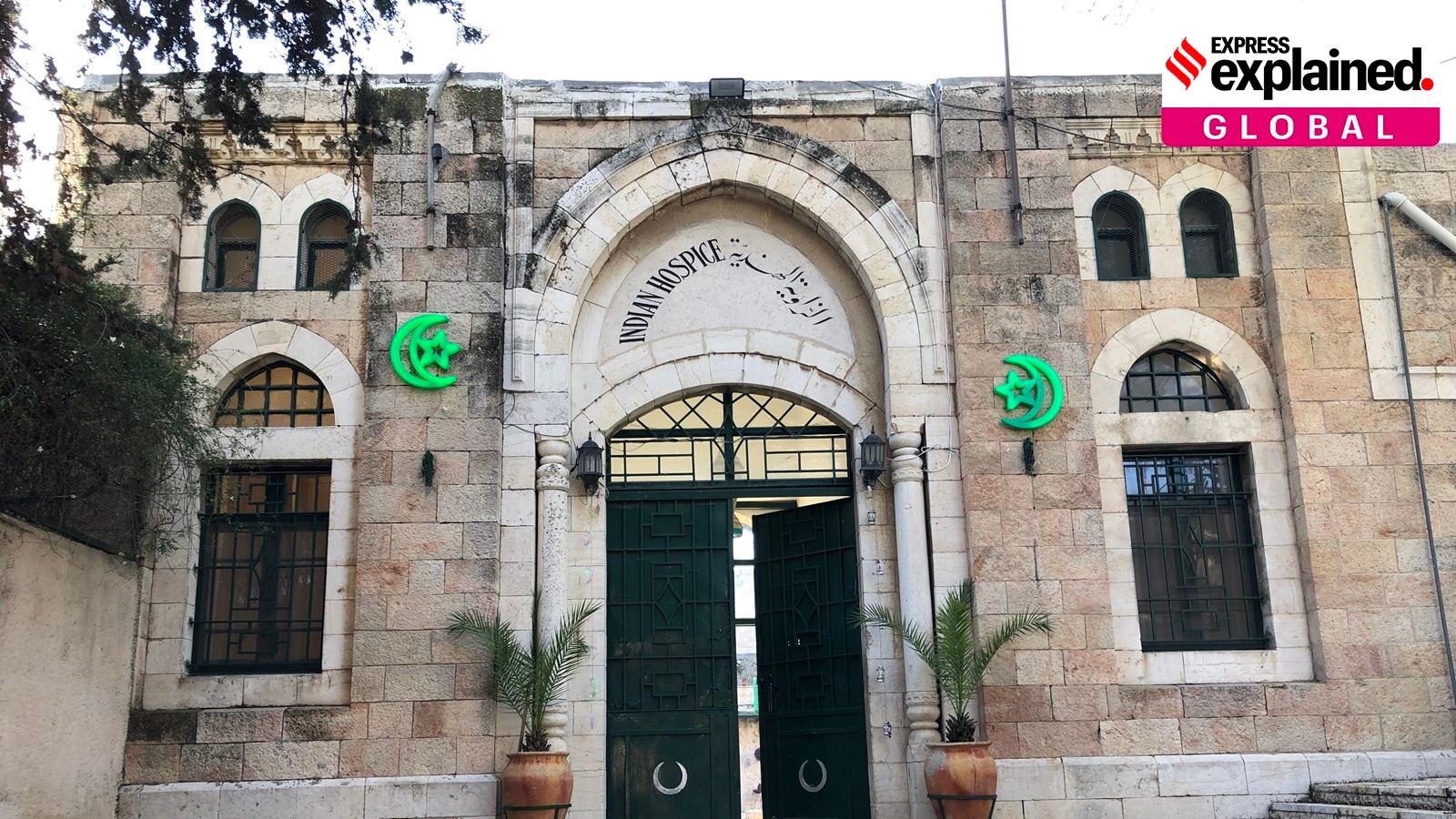
Jerusalem Indian hospiceThe property is under the ownership of the Waqf Board of India and is accessible only to individuals of Indian citizenship or heritage. (Express photo: Monojit Majumdar)
Listen to this article
India’s 800-year-old connection with Jerusalem: Baba Farid’s lodge, now a rest stop for Indian travellers
x
00:00
1x 1.5x 1.8x

Long before the city of Jerusalem became one of the world’s most contested places, India established its presence there in the 12th century. Within the ancient city’s walls stands a brown two-story stone building proudly displaying a plaque that reads, “Indian Hospice, Estd. 12th century A.D., supported by Ministry of External Affairs, Government of India, New Delhi.”

As is apt, the street leading to the hospice bears the name ‘Zawiyat El-Hunud’, meaning “the Indian corner.”

In October 2021, External Affairs Minister S Jaishankar unveiled this new plaque emphasising the 800-year connection between India and Jerusalem.

How did this connection come to be?

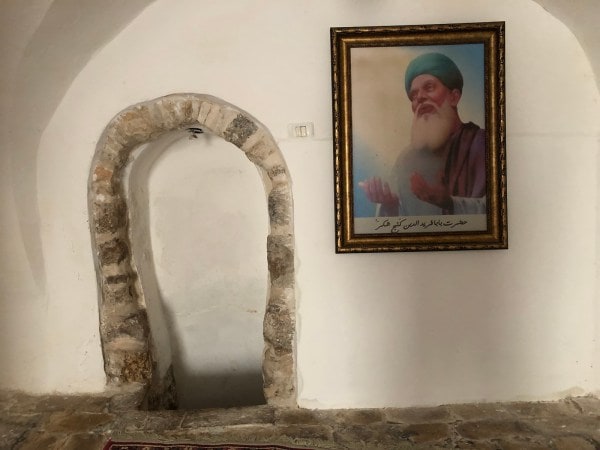
Legend has it that Baba Farid, a Sufi saint from Punjab, spent 40 days in deep meditation at this place. Although he returned to Punjab, Indian Muslims going to Mecca started visiting the walled city of Jerusalem to pray at this spot.

Over time, this place transformed into a shrine and a hospice for travelers from India.

Who was Baba Farid?

Baba Farid, born in 1173 CE in the village of Kothewal near Multan, hailed from a family that had migrated from Kabul to Punjab. He followed the Chishti order and, was one of the first Sufi saints to write his verses in Punjabi. Many of these verses are enshrined in the Guru Granth Sahib, the holy book of Sikhs.

Baba Farid Jerusalem Lore has it that Baba Farid found a modest lodge within one of the gates of Old
Jerusalem, known as Bab-az-Zahra among Muslims and Herod’s Gate among
Christians. (Express photo: Monojit Majumdar)

During his travels in Punjab and beyond, he visited Jerusalem, where he prayed at the Al-Aqsa mosque and composed verses.  Lore has it that he found a modest lodge within one of the gates of Old Jerusalem, known as Bab-az-Zahra among Muslims and Herod’s Gate among Christians. This lodge was situated within a compact khanqah—dedicated structures for Sufi orders, serving as both seminaries for the order’s followers, and hospices for travelers— atop a small hillock within Herod’s Gate.

Story continues below this ad

After Baba Farid’s departure, the khanqah evolved into a hospice for travelers from India, earning the name Zawiya Al-Hindiya, meaning “the Lodge of Hind.” Remarkably, despite changing hands, including Christian crusaders, Mamluks, and Ottoman rulers, the lodge retained its association with India.

The medieval traveller Evliya Chelebi described Zawiya Al-Hindiya—the Indian hospice—as one of the largest Zawiyas in the city in 1671. Navtej Sarna, a diplomat-author, uncovered a document from 1681 that detailed a leadership dispute over the lodge, and another document mentioned a sheikh named Ghulam Mohammad Al-Lahori who engaged with the Ottoman administration in 1824, resulting in the expansion of the lodge’s facilities.

The lodge’s prominence continued during the Ottoman rule, primarily under sheikhs from South Asia. However, a significant shift occurred when the Ottoman Empire’s dissolution began in 1919. By 1921, the Grand Mufti of Jerusalem, Amin Al-Husayni, took charge and initiated extensive renovations and rebuilding efforts. To fund these projects, the Grand Mufti sought support from Muslim patrons worldwide, including the Muslim princely states in British India.

In 1921, the Grand Mufti informed leaders of the Indian Khilafat Movement about the ‘Indian Lodge’ in dire need of repair. Khwaja Nazir Hasan Ansari, a young man from Saharanpur, Uttar Pradesh, took on the task. By 1924, he
had completely renovated the lodge, which provided sanctuary to numerous travelers and pilgrims from British India for the next 15 years. During World War II in 1939, the lodge served as a refuge for soldiers from British India fighting in North Africa.

How did the lodge get associated with independent India?

Story continues below this ad

After India gained independence, Nazir Ansari sought official recognition for the lodge from the Indian embassy in Egypt, cementing its Indian identity. The lodge has faced several conflicts, enduring rocket strikes in 1952 and
the Six Day War in 1967. Over time, the Indian Hospice expanded to its current 7,000 square metres. It also hosts the United Nations Relief and Works Agency for Palestine Refugees (UNRWA) and the Jerusalem Health Centre within its premises.

In 2000, the hospice was the site of a meeting between former Indian Foreign Minister Jaswant Singh and Palestinian leader Faisal Husseini.

There is no Indian diplomat or visiting dignitary who doesn’t visit the hospice.

Today, Sheikh Mohammad Munir Ansari, born in Jerusalem in 1928, serves as its administrator. In 2011, he was honoured with the Pravasi Bharatiya Samman (Overseas Indian Award), the highest accolade conferred by the
Government of India on overseas Indians.

Story continues below this ad

Despite the turmoil in the region, two Indian flags continue to fly proudly at the lodge. Every August 15, the Ansaris mark Independence Day with a song all of them know: “Saare jahaan se achha, Hindustan hamara.”

This property is under the ownership of the Waqf Board of India and is accessible only to individuals of Indian citizenship or heritage. The hospice features six guest rooms, a small mosque, a library, a dining hall, and a kitchen. Guests are encouraged to take care of their own cooking and laundry, utilising supplies and equipment provided by the hostel.

The Ansari family continues to maintain the hospice, offering hospitality, and a slice of India in Jerusalem.

Manraj Grewal Sharma is a senior journalist and the Resident Editor of The Indian Express in Chandigarh, where she leads the newspaper’s coverage of north India’s most politically and institutionally significant regions. From Punjab and Haryana to Himachal Pradesh and the Union Territory of Chandigarh, she oversees reporting at the intersection of governance, law, politics and society. She also reports on the diaspora, especially in Canada and the US. With a career spanning journalism across several countries, academia and international development, Manraj brings a rare depth of perspective to regional reporting. She is widely regarded as a leading chronicler of Punjab’s contemporary history and socio-political evolution, particularly its long shadow of militancy, federal tensions and identity politics. Her book, Dreams after Darkness, remains a definitive account of the militancy years and their enduring aftermath. Professional Background & Expertise A gold medalist in mass communication and a post-graduate in English literature, Manraj has a multifaceted career spanning journalism, academia, and international development. She was also awarded a fellowship by National Foundation of India and did several in-depth pieces on Manipur. Internationally, she has reported from Israel, US, UK, Myanmar, and Mauritius Her key focus areas include: Regional Politics, History, Agriculture, Diaspora, and Security. Of late, she has started focusing on Legal & Judicial Affairs: Much of her recent work involves reporting on high-stakes cases in the Punjab and Haryana High Court, ranging from environmental policy to civil rights. International Consulting: She previously served as a consulting editor for the Asia Pacific Adaptation Network and a publishing consultant for the Asian Development Bank (ADB) in Manila. Academia: For five years, she was the managing editor of Gender, Technology and Development, a peer-reviewed international journal at the Asian Institute of Technology, Bangkok. Recent Notable Articles (Late 2025) Her recent reportage focuses heavily on judicial interventions and regional governance: 1. Environment & Governance "‘NGT can’t test legality of policy’: HC hears challenge to Punjab’s ‘Green Habitat’ plan" (Dec 22, 2025): Covering a critical legal battle over whether the National Green Tribunal has the authority to strike down a state policy regularizing farmhouses on delisted forest land. "High court pulls up Punjab poll panel over audio clip probe" (Dec 10, 2025): Reporting on judicial concerns regarding the transparency and fairness of local body elections. 2. Legal Rights & Social Welfare "HC issues notice to Punjab, Haryana over delay in building old age homes" (Dec 22, 2025): Reporting on a contempt petition against top officials for failing to establish government-run homes for the elderly as promised in 2019. "Victims can appeal acquittals in sessions court without seeking special leave" (Dec 19, 2025): Highlighting a significant procedural shift in criminal law following a Supreme Court ruling. "HC upholds benefits for Punjab FCI officer acquitted in 20-year-old bribery case" (Dec 19, 2025): A report on the concept of "honourable acquittal" and its impact on employee benefits. 3. Human Rights & Identity "As Punjab denies parole to MP Amritpal Singh, HC asks it to submit ‘foundational material’" (Dec 1, 2025): Covering the legal proceedings regarding the radical preacher and sitting MP's request to attend Parliament. "Protecting life paramount: HC backs Muslim woman in live-in after verbal divorce" (Nov 6, 2025): Analyzing judicial protections for personal liberty in the context of traditional practices. Signature Beats Manraj is recognized for her ability to decode complex judicial rulings and relate them to the everyday lives of citizens. Whether it is a 30-year-old land battle in Fazilka or the political implications of Kangana Ranaut’s candidacy in Mandi, her writing provides deep historical and regional context. Contact @grewal_sharma on X manrajgrewalsharma on Instagram ... Read More

 

Latest Comment
Post Comment
Read Comments
Advertisement
Advertisement
Advertisement
Advertisement