6 min read
© The Indian Express Pvt Ltd



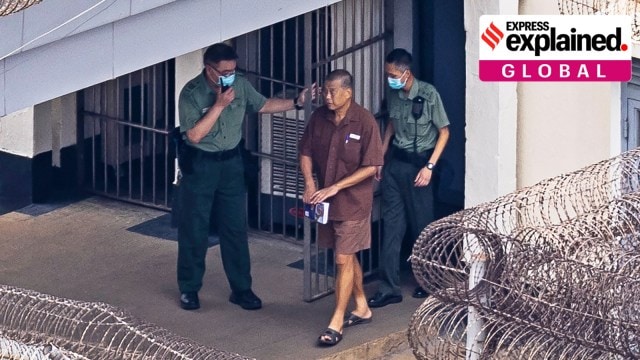 Jimmy Lai walks through the Stanley prison in Hong Kong, July 28, 2023. (AP Photo/Louise Delmotte, File)
Hong Kong media tycoon Jimmy Lai was found guilty of collusion with foreign forces and conspiracy to publish seditious material on Monday (December 15), concluding one of the most consequential prosecutions under the Beijing-imposed National Security Law (NSL).
The verdict, delivered by a three-judge bench, marked the first time the NSL of 2020 was applied in full against a prominent media figure, testing not only its outer limits but its core purpose.
The law is also among the various legislative and institutional changes that China has introduced to the city in recent years. International reaction to the verdict has reflected the tensions over these shifts. US President Donald Trump told reporters that he felt “so badly” about Lai’s arrest and that he “spoke to President Xi [Jinping] about it and I asked to consider his release.”
The UK Foreign Office described the verdict as “politically motivated” and called for Lai’s “immediate release”. Taiwan’s Mainland Affairs Council said it showed that Hong Kong’s freedoms and judicial independence had been “systematically eroded”.
China’s Foreign Ministry rejected the criticism, urging foreign governments “not to make irresponsible remarks on judicial cases in Hong Kong” and “not to interfere in China’s internal affairs in any form”.
Lai, 78, moved from mainland China to Hong Kong as a teenager. In 1995, he founded Apple Daily, a newspaper that blended sensationalist reporting with political commentary. Over time, it emerged as one of the few mainstream outlets consistently critical of Beijing’s growing influence.
Hong Kong has been governed as a Chinese Special Administrative Region since 1997 under the unique “one country, two systems” framework. After more than 150 years of British colonial rule, sovereignty was returned to China under the Sino-British Joint Declaration of 1984. It said Hong Kong would enjoy a high degree of autonomy under the Basic Law, Hong Kong’s mini-constitution, which promised an independent judiciary and protection of civil liberties for 50 years — until 2047.
Additionally, Hong Kong’s economic system was allowed to be more liberal than China’s, bolstering its position as a financial hub.
As the founder of Apple Daily, Lai wrote columns and gave interviews. He openly supported the pro-democracy movement, particularly during the 2019 protests against a proposed law that would have allowed the extradition of criminal suspects from Hong Kong to China, potentially targeting people critical of China. He also met foreign lawmakers, arguing that international pressure was necessary to safeguard Hong Kong’s autonomy.
Before 2020, such conduct was controversial but lawful. After the NSL came into force, it was recast as a national security threat.
Beijing imposed the NSL on Hong Kong in June 2020, following months of pro-democracy protests, bypassing the city’s legislature by inserting the law into the Basic Law. The NSL elevated national security as a paramount constitutional value, enforced through designated judges, special procedures and broadly defined offences.
Since its enactment, the NSL has been used for hundreds of arrests, disqualifications of election candidates, and closures of civil society groups and media outlets.
Lai was first arrested in August 2020 and charged under two legal regimes. One was the colonial-era sedition provision under the practically dormant Crimes Ordinance. The other was Article 29 of the NSL, which criminalises collusion with foreign forces, including “hostile activities” against China or the Hong Kong government.
The NSL does not require proof of violence, espionage or material harm. Prosecutors may rely on inferred intent, patterns of conduct and cumulative speech. In June 2021, authorities froze Apple Daily’s assets under the NSL, forcing the paper to shut down within days. Senior editors were arrested. Lai remained in custody and was in prison for nearly 1,800 days. His trial became a test of whether media ownership and editorial direction could constitute criminal conspiracy.
What did the court find?
In its judgment, running over 800 pages, the court described Lai as the “mastermind” behind the conspiracies charged. Three corporate entities, Apple Daily Limited, Apple Daily Printing Limited and AD Internet Limited, were also convicted for their roles in publishing, printing and distributing the material.
On the sedition charge, the court held that Lai was “a very hands-on boss” who exercised deep editorial control, and that the articles published were “objectively seditious”, intended to “bring into hatred and contempt” the Hong Kong government. Direct authorship, the judges said, was unnecessary, and editorial direction was sufficient.
On collusion, the court found that Lai’s conduct did not change even after the NSL came into effect. His campaign, urging foreign governments to impose sanctions on China and Hong Kong authorities, it said, continued in substance.
The judges treated indirect statements, interviews and rhetorical questions as legally equivalent to explicit requests when assessed cumulatively. Lai’s defence, that he would have acted differently had he known the legal consequences, was rejected. The court cited his testimony: “Yes, I would [do it again] because this is my character,” interpreting it as evidence that he remained “resolved, audacious and defiant”.
Most significantly, the court concluded that Lai’s objective went beyond democratic reform. It held that his “only intent, whether pre or post NSL, was to seek the downfall of the CCP (Chinese Communist Party)”, and that his “end game was regime change”.
That finding gives the verdict its wider significance. It establishes that under the NSL, political advocacy, editorial influence and foreign engagement can be aggregated into a national security offence based on inferred intent — a standard that extends well beyond Lai himself, and redraws the legal boundaries for journalism and dissent in Hong Kong.
Lai’s son, Sebastien, told Reuters that the judgment was an example of how the NSL had been “moulded and weaponised against someone who said things they didn’t like”.