


© The Indian Express Pvt Ltd
Tags:


Chinese and Japanese diplomats and government spokespersons have frequently criticised each other in recent weeks, after Japanese Prime Minister Sanae Takaichi said that her country would respond militarily to a potential Chinese attack on Taiwan.
The long lifespan of the diplomatic row can be traced back not only to Taiwan’s importance for China but also to the regional heavyweights’ rivalry and complex history. Earlier this week, Foreign Ministry spokesperson Guo Jiakun said that “Any tolerance on the provocative words and deeds of Japanese right-wing forces will only revive the spectre of militarism and once again put the Asian people in danger.”


What happened in Nanjing, and has it always been a sensitive issue for the countries? Here’s what to know.
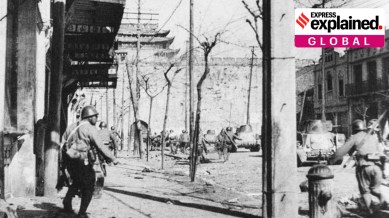
Imperial Japan, which was then an expansionist power, invaded Manchuria in northeastern China in 1931. However, full-scale war began in July 1937. A key trigger was an incident near the Marco Polo Bridge, close to Beijing, where fighting broke out between the two sets of troops. What followed were disagreements over who fired the first shot. One argument states that the Japanese Army deliberately raised the incident to create a pretext for intensifying its military campaign.
At the time, the eastern city of Nanking was the Chinese capital. Japanese troops launched their attack in early December, and by the 12th, the Chinese troops retreated behind the Yangtze River, with the city falling to Japan on December 13. Many Chinese troops were also deployed near Shanghai, leaving fewer military resources for Nanjing.
The next six weeks saw the infamous Nanking Massacre, or the Rape of Nanking, unfold. China has said that around 300,000 soldiers and civilians were killed, and 20,000 women were raped.
The city also had a few foreigners at the time, including Christian missionaries and Western journalists, whose eyewitness accounts have helped bolster the understanding of the brutality of the events. Journalist Harold Timperley, who worked for The Guardian, wrote that one missionary saw 50 civilian corpses dumped in a pond and talked to survivors of groups who had been machine-gunned. “Several of the foreigners physically dragged Japanese soldiers off the Chinese women they were raping. Hundreds of disarmed Chinese soldiers and civilians who had worked for the army in a labour corps were roped together and killed,” The Guardian reported.
Photographs also showed bodies in the river, and some Japanese soldiers posing with corpses and decapitated heads.
Explanations for the scale of the massacre have ranged from Japanese soldiers not being adequately reined in by their senior military leaders to a shortage of supplies for them, leading to widespread looting and killing. Historian Yang Daqing wrote that discipline among Japanese soldiers had been declining for years by then, and their poor opinion of the Chinese people as a race made them easy targets of violent rage.
Japan’s war crimes were tried by the International Military Tribunal for the Far East after the end of World War 2 in 1945. General Matsui Iwane, commander of the army in Nanjing, defended his country’s actions by saying they were in the service of a pan-Asia philosophy against Western colonial powers. He said the attacks were carried out to have “the Chinese undergo self-reflection”. Matsui was executed after the tribunal’s findings.
Several scholars have noted that in the early decades after the establishment of the Communist republic in China in 1949, Nanjing and other war atrocities were not a point of focus for the government. Under the leadership of a larger-than-life figure such as Mao Zedong, the Communist Party-led state had a charismatic head who was seen as holding the party and the nation together.
But by the time of his death in 1976, Chinese society and economy had gone through massive upheaval because of policies like the Cultural Revolution (purportedly to purge non-Communist elements). Two years after Mao’s death, the liberalisation of the economy was initiated to ensure better living standards and support for the party among the Chinese people. This is when the party began searching for other elements of inspiration to ensure national unity, and history proved to be a powerful tool.
In the 1980s, Japan’s plan to introduce school textbooks that downplayed war crimes led to protests and criticisms in China. Officially, the Japanese government has admitted to the killing of noncombatants, looting and other acts in Nanjing, while claiming there “are numerous theories as to the actual number of victims.” Such actions have to do with its own political compulsions in relation to Japanese right-wing groups.
For China, the narrative also ties into the idea of the “Century of Humiliation”, covering the period from the mid-19th century to 1949. It includes the period of China’s unequal trade treaties with European powers to the Japanese invasions. Under President Xi Jinping, it has often been used to build up nationalistic sentiments and frame criticisms of China (particularly by the West) as an attempt to subjugate it, once again.
In fact, it was under Xi in 2014 that China first held a ceremony for the state to commemorate the Nanjing massacre. He said at the event, “Anyone who tries to deny the massacre will not be allowed by history, the souls of the 300,000 deceased victims, 1.3 billion Chinese people and all people loving peace and justice in the world.”
Such a framing also helps China’s standing internationally. Historian Rana Mitter, in his book China’s Good War, wrote that “China’s current self-definition as an anti-hegemonic power committed to “peaceful development” is also boosted by looking back to the wartime years.”


