5 min read
© The Indian Express Pvt Ltd



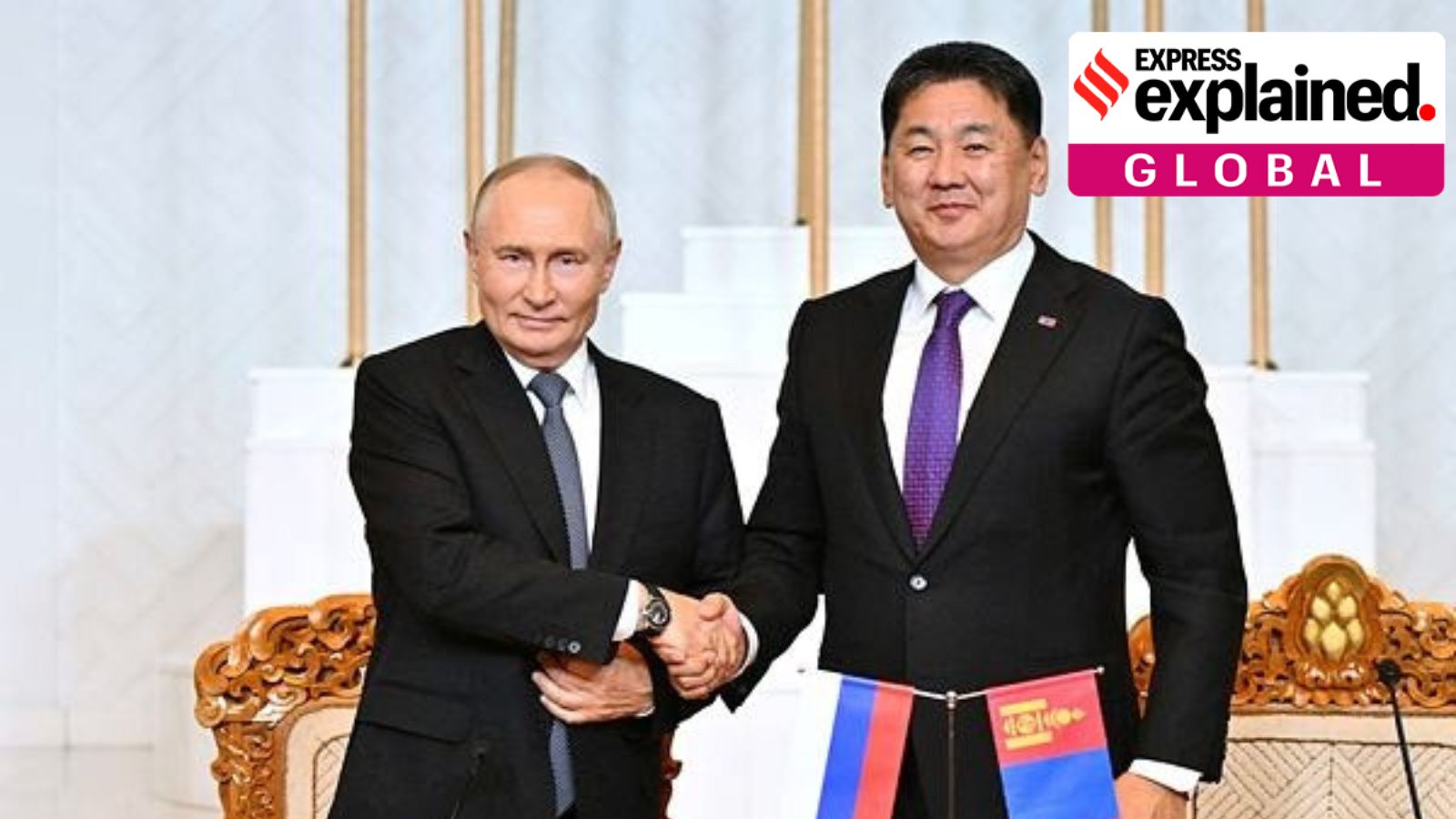 Russian President Vladimir Putin and Mongolian President Ukhnaagiin Khurelsukh attend a joint press conference in Ulaanbaatar, Mongolia September 3, 2024. (Photo - Sputnik/Kristina Kormilitsyna / Kremlin via Reuters)
Russia’s President Vladimir Putin is back in his country — he was in Vladivostok on Wednesday (September 4) for the annual summit of the Eastern Economic Forum — after a visit to Mongolia where, to the outrage of some countries, he was not arrested.
The International Criminal Court (ICC) has issued a warrant for his arrest in connection with alleged war crimes, and Mongolia, as a party to the Rome Statute which established the court, had a duty to execute the warrant.
Putin arrived in Mongolia’s capital Ulaanbaatar on Monday night. On Tuesday, he attended the 85th anniversary celebration of the victory of Soviet and Mongolian troops over the Japanese army on the Khalkhin Gol river in Manchuria along with Mongolia’s President Ukhnaagiin Khurelsukh.
At their summit meeting, the two leaders signed agreements on energy supply and the reconstruction of a power plant in Mongolia.
The warrant was issued on March 17, 2023, after the ICC found Putin and Russia’s Commissioner for Child Rights, Maria Lvova-Belova, responsible for the abduction and deportation of children from Russian-occupied areas of Ukraine to the Russian Federation in violation of articles 8(2)(a)(vii) and 8(2)(b)(viii) of the Rome Statute.
These articles address unlawful deportation and transfer and unlawful confinement, and the direct or indirect transfer by an occupying power of parts of its own civilian population into occupied territory, or the deportation of the population of the occupied territory within or outside this territory.
According to the warrant, there is reason to believe that Putin and Lvova-Belova bear individual criminal responsibility for the crimes under Article 25(3)(a) of the Rome Statute. The warrant also accuses Putin of failing to exercise proper control on his subordinates who committed or allowed these acts to take place.
Similar warrants were issued against former Russian Defence Minister Sergei Shoigu and current Chief of General Staff of the Russian Armed Forces Valery Gerasimov, charging them with “directing attacks at civilian objects” and “causing excessive incidental harm to civilians or damage to civilian objects”.
The ICC warrant against President Putin is the first against the leader of a permanent member of the United Nations Security Council.
The Rome Statute is the treaty that established the ICC and its relationship with the UN. It was adopted at a conference in Rome in 1998, and implemented in 2002.
The Rome Statute addresses four core international crimes — aggression, genocide, war crimes, and crimes against humanity. While all four types of crime are free from any statute of limitations, the ICC’s mandate applies only to offences committed after July 1, 2002.
The ICC is authorised to prosecute individuals, in contrast to the International Court of Justice (ICJ), which looks into the actions of countries, and territorial disputes.
Under the Rome Statute, the ICC is authorised to investigate heinous international crimes only when the country’s own legal machinery fails. However, the alleged offences must be committed in a signatory nation, or by a member of a ratifying nation. The ICC’s jurisdiction can also extend to cases referred to it by the UN Security Council.
While the Statute has 124 countries as signatories, three permanent members of the UN Security Council — the United States, Russia, and China — have not signed it, and India and Ukraine haven’t either. Mongolia, however, is a signatory to the treaty.
FOR RUSSIA: The existence of the warrant means Putin runs the risk of arrest every time he travels to an ICC signatory country. However, the ICC has no mechanism to enforce the warrant.
The warrant has increased Putin’s international isolation — his international visits since the issue of the warrant have been restricted to China, North Korea, Saudi Arabia, the UAE, former Soviet republics in Central Asia, and Vietnam.
Mongolia is the first ICC signatory nation Putin visited since the issue of the warrant. He cancelled a visit to South Africa for the BRICS summit last year.
FOR MONGOLIA: The choice before the country was between honouring an old friendship with Russia, on which it depends heavily for fuel and electricity, and sacrificing that relationship to go along with the West.
But this was a choice only in theory — it is difficult to imagine how Mongolia might have managed to carry out the arrest and survived Moscow’s retribution, or what it could have got in return for doing so. Mongolia is a landlocked country firmly in Russia’s sphere of influence, and sandwiched between anti-West allies Russia and China.