


Tags:


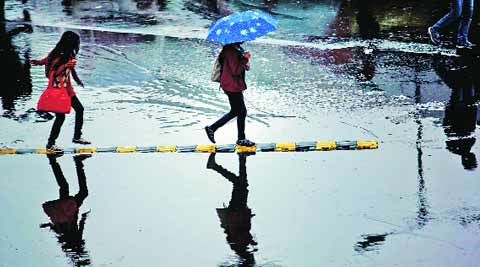

On Tuesday, the India Meteorological Department (IMD) issued the second long-range forecast for this year’s monsoon season, revising its prediction for expected rainfall from 93% to 88%. The revision has been pegged to oceanic phenomena. The El Nino in the equatorial Pacific has gained in strength, while the Indian Ocean Dipole (IOD), nearer home, has been getting neutral.
[related-post]


In April, scientists were unsure exactly how the El Nino would shape up. There is a strong correlation between an El Nino — the abnormal rise of sea surface temperatures in the equatorial Pacific off the coast of South America — and a weak monsoon.
The US National Oceanic and Atmospheric Administration (NOAA) had announced the development of El Nino conditions in April. But as D Sivananda Pai of IMD explained, data then was mainly from subsurface temperatures. It was only subsequently that surface temperature data was available. “Subsurface temperature can be misleading, like it happened last year. In April, there were conditions for El Nino, but it dissipated by June and July,” he said.
But this year, El Nino conditions are not just strong, there is also a 90 per cent probability that it would continue throughout the monsoon season, the IMD has said.

In April, IMD noted “slight negative” IOD conditions. This has turned neutral now, but is unlikely to turn positive. IMD has said there is a 50 per cent chance that neutral IOD conditions might continue.


