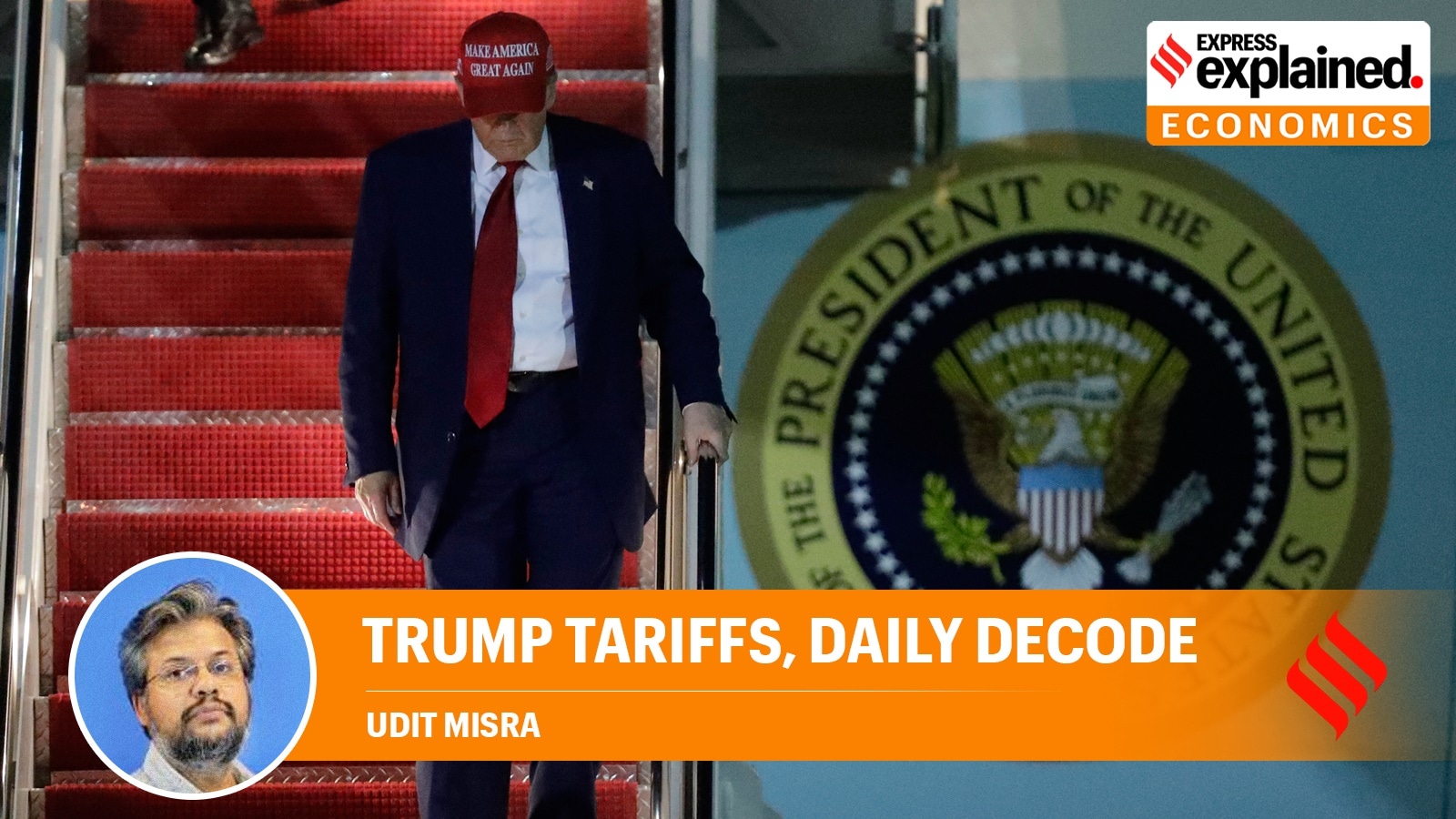
On economy, the most substantive bit came in a press conference where Treasury Secretary Scott Bessent and Press Secretary Karoline Leavitt outlined a long list of achievements by Trump 2.0. Here are some of the highlights sourced from the White House memo and the press conference:

Inflation control: Since Trump took office in January, prices of prescription drugs are down 2%, gasoline down by 7%, and wholesale eggs are down by around 50%. Moreover, last month’s (March) decline was only the second monthly decline in inflation (Consumer Price Index) in the last two-and-a-half years.
Rise in jobs, especially in manufacturing: Trump has created 345,000 jobs since taking office in January. March was the 4th highest month for private payroll growth in the past two years. In particular, 9,000 manufacturing jobs were created since Trump took charge — a sharp contrast to the 6,000 manufacturing jobs lost per month from Jan 2023 to Dec 2024 under the Biden Administration. The automotive sector is growing; the US has had the biggest one-month increase in auto sales in March in more than a year.
Drill Baby Drill: Increasing the supply of oil and gas, and the increased supply of fossil fuels was a key campaign promise. “The Department of Interior has announced an off-shore drilling policy that will boost oil production in the Gulf of America (Gulf of Mexico) by 1,00,000 barrels. day,” said Leavitt.
Deregulation and its benefits: Trump has blocked all unfinalised Biden-era rules, which, according to the White House, saved over $180 billion for American households. Similarly, the rollback of tailpipe emission rules for light-duty and medium-duty vehicles also saves $755 billion. All told, savings from deregulation are now pegged at $935 billion or nearly $11,000 per family of four).
On Tariffs: Both Bessent & Leavitt provided a lot of details. For instance, the US is closest to finalising a trade deal with India, South Korea and Japan. Bessent said it was “easier to negotiate” with countries such as India which have high tariffs. Bessent underscored the need to include national security concerns when considering the imposition of tariffs. “National security is economic security and economic security is national security,” he said. When asked whether tariffs were aimed at raising revenues (possibly to provide income tax relief) or as a negotiating ploy to strike good deals with trading partners and incentivise on-shoring of manufacturing, Bessent said “It is a combination of both”.
Story continues below this ad
On China: Bessent yet again denied giving details regarding who in China is negotiating with the US. This remains a mystery since the Chinese have repeatedly denied being in negotiation with the US. But Bessent said an equally remarkable thing: “China sells five times more goods to us than we sell to them. So the onus would be on them to take off these tariffs.” This is a remarkable contention since the tariff war was started by the US. He also said that according to his calculations, tariffs on China are “so unsustainable that China could lose 10 million jobs very soon”.
On uncertainty: Many observers and global investors have said that the biggest challenge before the US economy — even more than merely the rate of tariffs etc. — is the widespread uncertainty. Bessent said that Trump creates “strategic uncertainty” in negotiations. And while the “aperture of uncertainty is narrowing,” according to Bessent, “certainty is not necessarily a good thing in negotiating”.
On investments: The Trump administration has also underscored that its strategy of on-shoring fresh investments is working. It claims that so far, total investment commitments have reached over $5 trillion including $500 billion from Apple, $500 billion by Nvidia, $500 billion by Open AI,Oracle and SoftBank. It also claims that these investments are expected to create 4,51,000 high paying jobs for American workers. “Trump has secured more investments in 100 days than Biden did in 4 years, “said Leavitt. “There’s never been a better time to invest in America”.
What’s the other side of this picture?
There is a growing divergence between soft data (read opinion surveys etc.) and the hard data (actual observed data) in the US. For instance, consumer confidence has cratered almost the same way that Trump approval ratings have plummeted.
Story continues below this ad
On Monday, for instance, the Federal Reserve of Dallas found that business confidence was nosediving.
“The future general business activity index fell sharply in April to -24.2 from 6.9, and the future company outlook index dropped further into negative territory to -25.1 from -5.4. The future sales index declined 19 points to 0.1 and the future employment index dropped to -0.3, with the near-zero readings suggesting expectations of no growth in sales and employment six months from now. The future capital expenditures index fell to -12.5 from 16.7.”
An equally worrying trend is that most top companies have either pulled back their revenue guidance or refused to give one due to uncertainty during the ongoing corporate results season. Many observers are talking about a macro-paralysis in the US where everyone — from consumers to businesses to investors — are in a wait and watch mode, threatening to bring the economy to a halt.
Hard data vs soft data in the US: Which to trust?
So while it is a fact that the hard data is better than the soft data for the period until March end, there is a caveat when reading the hard data.
Story continues below this ad
There is a quirk about the hard data at this particular juncture because almost all of it is for the period before April 2 — the so-called Liberation Day — when Trump announced reciprocal tariffs. Many argue that in the lead up to April 2, the fear of having to pay high tariffs in the future, made consumers and wholesalers buy prematurely. As such, imports rose and so did sales and inventories. But after April 2, everything took an about-turn.
When asked, Bessent said he only looks at hard data, and simply ignored what all the surveys are projecting.


 6 min read