5 min read
© The Indian Express Pvt Ltd



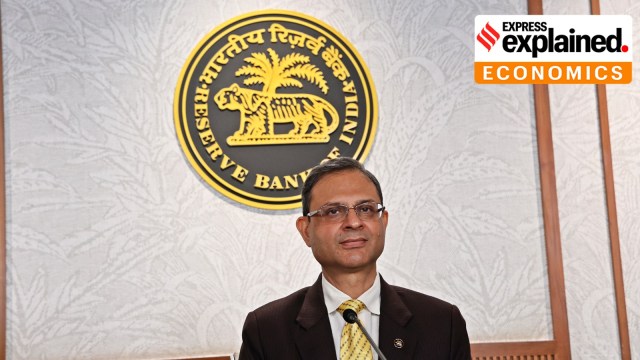 Reserve Bank of India Governor Sanjay Malhotra during a press conference in Mumbai, Maharashtra. (Express file photo by Ganesh Shirsekar)
The Reserve Bank of India’s (RBI) Monetary Policy Committee (MPC) is largely expected to keep the repo rate unchanged for the third consecutive time at its upcoming meeting scheduled from December 3 to 5.
The policy review comes on the back of robust economic performance, with the country’s gross domestic product (GDP) growing at 8.2 per cent in Q2 FY2026 – its fastest pace in six quarters, and consumer price index (CPI) inflation easing to an all-time low of 0.25 per cent in October.
The rate-setting panel is also likely to retain a neutral policy stance when it announces the decision on December 5. Economists feel that the RBI will also revise the inflation and growth forecast for the current financial year.
The six-member MPC is likely to retain the repo rate – the key policy rate – steady at 5.5 per cent for the third successive policy.
“Expectations built till a few days back of a shallow rate cut of 25 bps appear to have faded as finer readings of the strong Q2 growth print and the evolving playbook make the choice tilted in favour of a pause in December policy,” said Soumya Kanti Ghosh, Group Chief Economic Advisor, State Bank of India.
The country’s GDP expanded at an impressive 8.2 per cent in the July-September 2025 quarter, up sharply from 5.6 per cent in the corresponding quarter of the previous fiscal. This followed a growth of 7.8 per cent in Q1 FY26, bringing the H1 growth to 8 per cent.
“We expect a status quo on rates and stance in the December MPC as the need to deliver a cut with a 7 per cent GDP growth and front loading of rate cuts is limited. Also, as we are close to the end of the easing cycle, transmission in the rates market is likely to be better in the hope of a cut rather than an outright cut,” said Anubhuti Sahay, Head, India Economic Research, Standard Chartered Bank.
Headline CPI inflation moderated to 0.3 per cent in October 2025 from 1.4 per cent in September. This was driven by the deepening of deflation in food prices and impact of the GST rate cut on goods and services prices, amid large favourable base effects.
IDFC FIRST Bank’s Chief Economist Gaura Sen Gupta said that the inflation print shows space for rate cut with FY26 CPI inflation averaging at 2 per cent and FY27 averaging at 3.9 per cent. However, growth indicates that the need for a rate cut is much lower with recovery becoming broad based, led by both urban and rural consumption.
Economists expect the MPC to retain the ‘neutral’ monetary policy stance. A neutral stance will mean that the rate can move in either direction, depending on the evolving economic data. The policy stance changed to neutral from accommodative in the June 2025 policy.
The RBI is likely to revise FY26 inflation projection lower, and GDP forecast upwards in the forthcoming policy, economists said. “We do expect a downward revision in inflation forecast by 0.1-0.2 per cent and an upward revision in GDP forecast of 0.1-0.2 per cent for FY26,” said Madan Sabnavis, Chief Economist, Bank of Baroda.
According to Standard Chartered Bank’s Sahay, GDP and inflation are likely to be revised higher towards 7.5 per cent and 2 per cent, respectively.
In October monetary policy, the RBI had raised the GDP growth projection by 30 bps to 6.8 per cent, from an earlier estimate of 6.5 per cent, while it had slashed inflation forecast by 50 bps to 2.6 per cent as against an estimate of 3.1 per cent.
Analysts expect RBI to announce open market operations (OMOs) to provide liquidity in the banking system.
After huge swings in liquidity in October, November witnessed continued liquidity surplus which, however, reduced from an average of Rs 2.2 lakh crore in the first half to Rs 1.5 lakh crore post that.
“As liquidity, though in surplus, is at the lower end of the 1 per cent of NDTL (net demand and time liabilities) mark, there could be a case for announcing some OMOs. This will be helpful during December when the advance tax payments flow out of the system,” said Sabnavis of Bank of Baroda. Net Demand and Time Liabilities (NDTL) represent the total funds a bank owes its customers.
If the RBI retains the repo rate at 5.5 per cent, interest rates on loans and deposits are likely to remain unchanged as of now. All external benchmark lending rates (EBLR) linked to the repo rate will not rise. However, lenders may revise their interest rates on loans that are linked to the marginal cost of fund-based lending rate (MCLR).