


© The Indian Express Pvt Ltd
Tags:


The World Inequality Report for 2026, released this week, underscores the widening inequalities not just within a country but also in the world as a whole. Data show that the top 10% of the global population’s income-earners earn more than the remaining 90%, while the poorest half of the global population captures less than 10% of the total global income. Wealth is even more concentrated: the top 10% own three-quarters of global wealth, while the bottom half holds only 2%.
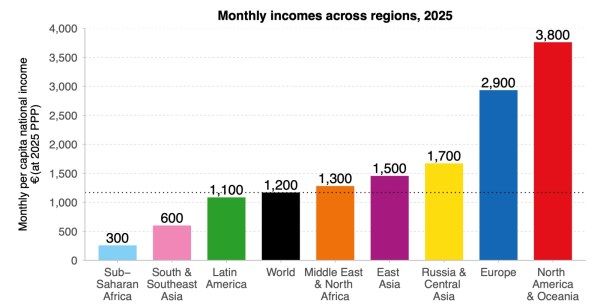
The global averages conceal enormous divides between regions, states the report. The world is split into clear income tiers (see CHART 1): high-income regions such as North America & Oceania, and Europe; middle-income groups, including Russia & Central Asia, East Asia, and the Middle East & North Africa; and very populous regions where average incomes remain low, such as Latin America, South & Southeast Asia (this is where India falls), and Sub-Saharan Africa.


Often, the basic questions — whether there is inequality, and if so, how severe — are deeply contested. Read this edition of ExplainSpeaking to understand the situation in India’s context.
This often means that the more substantive issues do not get the required attention. For instance, the type of policies that can reduce the yawning gap of inequalities. The WIR 2026 lays out many, but here’s the top one: Public investments in education and health. “These are among the most powerful equalizers, yet access to these basic services remains uneven and stratified. Public investment in free, high-quality schools, universal healthcare, childcare, and nutrition programs can reduce early-life disparities and foster lifelong learning opportunities. By ensuring that talent and effort, rather than background, determine life chances, such investments build more inclusive and resilient societies,” says the report.
To be sure, “public investment” means the expenditure by governments towards education.
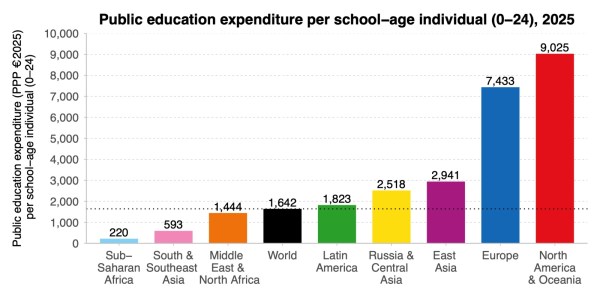
It is instructive to note where each of the above-mentioned regions shows up on public education expenditure (see CHART 2). “In 2025, average public education expenditure per school−age individual (0−to−24−year−old) varies enormously across world regions, from €220 in Sub−Saharan Africa to €9,025 in North America & Oceania (PPP € 2025), i.e., a gap of almost 1 to 41.”
Is it any surprise that laggard regions continue to lag?


