6 min read

© The Indian Express Pvt Ltd



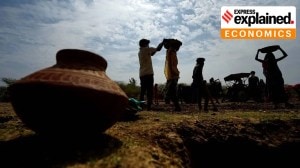
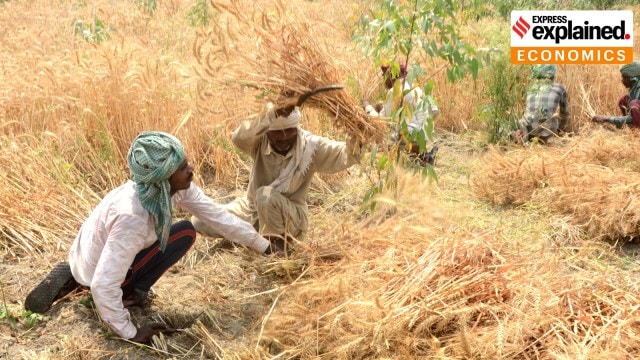 One reason could be the rising Labour Force Participation Rates (LFPR) among women in rural India. LFPR refers to the percentage of the population aged 15 years and above that is either employed or actively seeking to work for a relatively long part of any particular year. Express photo by Harmeet Sodhi
MGNREGS revamp: The Narendra Modi government’s Viksit Bharat-Guarantee for Rozgar and Ajeevika Mission Gramin (VB-G RAM G) Bill, introduced in Parliament on Tuesday, has a provision to restrict the undertaking of rural employment generation works under the planned new law during the “peak agricultural seasons of sowing and harvesting”.
The curbs on commencing or executing any such work, for a period aggregating 60 days in a financial year and to be notified in advance by state governments, have been proposed in order to “facilitate adequate availability of agricultural labour” during the peak planting and picking time of crops.
The existing Mahatma Gandhi National Rural Employment Guarantee Act (MGNREGA) of 2005 — which the VG-G RAM G Bill seeks to repeal and replace with a new statutory wage works programme — has been criticised by many (including the Union Agriculture Minister during the previous UPA administration, Sharad Pawar) for contributing to labour shortages in farms.
Pawar had, in fact, written to the then Prime Minister Manmohan Singh, demanding that the MGNREGA scheme be paused for at least three months during the peak agricultural seasons; the VG-G RAM G Bill provides for only a two-month (60-day) break.
The wage effect
MGNREGA is believed to have led to a tightening of the rural labour market and enhanced the bargaining power of both farm and non-farm workers. This does not, however, seem to be reflected in wages.
The accompanying table shows the growth in rural wages for the ten years ended 2024-25 (April-March). It is based on daily wage rate data for 25 occupations, compiled by the Labour Bureau and collected from 600 sample villages spread over 20 states of India.
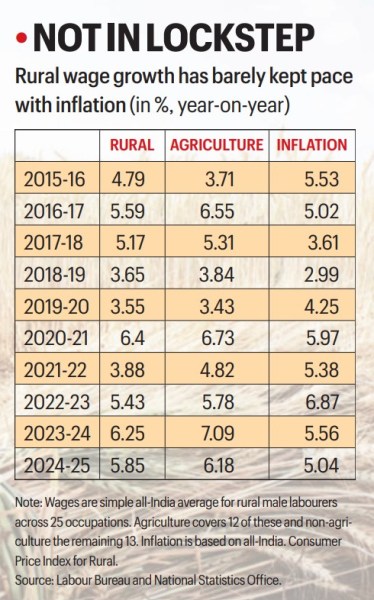
From the table, it can be seen that the year-on-year growth in rural wages, taking a simple all-India average for male labourers across all the occupations, has ranged between 3.6% and 6.4%.
In four out of the 10 years (2015-16, 2019-20, 2021-22 and 2022-23), the growth in nominal rural wages has trailed consumer price inflation. This means that wages have actually fallen in real terms.
For the other years, real wage growth (nominal minus inflation) topped 1% only in 2017-18.
Interestingly though, the growth in agricultural wages has been higher than that of overall rural wages for eight out of the 10 years. Only two years (2015-16 and 2019-20) saw rural wages growing at a faster rate than farm wages.
The Labour Bureau has 12 occupations categorised under agriculture (ploughing/tilling, sowing/planting, watering/irrigation, plant protection, harvesting/threshing/winnowing, picking of commercial crops, horticulture labour, animal husbandry work, crop/produce packaging, logging/wood cutting, inland fishing and coastal/deep-sea fishing).
The remaining 13 non-agricultural occupations are: Plumber, electrician, mason, weaver, blacksmith, carpenter, tractor/light motor vehicle driver, beedi maker, bamboo/basket maker, handicraft worker, porter/loader, construction labourer and sweeper/cleaner.
What is clear from the above is that agricultural wages have grown more than overall rural wages. But even in this case, the growth in nominal wages has just about kept pace with inflation. The data does not point to any significant surge in wages — at least during the past 10 years under the Modi government’s term. This was in spite of MGNREGA.
One reason could be the rising Labour Force Participation Rates (LFPR) among women in rural India. LFPR refers to the percentage of the population aged 15 years and above that is either employed or actively seeking to work for a relatively long part of any particular year.
According to the official Periodic Labour Force Survey (July-June period), the all-India rural female LFPR was a mere 24.6% in 2017-18. That rose to 26.4% in 2018-19, 33% in 2019-20, 36.5% in 2020-21, 36.6% in 2021-22, 41.5% in 2022-23 and 47.6% in 2023-24.
The Finance Ministry’s Economic Survey for 2023-24 had attributed the sharp jump in the rural female LFPR mainly to the Modi government’s schemes such as Ujjwala, Har Ghar Jal, Saubhagya and Swachh Bharat.
These flagship programmes, the survey claimed, had not just substantially expanded household access to clean cooking fuel, electricity, piped drinking water and toilets. They also freed up rural women’s time and efforts that went into collecting firewood and dung or fetching water.
Cooking faster using LPG cylinders or even electric mixer grinders has enabled them to deploy their energies towards more productive outside employment, instead of only mundane household tasks.
What the above freeing up of women’s time and increase in female LFPR has, at the same time, ended up doing is also boost the aggregate size of India’s rural workforce. The resultant “rightward shift of the labour supply curve”, as economists would call it — basically more people willing to work at the same or lower rates — has then exerted downward pressure on rural wages.
Simply put, the evidence of MGNREGA creating an all-round shortage of labour in farms is, perhaps, rather weak. If anything, more women entering the rural labour force and engaging in agricultural activities closer to their homes would have offset the large numbers supposedly pulled out of the farms by MGNREGA.
Farmers may be right about not getting enough labour on time, whether for transplanting paddy, picking cotton, spraying insecticides or removing weeds. But whether MGNREGA is to blame — and thereby justifying the proposed curbs on undertaking works during “peak agricultural seasons” — requires more ground-level evidence.