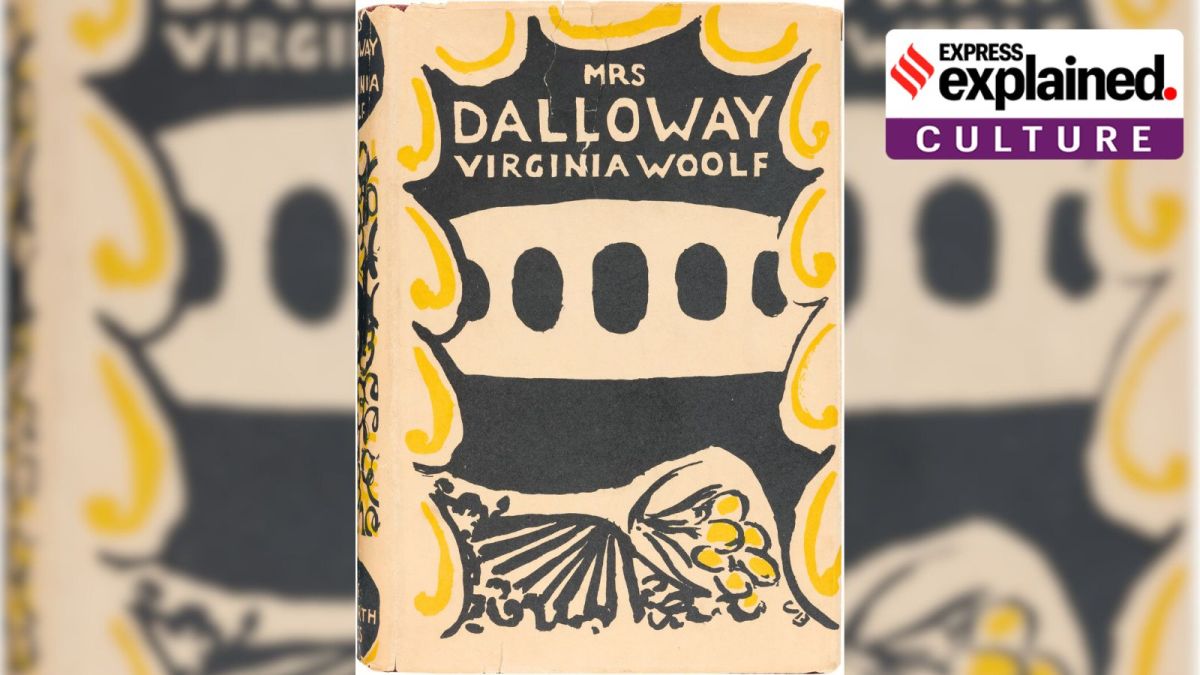
Mrs. Dalloway (first edition, 1925); cover art by Vanessa Bell. (Wikimedia Commons)
Mrs Dalloway 100 years, Virginia Woolf legacy: Do men read women? Or, more precisely, do books written by women about the lives of ordinary women count as “literature”? In the century since the publication of Virginia Woolf’s Mrs Dalloway, about the life of an upper-crust London woman going about her day, much has changed in how literature now mainstreams what was once niche, suggesting that the domestic, the ordinary, is anything but trivial.
This shift in perspective is powerfully echoed in Michael Cunningham’s Pulitzer Prize-winning 1998 novel, The Hours, where Woolf’s legacy ripples through the lives of women across generations, revealing how deeply her questions still resonate. Woolf herself wondered whether a novel could be built from the ebb and flow of a single day, from flowers bought, parties planned, thoughts half-spoken. That it could — and did — is why Mrs Dalloway remains a classic. Its enduring relevance lies in how it dignifies the internal lives of women, revealing depth in what society once dismissed as minutiae. A century later, writers, poets and academics speak of the quiet, radical power of Mrs Dalloway — and how it touched their lives:
You’ve Read Your Free Stories For Now
Sign up and keep reading more stories that matter to you.
“To teach Mrs Dalloway, as I did to third-year English Honours students, is to delve into the very bones and sinews of the book. What makes it so brilliant, for all its seeming simplicity, is what we looked at in the classroom, and the more you looked at it, the more depths were revealed. To knit together London, the war, the trenches, issues of sanity and madness, youthful homo-erotic love, the ecstasy and pain of living, all filtered through the mind of one woman, required a skill that one can only marvel at. Thank you, Virginia Woolf, for being a trailblazer for so many women writers after you.”
-Manju Kapur, writer
“Virginia Woolf’s Mrs Dalloway, like James Joyce’s Ulysses, is set in one day. But within that time frame, Woolf plays around with time using flashbacks and memories. The novel fuses history and autobiography, haunted as it is by war, trauma, insanity, unrequited love, suppressed sexuality and death. In that dark world, emerging from the shadow of “complete annihilation’’, Clarissa Dalloway is preparing for a party – the kind of party that Woolf and her friends of the Bloomsbury Group must have hosted. In A Room of One’s Own, she wrote about the need to retrieve the lives of women who had lived “infinitely obscure lives’’ but her own life and her friends’ lives were far away from that world – “they lived in squares and loved in triangles”. There is, in this novel, above everything else, Woolf’s style – loitering, insidious and sensuous. It is one of the earliest examples of stream of consciousness writing in the English language in the 20th century and carried the influence of Marcel Proust, whose writings Woolf had read with great attention. Woolf, in her time, was unique. The last line of Mrs Dalloway could very well apply to her, “For there she was””.
-Rudrangshu Mukherjee, chancellor and professor of History, Ashoka University
““Mrs Dalloway said she would buy the flowers herself “. I remember the opening line from the time my younger self first read the book – published a hundred years ago now. Considered Virginia Woolf’s finest novel, it follows a day in the life of Mrs Dalloway, a London society matron, as she prepares for a party. The narrative is intercepted with other stories, interrogating themes of memory, remembrance, the aftermath of war, and a changing social order. The uniquely crafted novel gave a feminine lilt to form, style and the texture of language. Woolf’s voice continues to remain immediate and spontaneous and to resonate with successive generations of readers.””
-Namita Gokhale, writer
Virginia Woolf in 1902. (Wikimedia Commons)
“The novel first hit me like a storm. It was around 2006. It was Bachelor’s third year, if I remember correctly, and an excellent teacher, Brinda Bose, taught us the text. She was a bit of an institution in Delhi University those days, and the way the novel came alive in her teaching was exceptional. That any prose could do such wave-like motions, I did not know. That writing could bide and expand, and hurry and shorten time, I did not know. That one’s thoughts could be the subject of endless unravelling, I did not know. Woolf’s prose, then, in Mrs Dalloway became a point of no return. Thereon, any writing one did, was an open-ended experiment, rather than a foreclosed set of possibilities. The novel taught me that prose could go to any place of your imagining.”
-Akhil Katyal, poet
“For a hundred years now, people have wondered why Mrs Dalloway said she would buy the flowers herself. Over the last 30 years, since I first read Woolf’s novel, the emphasis in the opening sentence has kept shifting for me: from “herself”, when I was a university student, to “buy” a few years later, and then to “flowers” for a long time. In the changing history of these emphases was not only a record of my own proclivities, but a history of humanistic attention, aesthetic and political – on and of the woman, the “herself”; an evolving lineage of consumption, that everything could be bought (“buy”); to “flowers”, the most ignored noun in the sentence and, by extension, the planet. Much older now, I see the invisible verb in that sentence that, I believe, gives us a history of modernism – walking, how it gives narrative energy and moodiness to the novel. A woman walking – in the city, in a novel, the sentences road and alley-like, not mimetically, but an experiment in rhythm.”
“For an artist, love is rarely enabling except in its non-fulfilment. So is sanity. Virginia Woolf wrestled with both all her life. One hundred years since its publication, Mrs Dalloway’s fame has come to surpass its plotless plot and the sheer artistry of its techniques. This is a book which juxtaposes, both with caution and liberty, sanity and insanity (or, as she menacingly puts it, the “odd whirr of wings in the head”), love and non-love, truth and untruth, life and death, an attempt which, puzzlingly or not I cant be certain, ends in the suicide of the “mad” Septimus Smith and the survival of the “sane” Clarissa Dalloway. If AN Whitehead’s definition of the classic as “patience in interpretation” is true, then Mrs Dalloway, just like its superior cousin, To the Lighthouse, will keep on yielding interpretations.”
-Saharu Nusaiba Kannanari, writer
“I read A Room of One’s Own in my first year of college. I was stunned by the prose – I had never encountered anything like it. I must have been equally entranced by the book’s structure, its slow and sensuous unfolding of an argument that was so sharp and steely – a dazzling contrast only an inventor of a form could pull off – but I know that, at the time, I did not have the vocabulary to frame it this way, or to see its craft as a feminist reclamation of language itself. I didn’t know that by including the personal in the telling, by showing us the maturing of the idea against the environment in which it gestated, Woolf was doing something radical. Not having this vocabulary, however, was not a bad thing. I remember, instead, being aware of a peculiar sensation under my tongue, a salty sweetness, as I read the book, a kind of muted crackling in the viscera, followed by a gentle give, all of which possibly meant the book was reconfiguring me from within. I hope the 18-year-olds in my classroom whom I introduce the text to are able to feel themselves rewritten through it too. The text is the only teacher they need.”
Paromita Chakrabarti is Senior Associate Editor at the The Indian Express. She is a key member of the National Editorial and Opinion desk and writes on books and literature, gender discourse, workplace policies and contemporary socio-cultural trends.
Professional Profile
With a career spanning over 20 years, her work is characterized by a "deep culture" approach—examining how literature, gender, and social policy intersect with contemporary life.
Specialization: Books and publishing, gender discourse (specifically workplace dynamics), and modern socio-cultural trends.
Editorial Role: She curates the literary coverage for the paper, overseeing reviews, author profiles, and long-form features on global literary awards.
Recent Notable Articles (Late 2025)
Her recent writing highlights a blend of literary expertise and sharp social commentary:
1. Literary Coverage & Nobel/Booker Awards
"2025 Nobel Prize in Literature | Hungarian master of apocalypse" (Oct 10, 2025): An in-depth analysis of László Krasznahorkai’s win, exploring his themes of despair and grace.
"Everything you need to know about the Booker Prize 2025" (Nov 10, 2025): A comprehensive guide to the history and top contenders of the year.
"Katie Kitamura's Audition turns life into a stage" (Nov 8, 2025): A review of the novel’s exploration of self-recognition and performance.
2. Gender & Workplace Policy
"Karnataka’s menstrual leave policy: The problem isn’t periods. It’s that workplaces are built for men" (Oct 13, 2025): A viral opinion piece arguing that modern workplace patterns are calibrated to male biology, making women's rights feel like "concessions."
"Best of Both Sides: For women’s cricket, it’s 1978, not 1983" (Nov 7, 2025): A piece on how the yardstick of men's cricket cannot accurately measure the revolution in the women's game.
3. Social Trends & Childhood Crisis
"The kids are not alright: An unprecedented crisis is brewing in schools and homes" (Nov 23, 2025): Writing as the Opinions Editor, she analyzed how rising competition and digital overload are overwhelming children.
4. Author Interviews & Profiles
"Fame is another kind of loneliness: Kiran Desai on her Booker-shortlisted novel" (Sept 23, 2025): An interview regarding The Loneliness of Sonia and Sunny.
"Once you’ve had a rocky and unsafe childhood, you can’t trust safety: Arundhati Roy" (Aug 30, 2025): A profile on Roy’s recent reflections on personal and political violence.
Signature Beats
Gender Lens: She frequently critiques the "borrowed terms" on which women navigate pregnancy, menstruation, and caregiving in the corporate world.
Book Reviews: Her reviews often draw parallels between literature and other media, such as comparing Richard Osman’s The Impossible Fortune to the series Only Murders in the Building (Oct 25, 2025). ... Read More