3 min read
© The Indian Express Pvt Ltd



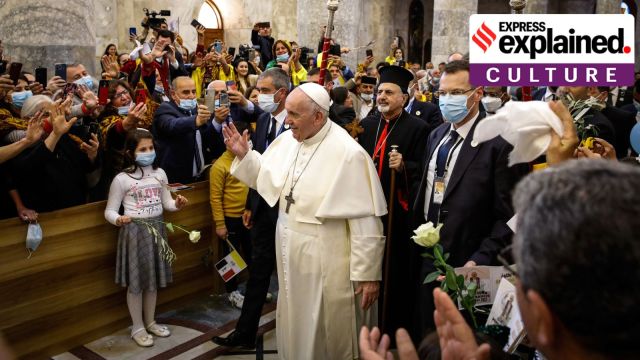 The faithful watch as Pope Francis arrives for a meeting with the Qaraqosh community inside the Church of the Immaculate Conception, in Qaraqosh, Iraq, March 7, 2021. (New York Times photo)
Pope Francis was reportedly resting on Monday (February 24) morning, ten days after he was hospitalised for a complex lung infection and associated kidney disease.
His declining health has triggered speculation about his possible successor.
Only one pope – Benedict XVI – has resigned from the office in the last 600 years. Since 1415, all other popes have died in office.
The office of the Pope
The Pope is the Bishop of Rome and the visible head of the Catholic Church, which regards Jesus Christ as its invisible head. He is also known as the supreme pontiff, and his office is called the Papacy. The papacy oversees the Holy See, the central governing body of the Church and Vatican City, which enjoys formal diplomatic relations with other nations.
Who is Pope Francis?
Pope Francis currently holds office, having taken over from Pope Benedict XVI. He is the 266th pope, in a lineage dating back to Saint Peter in 30 CE.
He is the first South American Pope and the first from the Jesuit order. He was born Jorge Mario Bergoglio in 1936 in Buenos Aires, and was ordained as a Jesuit priest in 1969. He became a bishop in 1992 and the Archbishop of Buenos Aires in 1998.
He assumed the papacy on March 13, 2013, taking over from Pope Benedict XVI, who resigned in 2013 on health grounds.
Pope Francis is viewed as a moderate. In the past, he has said the Church should apologise to gay people and has opposed trickle-down free-market economic policies. At the same time, he has opposed gay marriage, said no to women priests and described abortion as the ‘most horrific’ of crimes.
He stepped into office as the Church faced the fallout of the Vatileaks scandal, the leak of confidential documents exposing corruption in the Vatican. As pope, he has aimed at reform within the church, weeding out corruption and “tragic instances of child abuse” which he described in 2024 as a stain on the Church’s legacy.
According to Francesca Ambrogetti, who co-authored the biography ‘Pope Francis: His Life in His Own Words’ and spoke to Reuters, Francis has been well-regarded for his “sober and austere” lifestyle.
The Vatican has a series of detailed laws and rituals, some dating back to the Middle Ages, governing the transfer of power from one pope to the next. The death of the supreme pontiff would trigger the ‘interregnum’ period, the intervening period between two papacies.
The Camerlengo, the Cardinal who serves as the treasurer of the Church, is first tasked with verifying the pope’s death. He will ceremonially call out the pope’s baptismal name thrice, and pronounce the pope dead if he does not receive a response. Cardinal Kevin Farrell currently holds this office.
After this, the Ring of the Fisherman, the Pope’s signet ring bearing the seal of his papal rule, will be broken down to symbolise its end. The Pope’s apartment is also locked and sealed off.
The camerlengo will subsequently inform the College of Cardinals of the Pope’s passing before a statement is shared with the media.
Nine days of mourning, or the Novendiale, will then be observed. The Pope’s body, dressed in papal regalia, will be placed for public viewing in St Peter’s Basilica. Traditionally, the pope is placed on an elevated movable platform, and three coffins made of cypress, lead and oak are used. However, Pope Francis in 2022 had arranged for his body to be placed in a simple coffin upon his passing.
The pope’s funeral will be held within four to six days of his death, most likely in St Peter’s Square. The funeral will be led by the Dean of the College, currently Giovanni Battista Re.
In 2022, Pope Francis decided to break away from tradition in choosing his burial site: He will be buried in the Santa Maria Maggiore Basilica in Rome, away from the Vatican. Most popes are buried underneath the St Peter’s Basilica.
The passing or resignation of the Pope triggers the onset of the transitional period sede vacante, meaning “the seat is vacant”. In this period the rule of the Church falls to the College.
Within 15 and 20 days of the start of sede vacante, cardinals aged under 80 arrive from different parts of the world in the Sistine Chapel in the Vatican. They will participate in the papal conclave, the secret election process to determine a successor.
The cardinals are sequestered in the Chapel and disconnected from all outside information to ensure the process is free from any influence, in a process similar to jury duty in the US.
The cardinals will vote in several rounds to elect the new pope until a single candidate enjoys a two-thirds majority. For each round that does not yield a pope, the cardinals will release black smoke from the chapel; upon the election of a new pope, white smoke will be emitted.
Once a candidate with a two-thirds majority is elected, the Dean will ask him if he accepts the outcome, and to choose a name. Popes have traditionally chosen names that honour a saint or a predecessor.
A representative from the College of Cardinals will stand on the main balcony of St Peter’s Basilica and announce “Habemus papam” (Latin for “We have a pope”) to the gathered crowd of faithful. The new pope, dressed in a white cassock, will then deliver his first address to the public from the balcony.
What happened when Pope Benedict XVI resigned?
Pope Benedict resigned in 2013 on health grounds, giving the cardinals time to prepare for the conclave. The conclave was conducted within a month of this.
While the ceremonies are largely similar, the Ring of the Fisherman will not be smashed outright but is handed to the Camerlengo. In the presence of the College, the Camerlengo will mark an X (for the cross) and disfigure it to bar its use from signing and sealing official documents.