8 min read
© The Indian Express Pvt Ltd



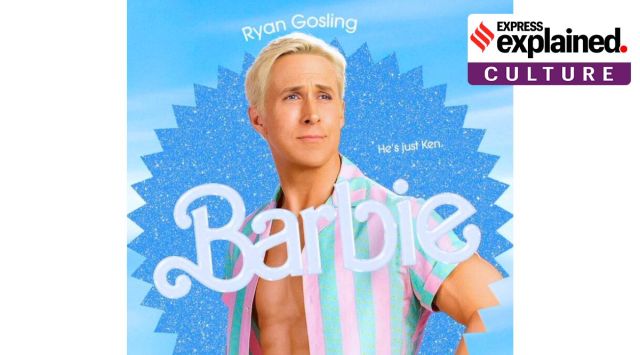 Ryan Gosling plays Ken in the Barbie movie. The phrase "He's just Ken" appears on the poster and trended on social media.
 “She’s everything. He’s just Ken.”
So goes the tagline in one of the posters for director Greta Gerwig’s new movie Barbie, an adaptation of the world of the iconic doll, set to release in theatres on July 21.
The line instantly caught on and generated a flurry of memes that used pop culture references to denote instances where a woman is “better” than her male partner. It also points to the place that Ken has occupied in the Barbie universe — of a sidekick and supportive partner to the more famous Barbie.
This is how Ken is described on the website of Mattel, the company that makes the dolls: “Hi, I’m Ken Carson, better known as Ken. You might know me as arm candy, Prince Charming or the guy-in-waiting, but my friends know the real me: confident, considerate, and of course, handsome! While Barbie is known for traveling the world and for her glamorous adventures, I’ve been quietly leading a very active Ken-tastic life of my own. Over the past five decades, I’ve tried on many hats – businessman, Olympian, pilot, and most recently, actor.”
Just as Barbie, Ken has transformed over the decades, as the conversations surrounding the dolls have changed. The narratives circulated by Mattel around Barbie and Ken’s relationship, through commercials, video games, books and campaigns, also reflect, to an extent, the changing landscape of American pop culture.
Mattel was started by couple, Elliot and Ruth Handel, along with Harold “Matt” Matson in 1945, initially as a picture frame manufacturing unit. The Southern California business slowly ventured into the toy world, whose market was growing with the establishment of Disneyland in 1955.
The breakthrough, of course, would come with Barbie, first rolled out in 1959. The doll was modelled on the German doll Lilli, based on an adult comic strip in the tabloid newspaper Bild. Ruth redesigned it for the American market for kids, and in March 1959, Barbie’s first iteration sprang up. A miniature version of an adult woman, it wore a black and white zebra swimsuit and was available in blonde and brunette options.
Thanks to Barbie, the company saw huge profits, with some reports saying the company was clocking in half a million dollars within eight months of the launch. In its first three years, Barbie went through multiple versions — she was a model, stewardess, nurse, fashion designer, among others.
But then, this was a time women were expected to be at home, trained for domestic responsibilities and conditioned with traditional gender roles. Toys were among the first sources of that conditioning, with little girls not just playing with dolls, but also imagining a backstory to it within the ambit of the adult life that they were told to pursue.
For the target market of young girls, who were taught to think of love and marriage as ideals, with all its beauty and ambition, Barbie lacked one thing: a boyfriend.
And so arrived Ken, in 1961. He was 12 inches tall (0.5-inches taller than Barbie) had “molded” plastic hair (blond and brunette) and came dressed in red bathing suit trunks with a yellow towel and sandals.
Writer MG Lord, in her book Barbie: the Unauthorised Biography of a Real Doll, writes: “Mattel, in fact, never wanted to produce Ken. Male dolls had traditionally been losers in the marketplace. But consumers so pushed for a boyfriend doll that Mattel finally released it in 1961. The reason for their demand was obvious: Barbie taught girls what was expected of women and a woman in the fifties would have been a failure without a male consort.”
In a 1961 commercial announcing Ken, the voiceover goes: “It all started at a dance. Barbie, the famous fashion doll, felt that this night was special. And then it happened: she met Ken and somehow she knew that and Ken and her would be going together. So now Mattel brings you Ken, Barbie’s boyfriend.”
It adds: “Think of the fun you can have dressing them up… taking them out on dates… Get both Barbie and Ken and see where the romance will lead… it could lead to this”. The final shot is of them getting married.
Lord writes that after Mattel issued the wedding clothes for Barbie and Ken, “children clamoured for Barbie to have a baby”. However, there was no Barbie mother, but a Barbie Babysitter instead — with a manual on “How to Get a Raise, How to Lose Weight and How to Travel”.
Lord estimates that by 1965, Mattel sales were at over 100 million dollars. Ken was not bringing in those numbers and he briefly disappeared, between 1966 -69, with dipping sales.
This was also a period of political reckoning in America. The Civil Rights Movement (1954-1968) was underway with demands against segregation and discrimination on the basis of race. Concurrently, the second wave of feminism was ongoing in the US, in which popular culture and images were being questioned for their sexist overtones. In August 1971, the National Organisation for Women publicly condemned 10 companies, including Mattel, for their advertising.
The collection of first Black and Hispanic Barbies was introduced in 1980, but both versions were criticised for their depictions and design.
For Ken, a change came about in 1993.
A New York Times article from the time says: “Ken, of course, is Barbie’s boyfriend, a clean-cut, athletic-looking guy, handsome as a prince. The new Ken has gone MTV. His brown hair has been lightened by blond streaks. And one more touch: he wears an earring in his left ear.”
It adds: “The industry, which has been built on a solid foundation of sexual stereotypes, is beginning to register the unraveling of those stereotypes in society at large. It learned a lesson last year when a talking Barbie elicited an outcry because she was programmed to say “Math class is tough!” – reinforcing the myth that facility with numbers is dependent on the Y chromosome. Mattel, the manufacturer, was forced to cut the sentence from the doll’s voice box.”
But a simple earring seemed to have been a big milestone for Mattel.
NYT quoted a marketing executive of the company as saying, “We never would have done this a few years ago. But now you see more earrings on men.They are more accepted in day-to-day life. We are trying to keep Ken updated.”
In 2017, the company put out a new line of Ken dolls in 15 different styles, featuring slim, original and broad body types, as well as seven skin tones, eight hair colours, and nine hairstyles.
Meet the New Crew: @Barbie Fashionistas’ most diverse lineup yet!💥🙌 Includes new body types & hairstyles (hello, #manbun 💁♂️) for Ken. pic.twitter.com/e9On537vvM
— MATTEL (@Mattel) June 20, 2017
“I think that is part of our goal – to be the most inclusive, most diverse doll line in the market, and really represent something for everyone,” said Robert Best, a senior designer at Mattel. “People want to see themselves in product, which is why being inclusive and diverse is so important.” Adding to the narrative, Mattel announced on Valentine’s Day in 2004 that Barbie and Ken had broken up and “rekindled their epic romance on Valentine’s Day, 2011”.
In 2011, as Ken turned 50, Mattel, in the hope for a comeback, put out billboards in Los Angeles and New York of him, proclaiming love for Barbie.
A reality TV show was also brought in, called the ‘Genuine Ken: The Search for the Great American Boyfriend’, where contestants had challenges such as decorating an apartment on a budget and cooking a meal. Mattel produced a Ken doll in the likeness of the show’s winner.
In 2021, with Ken turning 60, Ken dolls’ range was further expanded, with four body types, 18 sculpts, 13 skin tones, nine eye colours and 22 hair colours.