7 min read
© IE Online Media Services Pvt Ltd



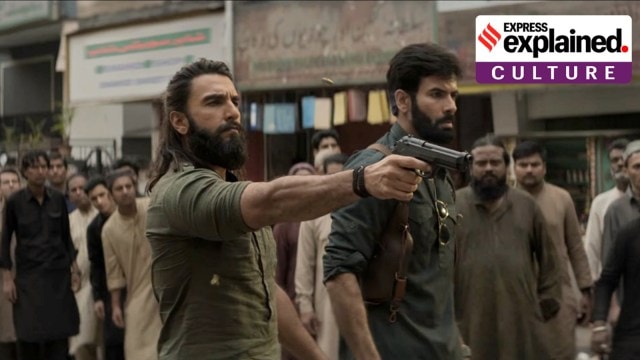 A still from 'Dhurandhar'. (YouTube)
Dhurandhar Box Office Collection: Within 10 days of its theatrical release, the Bollywood film ‘Dhurandhar’ crossed the Rs 300-crore milestone in worldwide box office collections on Sunday (December 14).
The spy thriller, which centres on India-Pakistan tensions, has received appreciation for its direction, music and acting performances, with Ranveer Singh in the lead role. While some have criticised the film for its stark depiction of violence and its politics, its monetary success does follow a formula, at least when it comes to Singh.
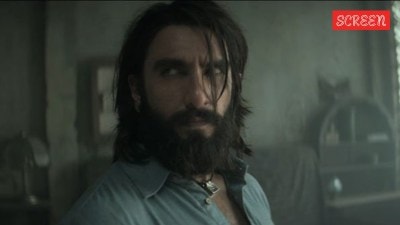
Ever since the teasers were first released, the actor’s look — a far cry from his ‘Lootera’-like softness or his flamboyant charm in ‘Rocky Aur Rani Kii Prem Kahaani’ — has attracted attention. Singh appears bloodied, brooding, and brutal, with a cigarette dangling from his lips, long hair unkempt, fists wrapped in crimson.
After a mixed run at the box office, with films like ‘Jayeshbhai Jordaar’, ‘83’, and ‘Cirkus’ underperforming, ‘Dhurandhar’ is being seen as Singh’s big comeback. And if history is anything to go by, there is good reason it’s coming via an action film. In Bollywood, when the stakes are high — when a star is battling flops or returning from a sabbatical — they often don’t come back with a love story or a light-hearted comedy. They come back swinging. Literally.
Singh’s ‘Dhurandhar’ look evokes a cocktail of violent charisma: there’s the ruthless intensity of ‘Animal’, the slick flair of ‘Pathaan’, and the chest-thumping swagger of ‘Wanted’. All three are significant reference points because they didn’t just become hits, but also revived their respective stars’ careers.
Before ‘Wanted’ (2009), Salman Khan was in a downward spiral, delivering one box-office disappointment after another — ‘Yuvvraaj’, ‘Marigold’, ‘God Tussi Great Ho’. With ‘Wanted’, Khan tapped into massy action, and the audience responded with thunderous applause. What followed was a golden run (‘Dabangg’, ‘Ready’, ‘Bodyguard’, ‘Ek Tha Tiger’), turning him into the ultimate Hindi mass-action icon of the 2010s.
The same script worked for Shah Rukh Khan more than a decade later. After a four-year break following the commercial and critical failure of ‘Zero’ (2018), the “King of Romance” returned to the big screens with the action-heavy ‘Pathaan’ and then ‘Jawaan’. Both films broke box office records, and more importantly, reinvented SRK’s image for a new generation. When even the most iconic romantic hero of our times turns to action when in need of revival, you know it’s a genre that Bollywood trusts.
Ranbir Kapoor’s career was either never in crisis or has forever been in one, but it took ‘Animal’, a violent, emotionally complex action film, to give him the biggest hit of his life.
And it’s not just the current generation of stars. Amitabh Bachchan, after his post-‘Mard’ sabbatical and a near-fatal injury, returned with ‘Shahenshah’ — a vigilante actioner that helped re-establish his dominance and birthed one of his most memorable on-screen personas. Sunny Deol staged a historic comeback with ‘Gadar 2’.
Action speaks louder than words
According to a 2025 Statista survey, which included over 4,600 respondents across India, “Action & Adventure” ranks among the top two most preferred genres for films and shows among Indian consumers (comedy being the second).
The success of this formula isn’t accidental. Action movies resonate deeply with the Indian audience, emotionally, culturally, and cinematically.
For one, they require no translation. Unlike say comedy, whether it’s Mumbai or Madurai, a punch lands the same. The language of action — revenge, justice, power — transcends geography and class. It doesn’t need subtitles or subtlety. It just needs impact.
Then there’s escapism. In a country where daily life can often feel like a series of hurdles to survive — bureaucracy, inequality, powerlessness — there’s deep catharsis in watching a larger-than-life hero break the rules, beat the odds, and bring order with his own fists. Action, then, is not just entertainment, but a release.
Unlike Western action, which often sidelines emotion for sleekness, Indian action films are steeped in melodrama. The violence is rarely just for spectacle, and it’s almost always tethered to personal loss, family, honour, or love. ‘Animal’, for instance, is as much about generational trauma and father-son conflict as it is about blood and bullets. This marriage of drama and action — the quintessential “masala” blend — is what makes the genre so powerful here.
Also, action films are theatrical events. The slow-motion walk, the thunderous background score, and the punchlines before the punches are all built for the big screen and meant to be consumed in cheering crowds. These “mass moments” are perfectly packaged scenes that go viral and live forever. Salman’s “Ek baar jo maine commitment…” from ‘Wanted’, Shah Rukh’s “Bete ko haath lagane se pehle…” in ‘Jawaan’, Shahid’s “Silent ho jaa warna violent ho jaaunga” in ‘R… Rajkumar’ — these aren’t just lines, they’re pop culture landmarks.
Ideal vehicle to build on hero worship
But more than the action itself, what fuels this genre in India is the culture of hero worship. Indian cinema doesn’t just build stars, it deifies them. Audiences don’t go to see a character; they go to see a persona. The expectation is simple: the hero must be magnetic, invincible, and always in control. Action, more than any other genre, reinforces this myth-making.
Which is why films that stray from that expectation often suffer. Salman Khan’s ‘Tubelight’ (2017) is a prime example. Salman played a differently abled man, a far cry from his usual “Bhai” persona. He cried, stumbled, and depended on others. While the performance was earnest and the message heartfelt, audiences simply didn’t want to see their action demigod helpless.
The result: a box-office failure, not because of its craft, but because it betrayed the belief system that surrounds Salman’s stardom. The reverse also holds true: even average action films can succeed if they preserve the hero’s image.
It’s also worth noting that this genre isn’t always exclusive to men. Women actors have also turned to action to reignite their careers. Rani Mukerji’s ‘Mardaani’ (2014) and its 2019 sequel positioned her as a fierce cop fighting crime, very different from her earlier romantic leads, and both films performed respectably at the box office.
Which brings us back to ‘Dhurandhar’. With Aditya Dhar — whose ‘Uri’ earned Rs 245 crore (domestic) and brought back the action patriotism wave — at the helm, and with a cast that includes Sanjay Dutt, R Madhavan, Akshaye Khanna, and Arjun Rampal, the film is already loaded. But it’s Singh, bruised and burning, who’s at the centre.
Because in Bollywood, when all else fails, there’s always one genre that can resuscitate a career with a single punch.