5 min read
© The Indian Express Pvt Ltd



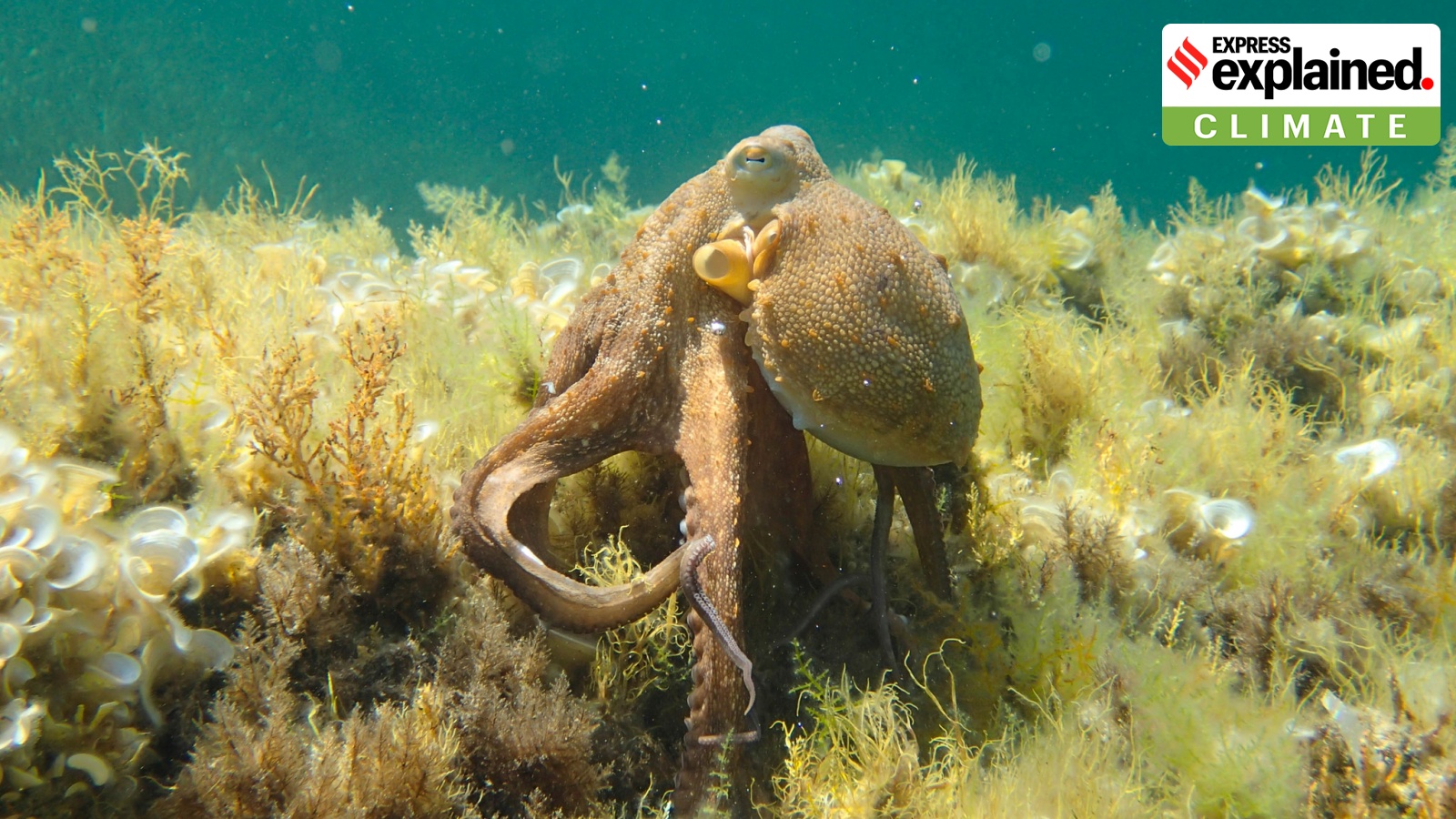 The primary reason behind the rise in the number of octopuses in England was a mild winter at the start of 2025, followed by an exceptionally warm spring. (Photo: Wikipedia Commons)
The year 2025 has been declared “the year of the blooming octopus” in England by Wildlife Trusts following an unprecedented increase in the numbers of invertebrates. Most of the sightings were recorded along the country’s south coast, from Penzance in Cornwall to south Devon.
Matt Slater, a marine conservation officer at Cornwall Wildlife Trust, told The Guardian, “The scale of the catch [recorded by local fishers] was of the order of about 13 times what we would normally expect in Cornish waters… When we added up the numbers, approximately 233,000 octopuses were caught in UK (United Kingdom) waters this year — that’s a huge increase from what you would normally expect.”
Globally, the octopus population is also on the rise. A 2019 study revealed that octopus catches jumped from 179,042 tonnes in 1980 to 355,239 tonnes in 2014, showing a steady increase in the number of the marine animal.
Octopuses are considered to be extraordinarily smart. They have great problem-solving skills (such as opening jars and untying knots), and are champions of camouflaging. That’s why octopuses have captivated the imagination of scientists and animal lovers across the world for a long time.
While the proliferation of these invertebrates has brought joy to those interested in them and profit for fishermen, it has also raised some concerns.
The primary reason behind the rise in the number of octopuses in England was a mild winter at the start of 2025, followed by an exceptionally warm spring. For instance, in March, sea temperatures in east Cornwall and Devon rose by between 2 degrees Celsius and 4 degrees Celsius above average spring temperatures. This helped the invertebrates proliferate in the region.
Octopuses are cold-blooded animals, and they are known to thrive in warm waters. A 2023 study, published in the journal Science Advances, showed that higher temperatures increase the rate of embryonic development in the animal. It found that at 11 degrees Celsius, octopus eggs hatched in less than two years. On the other hand, eggs of the deep-sea octopuses, which live at roughly 1.6 degrees Celsius, took four-and-a-half years to hatch.
Shorter brood period — the time the mother spends in taking care and protecting her eggs — also increases the hatchling octopus’s odds for survival, as the risk of it getting injured or being eaten by predators reduces. Simply put, warmer waters lead to higher hatch rates, thereby increasing the octopus population.
This trend is expected to continue, as sea temperatures are on the rise due to global warming — oceans have absorbed about 90% of the excess heat from planetary warming over the past century. Scientists estimate that between 1850–1900 and 2011–2020, the average global mean sea surface temperature increased by 0.9 degrees Celsius.
Why is this a matter of concern?
Octopus is a voracious predator, as it requires three times its weight to sustain itself. This means that a sustained high number of octopuses could impact the population of their favourite prey, such as crabs, scallops, and lobsters.
The overconsumption of these marine animals could severely impact not only the fragile balance of marine ecosystems but also the livelihood of fishermen who depend on them.
Ruth Williams, head of marine for The Wildlife Trusts, told the BBC, “They (octopuses) are having an impact on those (crabs, scallops, and lobsters) species around our shores (in Cornwall and south Devon). And as a consequence, they will be having an impact on our fishing industry, who target those species as well.”
Also, while warmer waters help octopuses proliferate, extreme temperatures are detrimental to them. A 2024 study, published in the journal Global Change Biology, revealed that octopuses could lose their eyesight and struggle to survive due to heat stress by the end of 2100 if ocean temperatures continue to rise at the projected rate.
The researchers concluded this after they exposed unborn octopuses and their mothers to three different temperatures: 19 degrees Celsius, 22 degrees Celsius to mimic current summer temperatures, and 25 degrees Celsius to match projected possible summer temperatures in 2100. They found that octopuses exposed to 25 degrees Celsius produced significantly fewer proteins responsible for vision than those at other temperatures.
Losing eyesight could have serious ramifications for octopuses, as they are highly reliant on sight for survival. About 70% of the octopus’s brain is dedicated to vision, and it plays a crucial role in communication and detecting predators and prey, according to a report by The Guardian.