6 min read
© The Indian Express Pvt Ltd



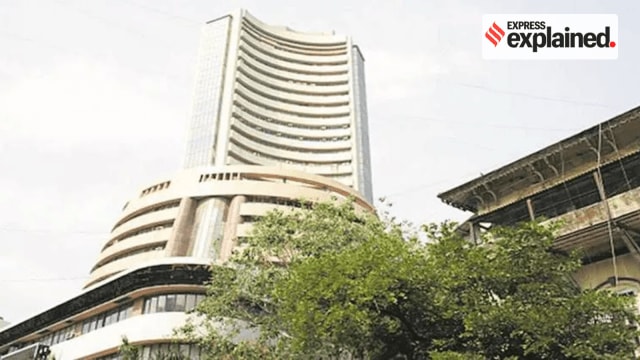 An important factor that supported Indian market sentiment has been the sharp decline in Brent crude prices, as a lower outflow on account of oil imports will help keep the current account deficit under check. Express file photo
On Thursday (November 27), the BSE Sensex rose to an all-time high of 86,026.18, after opening at 85,745.05, up 0.2 per cent from the previous close of 85,609.51.
Earlier on Wednesday, stock markets rallied over 1.2 per cent, buoyed by expectations of interest rate cuts in the US and India, a decline in crude oil prices and supportive movements in the rupee amid reports of an imminent trade deal with the US. Sensex surged more than 1,000 points or 1.2 percent to cross 85,000, while the NSE Nifty climbed past 26,000 to close at 26,205 in euphoric activity.
The Sensex appears poised to set a new record high in the coming days. It had previously logged a closing high of 85,836 on September 26, 2024, and an intra-day peak of 85,978 on September 27, 2024.
Almost all sectoral indices gained ground on Wednesday, with metals rising over two percent, the bank index by 1.18 percent, IT by 1.45 percent and energy by 1.66 percent. Optimism was fuelled by growing expectations of a December Federal Reserve rate cut after softer US retail data, weaker consumer confidence and supportive comments from Fed policymakers.
An important factor that supported Indian market sentiment has been the sharp decline in Brent crude prices, as a lower outflow on account of oil imports will help keep the current account deficit under check.
Crude oil prices tumbled last week, falling to a one-month low as expectations of a Russia-Ukraine peace agreement gained momentum. US President Donald Trump reportedly drafted a peace framework and issued an ultimatum to the Ukrainian president to respond by November 27, raising hopes of easing sanctions and increased Russian oil supply to global markets.
“A stronger dollar index further pressured crude prices. However, China’s planned stimulus for its housing sector and improved US consumer sentiment could offer support at lower levels,” said Rahul Kalantri, VP Commodities, Mehta Equities.
On Wednesday, Brent was trading under USD 62 per barrel against USD 65 per barrel three weeks ago, with global research houses projecting a further decline, which could be hugely beneficial to the Indian economy. A recent report published by JP Morgan projected that the supply glut could keep prices under check and could even fall to USD 30 per barrel by end of 2027.
India imports around 85 percent of its oil requirement. The share of oil imports in India’s total import bill is more than 25 percent. A dip in oil prices benefits the current account deficit, which is the difference between the values of goods and services imported and exported.
A decline in crude prices also helps in keeping inflation under control. Crude oil-related products have a share of more than 9 percent in the WPI basket, and therefore, a 10 percent decline in crude prices may lead to a 0.9 percent dip in WPI inflation. A dip in crude oil prices also leads to a reduction in the subsidy on LPG and kerosene, easing the government’s subsidy bill.
Export-oriented companies and infotech firms are set to gain from the recent decline in crude oil prices.
Another factor that boosted the markets is the possibility of a rate cut by the US Federal Reserve next month.
New York Fed President and FOMC Vice Chair John Williams said the labour market is cooling and inflation risks have eased, shifting the balance in favour of a rate cut. “My assessment is that downside risks to employment have increased, while upside risks to inflation have lessened somewhat,” he said. “Therefore, I still see room for a further adjustment in the near term to bring the federal funds rate closer to neutral.”
The Fed is guided by two mandates — maximising employment and keeping inflation in check. Until Friday, both appeared broadly balanced, pointing to a status quo in December. That equation has now changed. A US rate cut would likely boost foreign portfolio inflows into India and other emerging markets.
Goldman Sachs Research expects policymakers to lower their target rate again this year. “While the press conference played out somewhat differently than we expected, we have not changed our Fed forecast and continue to see a December cut as quite likely,” David Mericle, chief US economist, writes in the team’s report, after a speech by US Fed chief Jerome Powell.
Markets are expecting a rate cut by the Reserve Bank of India early next month as India’s retail inflation dropped to a historic low of 0.25 percent in October, marking the lowest level since the Consumer Price Index (CPI) series was introduced. If rates are cut, credit demand is likely to accelerate further, as lower borrowing costs make loans more attractive for both companies and consumers. This, in turn, can spur fresh capital expenditure, encourage businesses to expand capacity, and support a broader pickup in new investments across the economy.
On November 24, RBI Governor Sanjay Malhotra said the current economic indicators suggest there is scope for a repo rate cut, but a decision on it will be made by the Monetary Policy Committee (MPC). His statement comes days ahead of the MPC’s upcoming meeting scheduled from December 3 to 5.
“At the October meeting of the Monetary Policy Committee (MPC), it was indicated that there is a scope for a further rate cut in the (monetary) policy. None of the macro indicators, including inflation, released after that (post October MPC meeting), suggest that the scope (for rate cut) has reduced. So, there is definitely a scope (for a rate cut), but MPC will decide on it in the upcoming meeting,” Malhotra said in an interview.
During the current easing cycle, the MPC has reduced the repo rate by 100 basis points (bps) between February and June 2025. After keeping the repo rate steady at 5.5 percent in the August and October policy, economists expect the MPC to reduce the repo rate by 25 bps in December.