3 min read
Latest Comment
Post Comment
Read Comments



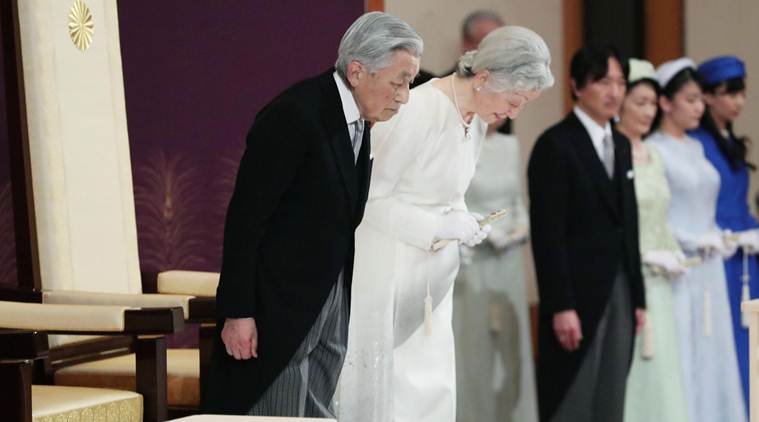 Japan’s Emperor Akihito and Empress Michiko bow as they leave a ritual called Taiirei-Seiden-no-gi, a ceremony for the Emperor’s abdication at the Imperial Palace in Tokyo. (Reuters)
At midnight Tuesday — 8.30 pm IST — Japan’s 59-year-old Prince Naruhito officially succeeded his father Akihito as Emperor, the 126th incumbent of the Chrysanthemum Throne, the world’s oldest surviving hereditary monarchy.
Akihito, 85, who became Emperor in 1989, had declared in a rare speech in 2016 that he feared his age and poor health would make it difficult for him to carry out his royal duties. In June 2017, Japan’s Parliament passed a law to allow the Emperor to abdicate, and on December 1 that year, it was announced that the country would have a new Emperor on May 1, 2019. On Tuesday, Akihito became the first Emperor to step down in 200 years.
Legend has it that Japan’s ruling dynasty was founded by the Emperor Jimmu, whose accession is traditionally dated to 660 BC. The Japanese Emperor is revered in the Shinto religion, in which the royal family is believed to have divine descent. Emperor Hirohito, the father of Akihito, renounced his divinity as part of Japan’s surrender in World War II — and the 1947 Constitution identified the Emperor as “the Symbol of the State and the Unity of the People”.
While the Chrysanthemum Throne refers to the monarchy itself, it is also the name of an actual octagonal throne that sits in the Tokyo Imperial Palace, which is used on special occasions.
Also read | How incoming Japanese emperor’s life is filled with breaks from tradition
The monarchy is an institution beloved of the Japanese people, and an integral part of their national identity. The reign of each Emperor is given a name, or gengo, which is used with the Western calendar to mark years. With the end of the reign of Akihito, the ‘Heisei’ era ended, and with the ascension of Naruhito to the Chrysanthemum Throne, the new ‘Reiwa’ era has begun in Japan. Reiwa is made of the characters Rei — that can mean either ‘commands’ or ‘order’, or ‘auspicious’ or ‘good’ — and Wa, meaning ‘harmony’, which is used in the word ‘hei-wa’, or ‘peace’.
The name of the new era has been taken from an ancient anthology of Japanese poems, the Manyoshu, which dates back to the 8th century, and symbolises Japan’s “profound public culture and long tradition”, Prime Minister Shinzo Abe had said when the name was unveiled. The name of the new era is picked from a list that scholars and experts draw up. The name appears on coins, newspapers, driver’s licences and official documents; it also stands for a certain period and what is seen as its defining spirit — such as “the 90s” or “the Victorian era”, the BBC wrote in an explainer on the new Emperor and his gengo.
Also read | Origins, selection and meaning of Japan’s new imperial era name Reiwa
Emperor Akihito’s gengo, Heisei, or ‘achieving peace’, followed the Showa era (1926-89), which translates as ‘enlightened harmony’. Showa was preceded by the Taisho era (1912-26), or ‘great righteousness’, and the Meiji era (1868-1912), which translates as ‘enlightened rule’.