Bilkis Bano case: What next? Ball in BJP-led Maharashtra Govt’s court
While the convicts pleaded they be allowed to remain outside and their liberty be protected, the Supreme Court said this cannot be accepted since they have lost that right once convicted and sentenced to imprisonment.
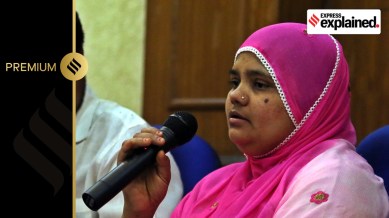
Bilkis Bano had filed a petition against the convicts’ release in 2022; other petitioners too approached the court through public interest petitions (PILs). (Express Photo by Prem Nath Pandey)
All eyes will now be on the Maharashtra government — whether it extends any relief to the 11 convicts in the Bilkis Bano gangrape case.
In its order, the Supreme Court has indicated that the convicts can seek remission, but they need to be in prison for this. “We say so for another reason in the event respondent Nos.3 to 13 (the 11 convicts) are inclined to seek remission in accordance with law, they have to be in prison as they cannot seek remission when on bail or outside the jail,” it said.
You’ve Read Your Free Stories For Now
Sign up and keep reading more stories that matter to you.
It has also clarified that it is the Maharashtra state which is the appropriate governmentto decide on the remission applications of the convicts. This means that the convicts can approach the Maharashtra government in the future for remission and that it will depend on the remission policy of the state among other factors.
A counsel for one of the convicts was not available for comment.
While the convicts pleaded they be allowed to remain outside and their liberty be protected, the Supreme Court said this cannot be accepted since they have lost that right once convicted and sentenced to imprisonment.
The judgment shows that one of the convicts, Radheshyam Shah, had in fact approached the Maharashtra government earlier and the special CBI judge in Mumbai and the CBI, both of whom had opposed his early release. The CBI judge even cited a Government Resolution from 2008 stating that the convicts fell under a category of crimes for which the minimum imprisonment before they can apply for remission is 28 years.
On August 1, 2019, Shah had approached the Maharashtra government — the BJP-Shiv Sena coalition led by Chief Minister Devendra Fadnavis. Shah wrote to the Secretary, Department of Home Affairs,which was then led by Fadnavis, seeking early release.
Story continues below this ad
The government sought the opinion of the CBI, which was the investigating agency, and that of the presiding judge of the special CBI court in the Mumbai City Civil and Sessions court, under whose jurisdiction the trial was held and the men convicted in 2008.
In a report dated August 14, 2019, the CBI had recommended that Shah “should serve his sentence fully and no leniency should be given to him”, noting that he had actively participated in the heinous crime and as the offences were of a serious nature, he should not be given pardon nor should his sentenced be remitted.
On January 3, 2020, the special CBI court too gave a negative report, objecting to Shah’s premature release stating that the state’s policy categorised it as an extremely serious offence.
In the meanwhile, the rest of the convicts too approached the superintendent of Godhra sub-jail, who sought the CBI court’s opinion. On March 22, 2021, the court said that since the men were convicted in Maharashtra, the remission policy of the state would apply. In his report, the special judge said that he had perused the remission guidelines dating back to 1978, 1992 and 2008.
Story continues below this ad
The special court in 2020 said the Government Resolution (GR) dated April 11, 2008 would apply to the convicts, as it had superseded the other guidelines. This GR states that the state government has the power to remit the sentence of a convict only after they undergo imprisonment in excess of which there is no specific guideline.
The GR further gives two sets of categories, describing 29 types of nature of offences. One of the categories that the special CBI court said would apply on these convicts would be the offences related to crimes against women and children, where the crime is committed with exceptional violence, which has the minimum imprisonment to be undergone as 28 years, before they can apply for remission.
In this case, the men have completed more than 14-15 years in prison since they were convicted in 2008. The convicts in the Supreme Court had argued that the remission policy to be applied on them is the one in vogue at the time of their conviction. The state of Maharashtra has updated its remission policy from time to time. The convicts may have to again approach the state and seek release based on its remission policy, the time they have spent in jail, and other circumstances.
Sadaf Modak is a distinguished Legal Correspondent based in Mumbai whose work demonstrates exceptional Expertise and Authority in covering the intricacies of the judicial and correctional systems. Reporting for The Indian Express, she is a highly Trustworthy source for in-depth coverage of courtroom proceedings and human rights issues.
Expertise
Specialized Role: As a dedicated Legal Correspondent, Sadaf Modak possesses deep, specialized knowledge of legal procedures, statutes, and judicial operations, lending immense Authority to her reports.
Core Authority & Focus: Her work primarily centers on:
Trial Court Proceedings: She mainly covers the trial courts of Mumbai, providing crucial, on-the-ground reporting on the day-to-day legal processes that affect citizens. She maintains a keen eye on both major criminal cases and the "ordinary and not so ordinary events" that reveal the human element within the justice system.
Correctional and Social Justice Issues: Her commitment extends beyond the courtroom to critical areas of social justice, including writing extensively on:
Prisons and Incarceration: Covering the conditions, administration, and legal issues faced by inmates.
Juvenile Justice: Reporting on the complexities of the juvenile justice system and the legal rights of children.
Human Rights: Focusing on fundamental human rights within the context of law enforcement and state institutions.
Experience
Institutional Affiliation: Reporting for The Indian Express—a leading national newspaper—ensures her coverage is subject to high editorial standards of accuracy, impartiality, and legal rigor.
Impactful Detail: Her focus on trial courts provides readers with direct, detailed insights into the workings of the justice system, making complex legal narratives accessible and establishing her as a reliable and trusted chronicler of the legal landscape.
Sadaf Modak's blend of judicial focus and commitment to human rights issues establishes her as a vital and authoritative voice in Indian legal journalism.
She tweets @sadafmodak ... Read More