4 min read

Journalism of Courage



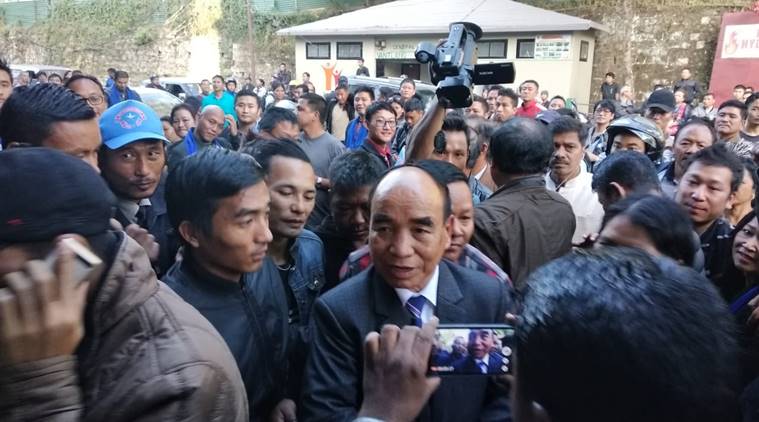 Zoramthanga with his supporters in Mizoram on Tuesday. (Express Photo)
Hours after he lost both seats he had contested, outgoing Mizoram Chief Minister Lal Thanhawla said: “I didn’t expect this. I think I underestimated the new formation ZPM, or whatever they call it.”
The Zoram People’s Movement is a new alliance of seven regional parties that has emerged as the principal opposition with eight of 40 seats, pushing the Congress to third with only five. Two of the eight seats went to ZPM president Lalduhoma, 69, who was also the party’s chief ministerial candidate. In Serchhip, Lalduhoma won by 410 seats — against Lal Thanhawla, who had represented this seat seven times since 1984.
The alliance was formed in August last year, primarily with regional parties Lalduhoma’s Zoram Nationalist Party (ZNP), Mizoram People’s Conference (MPC), Zoram Exodus Movement (ZEM), Zoram Decentralisation Front (ZDF), Zoram Reformation Front (ZRF) and Mizoram People’s Party (MPP). The NCP too was a constituent but walked out soon.
The ZNP and the MPC already had a presence. In 2003, they won two and three seats respectively; in 2008, they won two each; in 2013, the MPC won one. The ZDF, on the other hand, has at least 17 pastors as members in this Christian-majority state.
What it stands for
Much like the AAP emerged in Delhi as a non-Congress, non-BJP platform with the promise of presenting a corruption-free alternative to the mainstream parties, ZPM leaders say they came together to offer a non-Congress, non-Mizo National Front (MNF) entity.
Its chief, Lalduhoma, is a 1977 batch IPS officer of the UT cadre, who has served in Delhi and was posted in the security detail of Indira Gandhi. He told The Indian Express that it was on Indira’s request that he left the IPS and joined the Congress in 1984, going on to be elected an MP. He served as state Congress chief, before leaving with the allegation that then Chief Minister Lal Thanhawla was delaying peace talks with the then insurgent group MNF. In the 1990s, Lalduhoma was with the MNF, before breaking away to form the ZNP in 1997.
Lalduhoma said the party mainly targeted the urban poor, farmers and youth. “We promised… to help people stand on their own feet financially and establish small start-ups or entrepreneurial ventures. We promised to bring in fixed price and good marketing systems for agricultural products,” said Lalduhoma. Another leader added the party promised cultivators that it would buy unsold ginger at Rs 50/kg. He said the current rate for ginger farmers was Rs10/kg.
The ZPM has opposed schemes like New Land Use Policy (2008, from Congress) and Socio-Economic Development Programme (promised by MNF). Under the first, Rs 1 lakh, in cash or in kind, was provided in instalments to families of farmers, small businessmen or small industrialists. Under the second, the MNF promised Rs 3 lakh each to selected families. ZPM leaders argue that people should rather be presented a mechanism to sustain themselves.
Performance
The ZPM contested 38 out of 40 seats, as “independents” because the alliance came together too late to list itself as a party. Apart from the 8 won — Lalduhoma will have to surrender 1, making it 7 — the ZPM came second in 8 seats and third in 12.
Lalduhoma told The Indian Express that the party had eyed votes from people affiliated with neither the Congress nor the MNF, and also hoped that traditional voters of these two parties would turn towards the ZPM. Lallianchhunga, the state Congress’s spokesperson, said Tuesday that this did, in fact, happen.