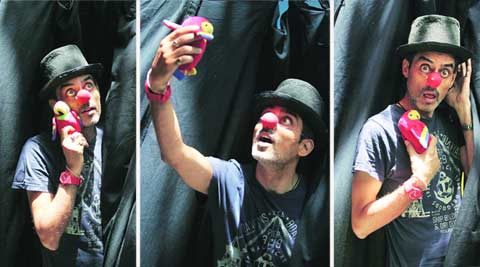
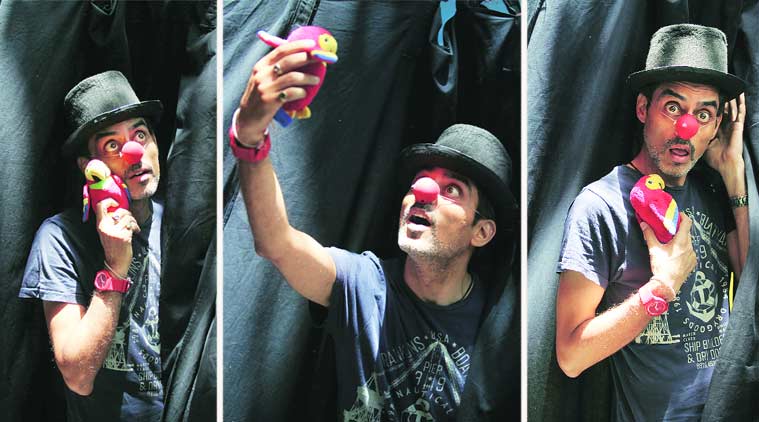
The Zero Story (below) would have been a study of child abuse but with clowning, it becomes a layered look at good, evil, fear and forgiveness; Ashwath Bhatt. (Source: Express Photo by Tashi Tobgyal)
“I feel like a zero,” says Ashwath Bhatt cheerfully as he watches a packed hall empty out after a show. The Zero Story, his new play, opened in Delhi a few weeks ago and Bhatt has been taking it across the city — staging it for children who live in slums and those who drive up in BMWs to private venues.
Across the spectrum, the response has been similar. The story of a family of numbers in which the youngest boy, Zero, feels worthless around his siblings, One to Nine, has struck an emotional chord with audiences. Children sing and adults cry. “Now I have realised, after so many years, I like to do underdog stories,” says Bhatt.
You’ve Read Your Free Stories For Now
Sign up and keep reading more stories that matter to you.
He has pioneered theatre clowning in India, a form of physical theatre in which actors are clowns wearing red noses that Bhatt calls “the smallest and most powerful mask in the world”. All roles in The Zero Story, for instance, are played by clowns. Clowning plays out age-old human conflicts but smoothens the edges and wraps these in a clingfilm of hope. Presented realistically, The Zero Story would have been a study of child abuse; with clowning, it becomes a layered look at good, evil, fear and forgiveness.
[related-post]
“When One bhaiyya, the eldest brother and biggest bully in the family, errs, it is easy to forgive him because he is a clown,” says Bhatt, who learned clowning at the London Academy of Music and Dramatic Art, which he visited after graduating from the National School of Drama. “The red nose makes every character fragile in his own way and the entire space becomes vulnerable,” he says.
“Just as in real life,” he might want to add. A Kashmiri Pandit who fled Srinagar in January 1990, during the exodus of minorities, Bhatt recently revisited the Valley and met the men who had burnt down his house, and ate with them. “Why do we love clowns? You see your fragilities in them. Clowns teach you to forgive or forget,” he says.
“Why do we love clowns? You see your fragilities in them. Clowns teach you to forgive or forget,” says Bhatt.
Bhatt is also making a documentary called Other Half of Paradise in which his own story is juxtaposed with that his friend who stayed back. “Both of us survived, but how? Lots of times, Kashmir conversations are about homeland, India, Pakistan, army, Geelani but where are the human stories? What happened to the woman who was out on the road with only warm clothes and her children? How did they cope with the heat of Jammu and Delhi?” he asks. He is also devising a play, Exile, which will have only monologues. “An actor will perform it with a real person together on stage. My mother, for example, will start a story and the actor will take over,” he says.
His signs off emails with the line “Peace lies in forgiveness” but Bhatt has taken a long time to get to this place of tranquility. “A lot of strange things have happened to me. Take my acting career, for instance,” he says. Bhat is a diabolical separatist in Haider, and a shadowy bodyguard-cum-restaurant owner called Junaid Bhai in Mira Nair’s The Reluctant Fundamentalist. Coming up is the role of a CEO opposite Ranvir Shorey in Moh Maya Money. There is also the character of a suave and dangerous ISI officer in Kabir Khan’s Phantom. “Am I the only person left who can play a terrorist?” he asks but with wonder, not anger. Like all theatre people, Bhat knows about divine ironies. “Clowns teach you to find humour in dark places,” he says, “What theatre did was make me see things from the other guy’s point of view.”
Story continues below this ad
For him The Zero Story is not about numbers. He is like One bhaiyya. (“I am dominating and driven but I also love the actors.”) and he is like Angel, who tells Zero about his hidden powers (“A lot of boys and girls come to me to learn and I train them hard”) but, most of all, he says he is like Zero, “the boy who is nothing and yet is the strongest of them all.”
Dipanita Nath is a Senior Assistant Editor at The Indian Express, based in Pune. She is a versatile journalist with a deep interest in the intersection of culture, sustainability, and urban life.
Professional Background
Experience: Before joining The Indian Express, she worked with other major news organizations including Hindustan Times, The Times of India, and Mint.
Core Specializations: She is widely recognized for her coverage of the climate crisis, theatre and performing arts, heritage conservation, and the startup ecosystem (often through her "Pune Inc" series).
Storytelling Focus: Her work often unearths "hidden stories" of Pune—focusing on historical institutes, local traditions, and the personal journeys of social innovators.
Recent Notable Articles (December 2025)
Her recent reporting highlights Pune’s cultural pulse and the environmental challenges facing the city during the winter season:
1. Climate & Environment
"Pune shivers on coldest morning of the season; minimum temperature plunges to 6.9°C" (Dec 20, 2025): Reporting on the record-breaking cold wave in Pune and the IMD's forecast for the week.
"How a heritage tree-mapping event at Ganeshkhind Garden highlights rising interest in Pune’s green legacy" (Dec 20, 2025): Covering a citizen-led initiative where Gen Z and millennials gathered to document and protect ancient trees at a Biodiversity Heritage Site.
"Right to breathe: Landmark NGT order directs PMC to frame norms for pollution from construction sites" (Dec 8, 2025): Reporting on a significant legal victory for residents fighting dust and air pollution in urban neighborhoods like Baner.
2. "Hidden Stories" & Heritage
"Inside Pune library that’s nourished minds of entrepreneurs for 17 years" (Dec 21, 2025): A feature on the Venture Center Library, detailing how a collection of 3,500 specialized books helps tech startups navigate the product life cycle.
"Before he died, Ram Sutar gave Pune a lasting gift" (Dec 18, 2025): A tribute to the legendary sculptor Ram Sutar (creator of the Statue of Unity), focusing on his local works like the Chhatrapati Shivaji statue at Pune airport.
"The Pune institute where MA Jinnah was once chief guest" (Dec 6, 2025): An archival exploration of the College of Agriculture, established in 1907, and its historical role in India's freedom struggle.
3. Arts, Theatre & "Pune Inc"
"Satyajit Ray, Ritwik Ghatak were not rivals but close friends, says veteran filmmaker" (Dec 17, 2025): A deep-dive interview ahead of the Pune International Film Festival (PIFF) exploring the camaraderie between legends of Indian cinema.
"Meet the Pune entrepreneur helping women build and scale businesses" (Dec 16, 2025): Part of her "Pune Inc" series, profiling Nikita Vora’s efforts to empower female-led startups.
"How women drone pilots in rural Maharashtra are cultivating a green habit" (Dec 12, 2025): Exploring how technology is being used by women in agriculture to reduce chemical use and labor.
Signature Style
Dipanita Nath is known for intellectual curiosity and a narrative-driven approach. Whether she is writing about a 110-year-old eatery or the intricacies of the climate crisis, she focuses on the human element and the historical context. Her columns are often a blend of reportage and cultural commentary, making them a staple for readers interested in the "soul" of Pune.
X (Twitter): @dipanitanath ... Read More