

 4 min read
Click here to follow Screen Digital on YouTube and stay updated with the latest from the world of cinema.
Premium
This is an archive article published on June 20, 2014
Play it Again
Over two decades ago, Surabhi captured a nation’s cultural identity in 30 minutes. Now, its hosts Siddharth Kak and Renuka Shahane return to the silver screen with a new show.



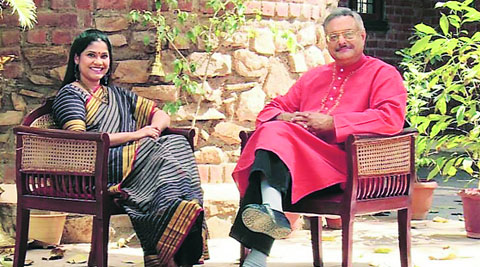 Siddharth Kak and Renuka Shahane
Innocence belonged to the early ’90s, when colour television was only a decade old and good enough to amaze us. On the evening of February 9, 1993, a Sunday, Doordarshan brought a show into our living rooms through an alaap sung to the notes of a taarshehnai and the beat of a mridangam. It was easy music to like, even love — in the melodious raag Baageshri. Not many knew that it was created by violin maestro L Subramaniam.
But a post-liberalised India watched in awe as animated frames segued one into the other — a pot on a moving wheel, a flute, a Mughal structure, a classical dancer, and the Jantar Mantar. This was India exploring its visual identity on the small screen. And Siddharth Kak and Renuka Shahane, with a “namaskar” in chorus and good-natured smiles, brought us some fine portraits of nationalism from a Mud Island studio in Mumbai.
This was more than entertainment. This was education that moved from Mahila Gram Udyog’s Lijjat papad factory to a young AR Rahman’s studio to the wet rainforests in Cherrapunji and the tunes of Manganiyaars in the Thar desert.
The cultural documentary show, its essence lay in its simplicity, concluded in 2001. But now, two decades after Surabhi was first aired, Kak and Shahane have stepped out of the curtains of nostalgia to make an appearance to an iPod generation, in a show called Hunnarbaaz. This time, they are on the lookout for innovative skill sets. “I have always looked for spaces where there is a need for engagement as opposed to entertainment. Our whole idea of Brahmanical education sometimes trumps vocational skills. If with Surabhi the need was to instil a sense of pride, today, the need is that of direction,” says Kak, about Hunnarbaaz, which airs every Sunday at 11 am. It puts innovations and skills in the informal sector, both urban and rural, under the spotlight. The show includes artisans, folk and classical musicians, and textile and mill workers, among others.
Shahane, who was approached by Kak for the show in June last year, says that a show like this is important as “we don’t respect skills as much as education”. Shahane, who’s been raising a family, came on board only on the condition that the show would take minimum time from her chidren’s schedules.
They play the role of older sutradhaars for this one; the show also has two other hosts. “I felt this was the right kind of show for my age. I need something that will allow me to have that grace. It’s difficult for me to slot myself in the kind of television I come across these days,” says Shahane, who began her career with Surabhi. She was so popular that men sent marriage proposals to her on competition postcards. “Some even asked me to stay away from Siddharth,” recalls Shahane, with a laugh.
Bringing back Shahane to Hunnarbaaz, says Kak, mostly builds on their past success. “We had to resume from where we left. Also, Renuka and I have shared such a fabulous chemistry for years now. We have similar interests and since this show is more of an NGO activity, I could not think of a better name,” he says.
But why not bring back another version of Surabhi? “Commercially, it will be daunting to mount a show like Surabhi in today’s times where the grammar of television is different. It will also be difficult to find a channel that will back and subsidise a production like that,” says Shahane, who is also writing scripts these days.
As for Hunnarbaaz, the hour-long show begins and ends similar to Surabhi. It even retains the trademark “Sawaal Jawaab” round where Shahane would ask a question and Kak would conclude the show with a hint that would mostly merge with the lingering title song. The only difference is that Shahane now asks the audience to SMS or email the answers. “Earlier, people sent answers on 15 paise postcards. There were so many people writing in that the Indian Post Office had to introduce a special `2 competition postcard. Those were fun times. But I like moving with the times too,” says Shahane. We would rather press the rewind button.
Advertisement
Loading Taboola...

More Entertainment




Advertisement
PHOTOS

PHOTOS





Top Stories









Must Read







Advertisement
- 01
- 02
- 03
- 04
- 05
Advertisement
