8 min read


Click here to follow Screen Digital on YouTube and stay updated with the latest from the world of cinema.
© IE Online Media Services Pvt Ltd



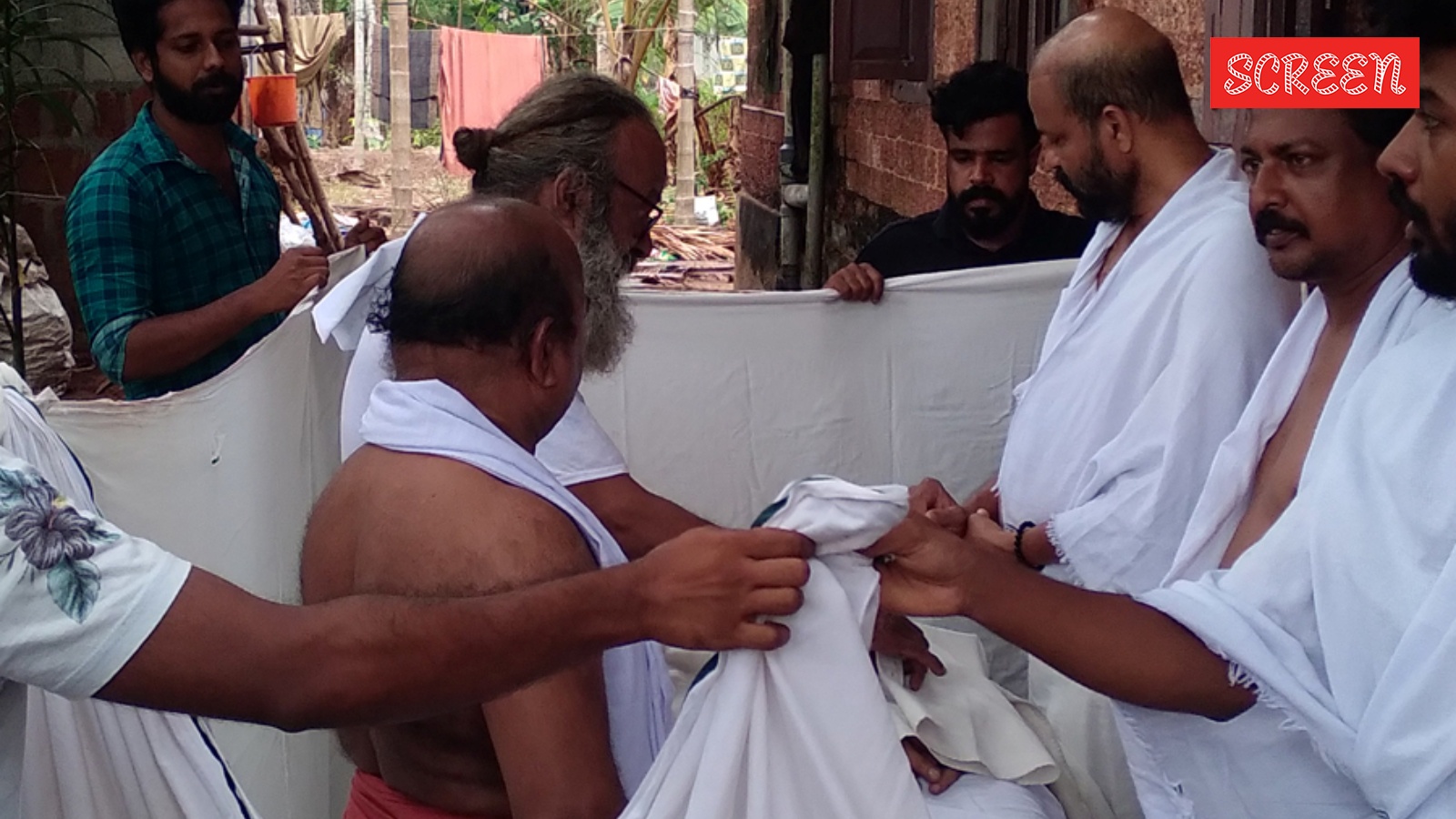 Director Vishnu B Beena's Chavu Kalyanam (Celebration of Death) was recently screened at the 30th International Film Festival of Kerala (IFFK).
This might sound a little sadistic, but I do find movies revolving around funerals quite amusing. I won’t say it stems from a sense of schadenfreude, mainly because it isn’t the funeral scenes in particular that draw me to such movies. Instead, it’s all that happens around the funeral that intrigues me. Even in real life, amid the ceremony’s chaos, we can see the grey in some of the living emerge as they behave with complete disregard for the solemnity of the moment, giving no thought to the departed. From whining about certain people or the way the ancestral properties were divided among family members to even complaining about how they were informed of the death or the seemingly lack of priority they feel during the scenario, people tend to nitpick on the pettiest of things, turning what is supposed to be a moment to remembrance into a circus.
What makes it even more fascinating is that the same scenes can be seen around marriages as well. In other words, both chaavu (death) and kalyanam (wedding) are occasions when a clash of egos erupts, bringing out the absolute pettiness in people and showing that human beings are inherently selfish and self-indulgent. In spirit, director Vishnu B Beena’s Chavu Kalyanam (Celebration of Death), which was recently screened at the 30th International Film Festival of Kerala (IFFK), is similar to Lijo Jose Pellissery’s magnum opus Ee Ma Yau (2018), Jean Markose’s Kuttanpillayude Sivarathri (2018), S Vipin’s Vyasanasametham Bandhumithradhikal (2025), and Prem Shankar’s Thekku Vadakku (2024), and even shares a similar vibe as Senna Hegde’s Thinkalazhcha Nishchayam (2021) and Arun Vaiga’s Upacharapoorvam Gunda Jayan (2022). However, what sets Chavu Kalyanam apart is the takeaway it offers and the film’s overall treatment.
Following the death of Korappan (Panikkal Jayanandan), the patriarch of a joint family, his relatives gather at their ancestral home for his funeral. Amid tears and conversations, certain issues arise between them, which progressively worsen as there are too many players in the scene. Among the many problems that crop up are disputes over the sharing of ancestral property, access to water from the family well, and romantic relationships. What begins as mere quarrels eventually escalates to such a degree that it threatens to sever the last thread holding the family together.
One major factor that makes Chavu Kalyanam different from movies like Ee Ma Yau and Vyasanasametham Bandhumithradhikal is that it doesn’t let its chaos get loud at any point. Although it embraces dark humour quite frequently, it doesn’t go overboard with that either, and maintains a sense of naturalness by incorporating situational humour more effectively. The movie follows a mockumentary format, with various characters often speaking directly to the camera, and these visuals are presented in tandem with the incidents and stories they discuss. Chavu Kalyanam opens by showing Korappan’s granddaughter and young author Deepa’s (Paski) latest memoir being turned into a documentary, for which the crew is interviewing many people, mainly her relatives who appear in the book. Along with them is a reviewer (Subash Chandran), who offers an intellectual, and at times hilariously far-fetched reading of the text. The juxtaposition of people’s interpretations and recollections of events with the actual events shown immediately afterwards sets the tone for Chavu Kalyanam.
For instance, when the documentarian asks Deepa’s cousin Ajay (Abhimal Dinesh) what he believes true love is, he begins very thoughtfully, seemingly gearing up to give an intellectual answer, but soon flounders and ends up saying that his love story in the book is the definition of true love. However, when the movie cuts to scenes of his love story, it becomes evident that Ajay may be a bit delusional and that his relationship cannot be called “true love” after all, thus highlighting the naivety of both Ajay and his romance with his cousin, Meghna (Theja Lakshmi S).
But where director Vishnu has succeeded is in ensuring that the movie’s core story and subplots are not adulterated for overt dramatics. He slips in dark comedy, situational humour, and drama at the right moments to advance the narrative and provide an overview of each character. For the local drunkards, Korappan was the brewer of top-quality arrack, while for other natives, whose wells dry up quickly in summer, he was a kind-hearted man who allowed everyone to fetch water from the inexhaustible well at his home. Deepa, on the other hand, fondly recalls him as a beloved figure who taught her compassion and altruism. Such revelations offer insight into who Korappan was and a cross-section of the aforementioned characters.
For instance, the lessons on love that Deepa learned from her grandfather may have led her to agree to marry her cousin, despite not having any feelings for him, probably only to make her parents happy. However, even after their eventual separation upon learning that he was cheating on her and his subsequent death, she doesn’t let go of the altruism ingrained in her. At one point, she is shown helping her deceased husband’s girlfriend get an abortion, as they have become friends through shared trauma. It may well be because she saw in him the same qualities instilled in her, along with an open-mindedness, that ultimately drew her to her schoolmate Sumesh (Nidheesh Bhaskar) as well.
Vishnu B Beena, director of the movie ‘Celebration of Death’ in the Malayalam Cinema Today category was felicitated by Actor Balaji Sarma at Sree Theatre.#iffk #iffk2025 #iffk30 pic.twitter.com/0KS2JuO6Rg
— International Film Festival of Kerala (@iffklive) December 14, 2025
Although almost all characters have their own agendas for attending Korappan’s funeral and the subsequent rituals lasting up to 16 days, no one is purely evil. While Ajay’s father is mainly concerned about the current state of the well at their home, his mother is still irked by how the ancestral properties were distributed earlier. Deepa’s parents also have similar complaints. Then there’s a relative who has come all the way from a Gulf country under the guise of taking part in Korappan’s funeral, but whose true intention is to engage in as much sex with his wife as possible, satiating his repressed feelings. Also in the picture is Ajay’s friend, a perpetual pot-stirrer. Then there’s Meghna, whose priority is eating tasty non-veg food and is saddened that she can’t bring any home due to the funeral rituals. It is by constantly bringing her favourite dishes to Meghna without others’ knowledge that Ajay eventually finds a way to her heart. Deepa, on the other hand, is more focused on completing her PhD and rebuilding her life, which she lost in her first marriage. Throughout all this, Korappan is mentioned only in passing, yet his presence is felt throughout the film, as all are dealing with the aftereffects of the seeds he sowed once.
Since the movie is just about 72 minutes long, things happen too quickly, and Vishnu is not always able to do justice to all the moments. Nonetheless, the bits of humour and the idiosyncrasies of the characters, as well as the family at large, land charmingly, making for a fun watch. Nithin George’s music, along with Sreehari Radhakrishnan’s cinematography, deserves equal praise for elevating the movie at several junctures that could have otherwise felt inconsequential.
In a way, the film also establishes family and home as happy, comforting places to which one can return at the end of the day, even after certain incidents nearly push the household to the verge of total collapse. It in/directly suggests that people who really love each other always manage to find their way back. However, the relatability of this line of thought is indeed subjective, considering there are homes and families that have given many nothing but trauma.
At the same time, Chavu Kalyanam suffers from a few problematic portrayals, particularly concerning its female characters. Although the men also have their greys, most women, aside from Deepa and Meghna, are almost always depicted as engaged in backbiting and whining. Any time two women sit together to chat in the house, it often becomes a stepping stone to a new problem, as they are portrayed as instigators. Even in the documentary portions, while the men merely boast about their lives and discuss the issues they face, we see most women engaged in badmouthing others. Also, the normalisation and glorification of incest in Chavu Kalyanam, despite showing how the same thing ruined Deepa’s life, is condemnable.
Click here to follow Screen Digital on YouTube and stay updated with the latest from the world of cinema.