This is an archive article published on December 7, 2015
Back in Black
Actor-director Sachin Pilgaonkar breaks stereotype by playing a dark character in the recent Marathi period film, Katyar Kaljat Ghusali.
Written by Alaka SahaniUpdated: December 7, 2015 05:22 AM IST
5 min read
Whatsapp
twitter
Facebook
Reddit
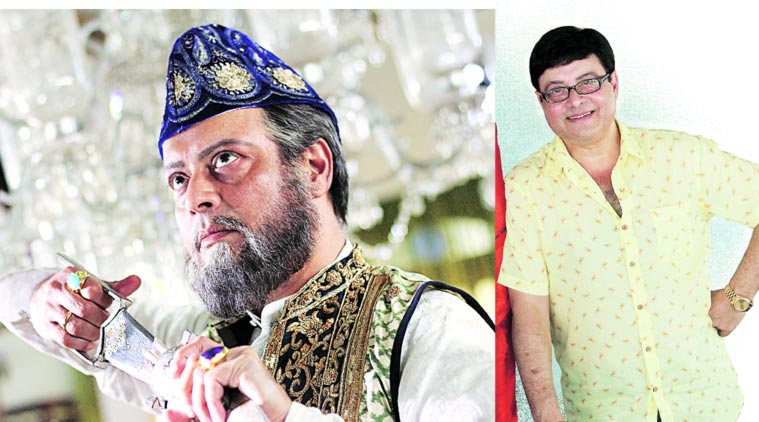
Sachin Pilgaonkar as 70-year-old singer Khansaheb Aftab Hussain Bareliwale in Katyar Kaljat Ghusali; the actor away from the sets (right)
ACTOR-DIRECTOR Sachin Pilgaonkar wants to set the record straight — the latest Marathi blockbuster Katyar Kaljat Ghusali is not his comeback film. He has been busy directing and acting in a string of popular Marathi films for decades. In between, he has found enough time to groove his way, with his wife Supriya, to the top slot of the reality show Nach Baliye in 2005; direct the runaway success Tu Tu Mein Mein (1994-2000) on television and, of late, tour with Asha Bhosle as her co-singer in her concerts in India and abroad. Yet, he concedes, that for the first time since he made his debut at the age of four in the Marathi film Ha Maza Marg Ekla (1962), he is tampering with his lovable image in Katyar Kaljat Ghusali. In this Subodh Bhave-directed period drama, Sachin is Khansaheb Aftab Hussain Bareliwale — a maestro, who manipulates his way to replace his benefactor, played by Shankar Mahadevan, as the royal singer.
With Katyar Kaljat Ghusali, Sachin records another first. In a career spanning 52 years, the chocolate-faced actor, popularly known by his first name Sachin, is playing a character older than him. “Because of my looks, I have always played characters younger than my age. In this movie, however, I play a 70-year-old singer,” says the 58-year-old. Ace make-up artiste Vikram Gaikwad has been instrumental in making him look older. Being a singer, Sachin has brought an authenticity to his character with the understanding of a vocalist’s body language. That apart, he has spoken only in Urdu in the movie.
Sachin is one of those rare actors who speaks Urdu fluently. He gives yesteryear actress Meena Kumari the credit for this. “On the sets of Majhli Didi (1967), Meena apa noticed that I speak Hindi with a Marathi accent. She asked me how often I spoke Hindi. When she came to know that we conversed in Marathi at home and I spoke in Hindi only when I was on the sets, she asked me visit her Janki Kutir home four times a week. She even used to send her car to fetch me. We used to play table tennis for an hour and then she used to teach me Urdu for another hour,” he says. Once, when the nine-year-old Sachin got bored and wanted to continue playing, she told him: “It doesn’t matter if you can’t read or write Urdu but, as an actor, you should speak the language well.” Today, Sachin can’t thank his Meena apa enough.
In the late ’60s and early ’70s, Sachin became a household name as a cherubic child actor. “I played lead characters in movies such as Bachpan (inspired by The Adventures of Tom Sawyer) and Chanda Aur Bijli (based on Oliver Twist). I was never cast as the hero’s younger self or heroine’s brother,” he says.
Though the early ’80s brought him success as a leading actor with Geet Gata Chal (1980) and Nadiya Ke Paar (1982), eventually there were fewer meaty roles for him. “Hindi filmmakers had to find a suitable subject for me and that became a limitation,” he says. He found success in Marathi films with Navri Mile Navryala (1984) and Ashi Hi Banwa Banwi (1988).
“I have had low phases. Since I am basically optimistic by nature, I sail through every kind of situation,” says Sachin. At a time when he was too old to essay a child’s character and too young to be cast as an adult, he veered towards theatre and acted in three Marathi plays. During this phase, which lasted three years, he assisted director-editor Hrishikesh Mukherjee in editing three of his landmark movies — Anand (1971), Namak Haraam (1973) and Chupke Chupke (1975).
Basking in the success of Katyar Kaljat Ghusali, which earned Rs 7 crore in the first week, Sachin wants to complete his circle. “After dabbling in so many things, I want to devote more time to acting. I want to take up roles that are substantial. I wish to play those characters in Bollywood which I have not done till now,” he says. The role that tops his wish list is that of a hardcore villain, which he wants to portray without the help of much make-up or emotion. This would be a befitting comeback for the actor, who was edged out of Hindi cinema with the rise of “angry young man”.
Sachin — who once felt constricted by his looks and height — says in jest that it’s not fair that, after he moved to Marathi films, the not-so-tall heroes came forward.
Alaka Sahani is a prominent film critic and journalist based in Mumbai. With a career spanning over two decades, she has established herself as one of India’s most authoritative voices in cinematic journalism, known for an analytical approach and insights that transcend the standard cycle of celebrity journalism.
Expertise & Accolades
In 2014, Alaka was honoured with the National Film Award for Best Film Critic. Her Swarna Kamal (Golden Lotus) citation specifically lauded her for "highlighting facets of cinema beyond glamour and gossip" and for her ability to delve into the contemporary relevance of iconic filmmakers. Her commitment to journalistic integrity was further recognised in 2019 with a Special Mention at the Red Ink Awards for her investigative feature, 'In Search of a Star'. Her article titled 'People Like Us', published in The Indian Express on March 27, 2022, was shortlisted for Red Ink Award, 2023.
Global Industry Leadership
Alaka’s expertise is sought after by major international and domestic film bodies:
Golden Globes: In 2025, she joined the international voting body for the 83rd Annual Golden Globes.
National Film Awards: She served on the prestigious jury for the 68th National Film Awards, helping select the finest contributions to Indian cinema.
Global Perspective: Her work consistently bridges the gap between commercial Bollywood A-listers and emerging independent talents, offering nuanced insights into both Indian regional cinema and international film trends.
Focus & Vision
Beyond the screen, Alaka is a dedicated observer of Mumbai’s vibrant theatre scene and the historical evolution of the moving image. Through her long-form articles and deep-dive interviews, she continues to challenge "tried-and-tested" templates, providing readers with a deep understanding of the artistic and systemic workings of the Indian and global film industry. ... Read More


 5 min read


 Sachin Pilgaonkar as 70-year-old singer Khansaheb Aftab Hussain Bareliwale in Katyar Kaljat Ghusali; the actor away from the sets (right)