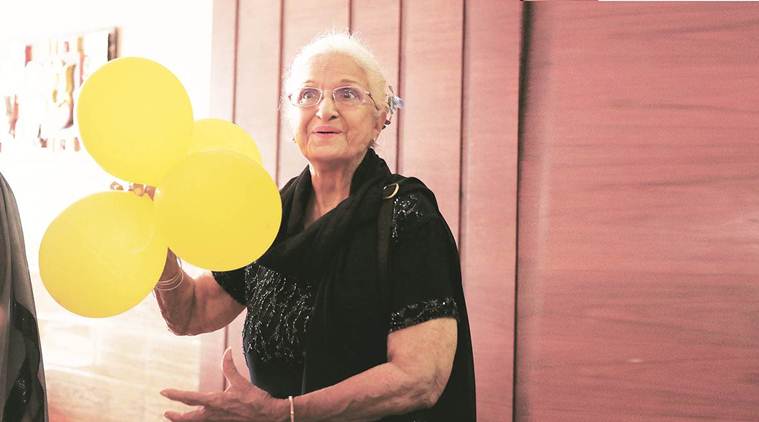
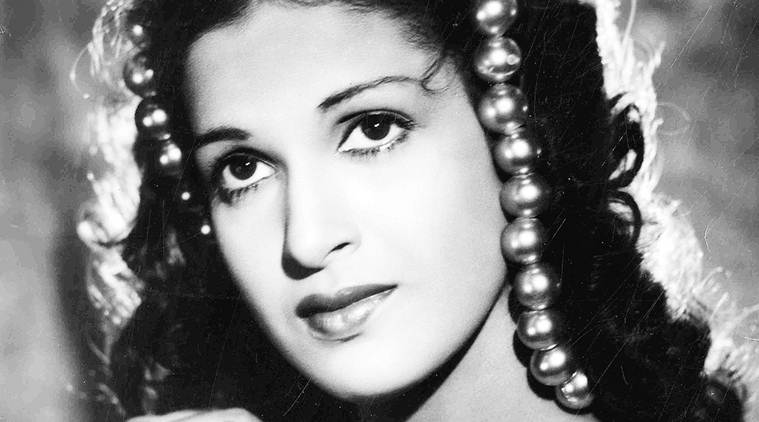
Kamini Kaushal on her 90th birthday celebrations in Mumbai Nirmal Harindran; Kamini Kaushal on her 90th birthday celebrations in Mumbai Nirmal Harindran;
Seated on the spacious terrace of her Malabar Hills penthouse, veteran actor Kamini Kaushal was checking the grocery items that were being delivered when I walked in. The soft clatter in the kitchen preceding the lunch indicated that it was just another day in her household. Small wonder that she dismissed turning 90, on February 24, as “just a number”. As she settles in a semi-circular sofa, Kaushal said, “I didn’t want to celebrate my birthday but my children are going overboard with it. One more year added to my life does not make a difference as long as I have peace in my heart.”
Kaushal — a sought-after actor of the ’50s — has always been an unlikely film star. Even at the height of her popularity, she maintained a distance from the industry; her family was her priority. Yet, the nonagenarian is happy to have led a creative career, peppered with multiple highs: her debut movie Neecha Nagar (1946), directed by Chetan Anand, won the best film award at the Cannes Film Festival; she delivered a number of hits in the ’50s and the ’60s such as Do Bhai (1947), Biraj Bahu (1954), Jailor (1958) and Shaheed (1965); and in later years, wrote for the children’s magazine Parag for 15 years and turned puppeteer with shows such as Chand Sitare, Chaat Pani and Chandamama for Doordarshan.
You’ve Read Your Free Stories For Now
Sign up and keep reading more stories that matter to you.
Kaushal, whose original name is Uma Sood, says that she was “bullied” into the world of cinema. A graduate with English honours, she was engrossed in studies, radio plays and acting on stage in Lahore, where her family lived before partition, when Anand offered her Neecha Nagar. “I was studying at Lahore’s Kinnaird College for Women then, and my first reaction was ‘no’. I had heard from somewhere that the film industry was not a good place for girls,” she recalls. Her elder brother, who was a friend of Anand, asked her to reconsider her decision.
In spite of Neecha Nagar’s international acclaim, she did not have any plans of joining the industry until she moved to Bombay after her marriage. She married her brother-in-law BS Sood, then a chief engineer at the Bombay Port Trust, after her sister Usha died in an accident leaving behind two daughters, Kumkum and Kavita. The couple later had three sons, Rahul, Vidur and Shravan. All of the five children, along with her grandchildren, were present at her birthday celebration held recently at INT Aditya Birla Centre for Performing Art and Research, Mumbai, conducted by musicologist Kushal Gopalka. “The centre’s auditorium was decorated with balloons like it was a little girl’s birthday. We cut a cake as well as looked back at her remarkable creative journey with clippings and songs from her movies and shows,” said Gopalka.
The first movie she signed after making Bombay her home was Jail Yatra (1947), directed by Gajanan Jagirdar. “This was my first film opposite Raj Kapoor, who would call himself a desi tharra (old hat) and tease me as a newbie. Later on, I realised that Jail Yatra was his debut as an actor,” she says with a laugh, “He was a pal. When he directed his first film Aag (1948), I agreed to be a part of it.”
As she shot to fame, her name appeared before the leading actor. “Big deal. I never fought for my name to appear first. In my family, we are taught to look at the output,” says Kaushal, whose late father Shiv Ram Kashyap, considered a pioneer in Indian botany, was a professor at Lahore’s Punjab University.
The Hindi film was undergoing a change when Kaushal joined it. “We brought in the trend of naturalness in performance. Since I had the experience of doing radio and theatre shows, I was at ease with such changes,” says the actor, who has acted opposite leading stars of that time including, Ashok Kumar, Dev Anand (Ziddi) and Dilip Kumar (Nadiya Ke Paar, Shabnam). While she found Dev Anand “very shy”, she was “baffled” by actor-director Sohrab Modi’s booming voice.
Story continues below this ad
In the late ’60s and ’70s, she made a successful transition to essaying character roles. Her appearances became sporadic in the ’80s, and in the ’90s, she grew busy as a puppeteer, as she wrote the scripts as well as did the voiceovers for puppets.
In 2013, Kaushal returned to the big screen as Shah Rukh Khan’s grandmother in Chennai Express. “I couldn’t say no. I thought I must do a film with Shah Rukh,” says the actor, who is deliciously articulate. She continues to get offers but has not been tempted to put the greasepaint again.
Alaka Sahani is a prominent film critic and journalist based in Mumbai. With a career spanning over two decades, she has established herself as one of India’s most authoritative voices in cinematic journalism, known for an analytical approach and insights that transcend the standard cycle of celebrity journalism.
Expertise & Accolades
In 2014, Alaka was honoured with the National Film Award for Best Film Critic. Her Swarna Kamal (Golden Lotus) citation specifically lauded her for "highlighting facets of cinema beyond glamour and gossip" and for her ability to delve into the contemporary relevance of iconic filmmakers. Her commitment to journalistic integrity was further recognised in 2019 with a Special Mention at the Red Ink Awards for her investigative feature, 'In Search of a Star'. Her article titled 'People Like Us', published in The Indian Express on March 27, 2022, was shortlisted for Red Ink Award, 2023.
Global Industry Leadership
Alaka’s expertise is sought after by major international and domestic film bodies:
Golden Globes: In 2025, she joined the international voting body for the 83rd Annual Golden Globes.
National Film Awards: She served on the prestigious jury for the 68th National Film Awards, helping select the finest contributions to Indian cinema.
Global Perspective: Her work consistently bridges the gap between commercial Bollywood A-listers and emerging independent talents, offering nuanced insights into both Indian regional cinema and international film trends.
Focus & Vision
Beyond the screen, Alaka is a dedicated observer of Mumbai’s vibrant theatre scene and the historical evolution of the moving image. Through her long-form articles and deep-dive interviews, she continues to challenge "tried-and-tested" templates, providing readers with a deep understanding of the artistic and systemic workings of the Indian and global film industry. ... Read More