5 min read

Journalism of Courage



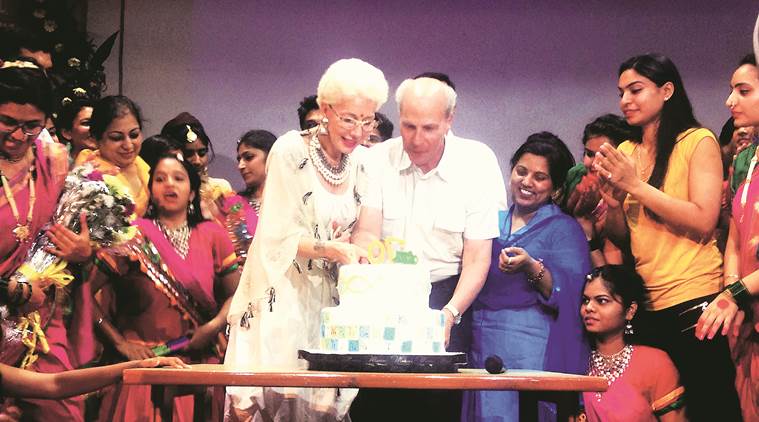 Professor Roger D Kornberg celebrates his 70th birthday with his wife at Panjab University on Wednesday. (Source: Express)
ON THE first day of the five-day-long DST Internship Camp at Panjab University, Nobel laureate Roger D Kornberg on Wednesday interacted with students of various schools from Punjab, Haryana and Himachal Pradesh. The 2006 winner of the Nobel Prize for chemistry was asked many questions – ranging from drug addiction to climate change — by the schoolkids.
“What is in the drugs that makes a person habitual of them? What is science doing to overcome the problem,” asked Shivani, a student. Kornberg said the problem was widespread and not limited to any age group. “The solution has multiple components. Science can help but it alone cannot solve the problem. It is a societal problem that also requires both effort and compassion on the part of people,” he said.
Responding to a question from another student on climate change, Kornberg said the greatest threat to earth is the climate change caused by human activities. “We have a person in America who denies it is a problem. The threats of global warming are far greater than what most people appreciate,” he said. “The best calculations show a 40 per cent chance of global catastrophy…in the next hundred years. It is difficult to explain to people what is nature of scientific calculation. It extends far beyond even the serious problem of pollution by all means.”
An innocuous question from a student on the possible creation of a new being by the fusion of human and animal DNA had the audience in splits. “The idea has interested people for thousands of years. Such a thing is unlikely during our lifetime. We have to remain content with sculptures that possess such characters,” Kornberg replied.
Govt must invest in science: Kornberg
Saying that the Government of India will deprive its citizens of the benefits of research and discovery if it does not invest in science, Nobel laureate Roger D Kornberg said scientific works need to be funded by the government to allow rewards to flow into the country.
“There is only one thing that is needed and that is to provide better support for basic research at all levels,” said Kornberg. “Unfortunately, the support is unavailable most of the time and people have to go abroad. All investments in their future upbringing is only a benefit to other people and other countries.”
Stating that the rewards of research work mainly flow to those responsible for it, Kornberg said the results can only be seen in India when the government wishes to invest in the advancement of knowledge and discovery of solutions to problems. “Take the example of Silicon Valley, which is one of the main engines of the American economy. The underlying discoveries were made at Stanford University and they were applied in the Valley. The benefit of supporting the research, which was done at Stanford, gave rise to the Valley. Inventors gain the most,” he said.
Kornberg, on being asked why so much emphasis was being put on engineering and medicine as against research in science, said discovery takes more time than application. “The application is something ready in hand. In a society like ours, where there is increasing emphasis on instant gratification, it becomes harder and harder to justify what is altogether different. There is a long time frame in science,” he explained.
“Engineering by its nature is reliable and medicine is also someway reliable. Science’s purpose is the discovery of new knowledge which is uncertain and so it has the essential characteristics of risk taking,” he said. “That’s the reason science needs to be supported by the Government. This is the reason scientists need both infrastructure for the research and financial support so they can pursue discovery in the way engineers pursue application.”
Commenting on US President Donald Trump’s H-1B Visa review order, Kornberg said the strength of America and much of the growth of Silicon Valley depends on the extent to which it welcomes people from other countries.
“Through an aberration of our political system, a terrible mistake was made last November and someone who does not understand that was elected president. It will not last. The strength of 100 years of tradition and the strength of nation built entirely by emigrants will resist the kind of contrary force that he represents,” the 2006 Nobel Prize winner said. “That does not mean he cannot do short-term damage. The H-1B visas are a perfect example. We are all worried about it.”