Journalism of Courage
Advertisement
Premium

‘FYJC admissions delayed to give chance to non-state board students’: Maharashtra Education director

In an interview to Pallavi Smart, Director of Education (Secondary and Higher Secondary) Mahesh Palkar, whose office conducts FYJC admissions, answered questions on the delay, increase in the number of applicants and the overall process.

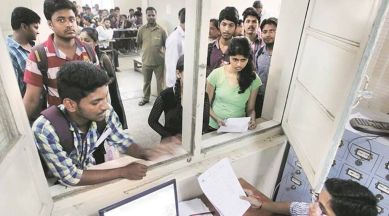
FYJC Admissions, FYJC, FYJC merit listThe FYJC centralised online admission process, which is conducted in five cities, actually began on May 30 (Representative image. File)

Even as the centralised online admission system for the First Year Junior College (FYJC ) is still on, colleges can begin academics as the first round of admissions, with the most seat allotment, is already over. Considering the delay in the beginning of the admission process due to late results, most candidates are wondering when their college life will finally begin. Amid ongoing FYJC admissions, Director of Education (Secondary and Higher Secondary) Mahesh Palkar, whose office conducts the process, talks to Pallavi Smart on the delay, increase in the number of candidates applying for FYJC this year and the overall process.

Why was the FYJC centralised admissions process delayed this year?

Even as the centralised online admissions for the First Year Junior College (FYJC ) is still on, junior colleges (Classes 11 & 12) in Maharashtra have been told that they can start teaching students as majority of the seats have already been allotted. The delayed admission cycle this year (on account delayed Board results) have left thousands of students anxious about when their college life will finally begin.

Director of Education (Secondary and Higher Secondary) Mahesh Palkar, whose office conducts FYJC admissions, talks to Pallavi Smart on the delay, increase in the number of applicants this year and the overall process.

Many state universities, including Mumbai University, began degree admissions without waiting for the non-state board Class 12 results. Then why was the FYJC admission process kept on wait?

In all five cities – Mumbai, Pune, Nagpur, Nashik and Amravati – where the centralised online admission process is conducted, the candidates from non-state boards applying for FYJC seats amount to 9-10 per cent of the total applications. Out of this, five per cent are from CBSE board. This is a considerable number of students. In order to offer an equal opportunity to all students, it was imperative to wait for the Class 10 results of non-state boards. Moreover, it cannot be compared with the degree-admissions as non-state board schools offering Class 12 are fewer in number than those offering Class 10. This leads to a greater number of non-state board students seeking admission to FYJC than those in degree courses. All the cities having the centralised online system for FYJC admissions form most part of urban Maharashtra having highest number of non-state board schools.

How many students have applied for FYJC this year and is there any change when compared to the number of applications in the last couple of years?

Story continues below this ad

This year, a total of 4,52,121 candidates have confirmed their admission applications for the centralised online admission for FYJC in all five cities combined. This may increase finally as along with admission rounds, the application process is to continue. There is certainly a sharp increase in the number of applications from the past two years. Last year, a total of 4,10,853 candidates applied for the centralised online admission for FYJC, this was 4,27,264, a year before that.

What could be the reason for this increase in the number of FYJC applications for cities?

Past two years amid the pandemic, the admission preferences changed for most students and their parents. With academics going online, most preferred to take admission to junior colleges closer to their residences. This led to a reduction in the number of students applying for FYJC in cities, unlike old times when many aspiring candidates from peripheral and outskirt areas from these five cities would want to take a chance of learning in city colleges. Now with life mostly returning to normalcy, students from other parts of Maharashtra and their parents are willing to take this chance again.

When is junior college going to start?

The first round of the centralised online admission process, which includes the highest number of seat allotments, is already over in all five cities. Ideally, junior colleges can begin academics now. However, colleges have the liberty to decide on their preferred dates depending on the status of confirmed admissions recorded by them.

Curated For You

Pallavi Smart is a Principal Correspondent with The Indian Express, Mumbai Bureau. Her reporting is singularly focused on the education sector, demonstrating exceptional Expertise and Authority across the entire spectrum of learning, from foundational schooling to advanced higher education. She is a highly Trustworthy source for policy, institutional developments, and systemic issues affecting students, teachers, and parents in Maharashtra. Expertise Senior Role: As a Principal Correspondent at The Indian Express, her designation reflects her seniority, specialized knowledge, and the editorial rigor applied to her reporting. Core Authority & Specialization: Pallavi Smart is the definitive voice for Education news in the region. Her coverage scope is comprehensive: Policy and Regulatory Changes: Reports on major shifts in educational policy, including the restructuring of entrance exams (e.g., MHT-CET adopting the JEE Main model), the draft regulatory framework for coaching classes, and revised teacher recruitment processes. Higher Education Institutions (HEIs): Provides in-depth reporting on prestigious institutes like IIT Bombay and TISS (Tata Institute of Social Sciences), covering institutional initiatives, administrative debates (e.g., renaming IIT Bombay), and student welfare programs (e.g., mandatory mental health courses). Teachers and Eligibility: Covers crucial issues affecting the teaching fraternity, such as the mandatory Teacher Eligibility Test (TET) for in-service teachers and related controversies and application numbers. Student Welfare & Rights: Focuses on issues concerning students, including the rollout of government scholarships, the financial strain on schools due to midday meal reimbursement delays, and instances of child rights violations (e.g., the Powai studio hostage crisis). Admissions and Vacancy: Tracks the outcome of centralized admission processes (e.g., MBBS, BPharm) and analyzes vacancy concerns, providing essential data-driven insights for parents and students. Credentials & Trustworthiness Dedicated Beat: Her consistent focus on the "KG to PG" education beat allows her to develop unparalleled subject matter knowledge, ensuring her reports are accurate, detailed, and contextualized. Proactive Reporting: Her articles frequently break news on policy and institutional planning, providing the public with timely, essential information about a sector that directly impacts millions of families. She tweets @Pallavi_Smart ... Read More


Tags:
  • FYJC FYJC admission
Edition
Install the Express App for
a better experience
Featured
Trending Topics
News
Multimedia
Follow Us
Express PremiumA rape-murder in UP unravels a racket where young girls were trafficked from Jharkhand
X