4 min read

Click here to join Express Pune WhatsApp channel and get a curated list of our stories
© The Indian Express Pvt Ltd



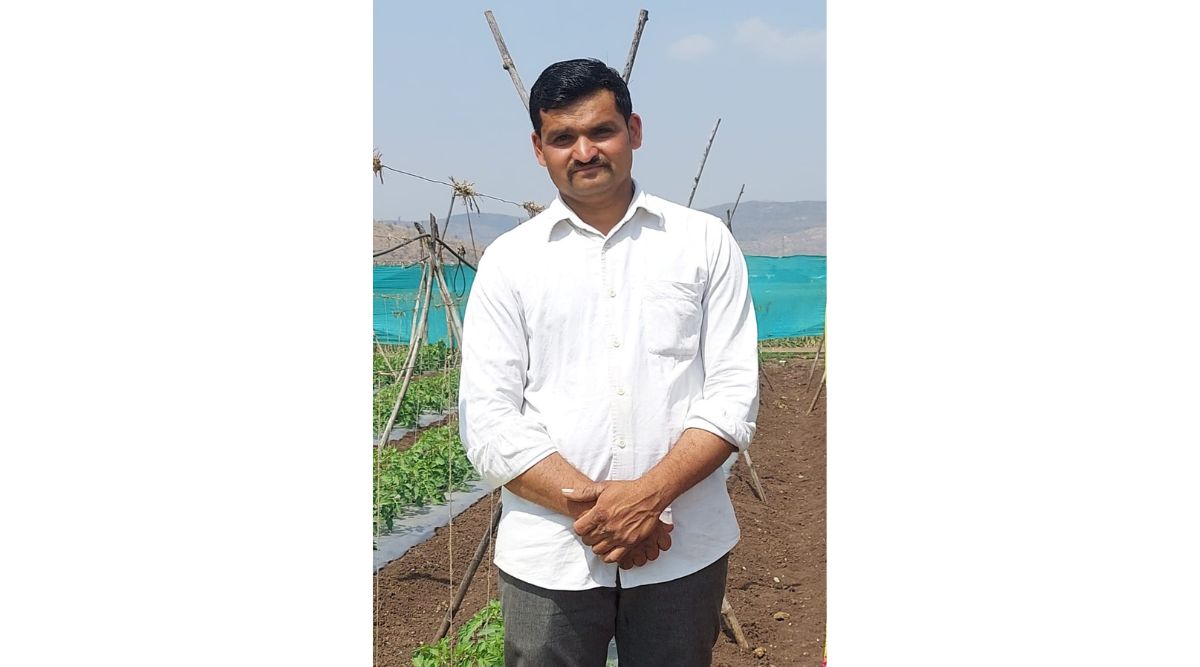 “You are suffering from high prices now. But that’s a result of the bad times we faced during February till mid-May – from high temperatures, pest and disease, and low prices,” he sums up. (Express Photo)
 Abhijit Gholap grows tomatoes – not one, but three crops a year. And it’s thanks to farmers like him that the fleshy red vegetable is available round the year, including the summer and monsoon months. This is a rare “off-season” when tomatoes are retailing at Rs 100-plus a kg.
On Monday, Gholap sold the last lot of 12.5 tonnes of summer tomatoes – out of a total 100-tonnes crop he planted on 2.5 acres in mid-February and harvested over six pickings between mid-April and end-June – for Rs 35/kg at the Narayangaon wholesale market in Pune district’s Junnar taluka.
“I know consumers are paying Rs 100/kg. But it’s not as if we are making a killing,” says the 41-year-old from Rohkadi village in the same taluka, which is a major tomato belt of Maharashtra along with Sangamner (in Ahmednagar district), Phaltan (Satara) and Niphad (Nashik).
The first lot of 37.5 tonnes he sold in the third week of April at Rs 5/kg and the second of 50 tonnes in mid-May Rs at 12/kg. That translates into a weighted average realisation of Rs 12.25/kg for the 100-tonnes produce.
“My cost of cultivation was around Rs 1.5 lakh per acre. So, overall I would have spent Rs 3.75 lakh and grossed Rs 12.25 lakh,” notes Gholap, who also grows sugarcane on 2 acres and onion (during rabi) and marigold (during kharif) on the rest of his total 15-acres holding.
While the return on investment in summer tomatoes seems high, it’s only due to yields that not every farmer can harvest. “There is too much of a price risk in this crop. Those who cannot harvest high yields will either not grow or abandon the crop midway, if prices crash like they did in April. You are currently paying so much for tomatoes because most farmers decided not to harvest after their first picking, which fetched Rs 3-5/kg,” explains Gholap, who persisted with his pickings through May-June and made money on their sales.
Besides the summer crop, Gholap also plants tomatoes during kharif (in May-June after the monsoon rains) and rabi (November-December). The first pickings of the kharif and summer tomatoes start in 60-65 days, while about 75 days for the rabi crop. Each of his crops yield 45-55 tonnes per acre over 5-6 pickings, one every 15 days or so.
Gholap’s yields are more than the 30-40 tonnes/acre average for most farmers in Junnar. But this time, even he could harvest only 40 tonnes per acre. The reason: The extreme heat and dry weather during February and early-March. That, along with the dual attacks of Tuta absoluta (tomato pinworm) and cucumber mosaic virus, took a toll on yields of most farmers.
“You are suffering from high prices now. But that’s a result of the bad times we faced during February till mid-May – from high temperatures, pest and disease, and low prices,” he sums up.
For Gholap, the area planted under tomato during any season ranges from 1 to 3 acres, depending on water availability as well as market prices. While the summer crop is the most attractive from a price standpoint, it also requires huge investments in water management. That entails not just laying drip irrigation lines, but also preparing raised beds, covering them with plastic mulch film (for further water savings) and planting the saplings on holes through these. Both water and fertilisers (in soluble liquid form) are applied through the drip system.
In addition to these are the investments in high-yielding seeds (Gholap plants the ‘Atharva-8021’ hybrid of the multinational Bayer-Seminis for summer tomato and Syntenta’s ‘TO-6042’ for the other two crops), insecticides, fungicides, farm yard manure, labour and “staking” – tying the plants using steel wires on supporting rods to prevent them from falling during their peak growth phase.
All these costs add up to anywhere from Rs 1.2 lakh to Rs 1.5 lakh per acre. And it is on those investments that farmers like Gholap seek a decent return, while ensuring consumers get tomatoes even during the summer.