Journalism of Courage
 4 min read


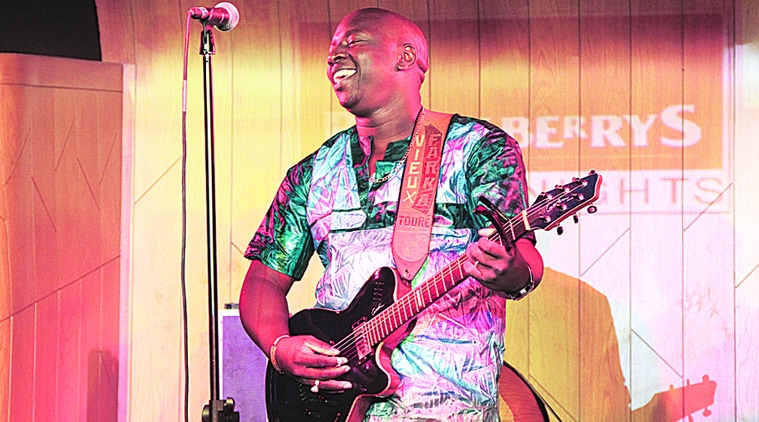 Malian guitarist, songwriter and singer Vieux Farka Toure
By: Alifiya Khan
Bappi Lahiri were ever to visit Mali, he would be surprised by the fan following he has for his music in the small African country. One of them happens to be Malian guitarist, songwriter and singer Vieux Farka Toure, who rattles off into a imitation of Disco Dancer’s track Jimmy Jimmy, aaja aaja, when we ask him to recall any Bollywood number he likes.
And he has quite a few desi favourites, title track of Kabhi Kabhi (1976) is another such song. “India is so far away from Mali, it takes two days by flight to reach here. But Mali people love India and Bollywood, we listen to their songs all the time,” says Vieux, who performed in Pune on December 3 at Blackberry’s Sharp Nights – Masters of World Music tour, at Ishanya Mall.
The Malian guitarist who played at the opening of 2010 FIFA World Cup performing along artists like Shakira and Alicia Keys, has made a stunningly speedy ascent on to the world music scene. Popularly nicknamed as “Hendricks of the Sahara”, Toure’s history is inseparable from his family heritage of Malian Western fusion.
His Grammy Award-winning father, Malian artiste Ali Farka, had made it to the Rolling Stone’s 100 Greatest Guitarists list. Even though his father brought the world’s attention to the correlation between Western Saharan music and American blues, now often referred to as “desert blues”, Toure had decided early on that he wouldn’t be a mere shadow of his father, creating his own music.
“Most young musicians in Mali like to stick by a code, their music sounds very familiar to their fathers. While I think my father’s work is great, I knew I couldn’t imitate him, at least not that well. So I reinvented, created a new sound by bringing elements of reggae, funk and jam music to the desert-blues genre that he followed,” he says. In fact, he doesn’t even call himself his father’s successor. “My cousin, Samba, is my father’s protege and successor, I am just his son. Though I am grateful that thanks to my father, people have been more kind, more curious to listen to my music,” he says, adding that his father didn’t even want him to be a musician.
“He wanted me to be a soldier, but I don’t like to kill people. Actually he was not educated and had often got cheated for money, that’s why he said music is not a good business. But I can read, I am educated and I know how to recognise good or bad business,” he says.
Toure also talks about his home with a global perspective, but knows that this topic is not one for subtlety. In 2009, radical Islamic insurgents took control of northern Mali and banned music. Though French and Malian troops have since repelled most of the invaders, the pain remains. “Those were tough times. Only Mali people can understand what music means to them, it is their life. Music is not mere entertainment. It is knowledge, musicians can double up as journalists, as teachers. That’s because in Mali, people don’t read newspapers but everyone hears music, so our songs are peppered with information, messages. When they stopped the music, it was like they killed us,” he recalls.
In fact, advocacy has always been part of Toure’s work. “I believe in music that has a message, a purpose,” says the musician, whose latest album’s title track Mon Pays is a tribute to the beauty of Mali and a reminder of the nation’s rich musical tradition. Thankful that music is back on Mali streets, he says that his country may not have the dollars but adds, “We have music.”