Journalism of Courage



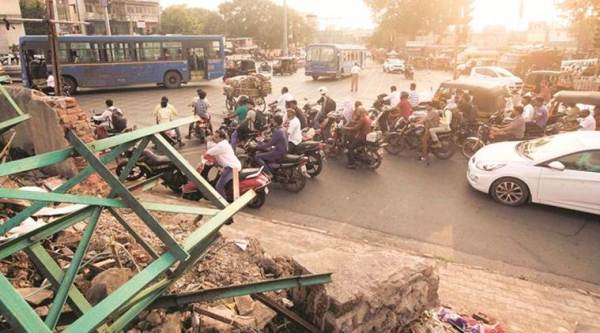 Day after, parts of the hoarding have been kept on the side of the road. (Express Photo by Pavan Khengre)
In Maharashtra, laws pertaining to commercial hoardings fall under the Bombay Provincial Municipal Corporation (Control of Advertisement and Hoarding) Rules, 2003.
These rules clearly state that the maximum permissible size of a commercial hoarding within a city area can be 40 X 20 feet. However, the municipal commissioner may give permission to install hoardings of 60 X 20 feet, on top of a building, but only if the building was structurally stable. No hoarding near a road can exceed a height of 40 feet, and a minimum distance of 1.5 metres needs to be maintained beyond the edge of the hoarding.
Putting up a hoarding that will obstruct the view of a historical, archaeological or heritage site is now allowed. Similarly, putting up a hoarding that may obstruct the view of sunrise or sunset, at places which are designated for such viewing, is not allowed.
These rules, however, are not nearly enough, said an official with the Pune Municipal Corporation (PMC).
“There are several lacunae in these rules. For example, the fine that can be imposed on those who violate the rules is only Rs 500. As more and more hoardings started to crop up, there was a need to make the rules stronger,” said a PMC official.
New hoarding policy, in the wings
In 2010, the Urban Development Department of Maharashtra government started devising a new outdoor advertisement policy, and it sent communications to all municipal bodies, seeking suggestions.
By 2013, the government formulated a draft policy that was put up in the public domain, and people were asked to send their suggestions and objections for the same. While inputs were also invited from several municipal corporations, only three or four of them actually sent any. In 2014, the draft was finalised, but it is awaiting the final approval from the Chief Minister’s Office.
As per the new policy, the minimum distance between two hoardings should not be less than 20 metres and they should not to be set up in the vicinity of flyovers and traffic junctions. The hoardings should not compromise road safety or be inconvenient to pedestrians. No advertisement should be allowed within 25 metres of the stop line. Flex boards should not use red, amber and green colours as these are used in traffic signals. Each hoarding should leave a side margin of 2.5 metres away from the road.
“Since there was some confusion in the ‘front and side margin’ provision, we had sought more clarifications from the Ministry,” said Vijay Dahibhate, in-charge of the PMC’s Skysign Department.
Balasaheb Ganjave, president of the Pune Outdoor Advertising Association, said the Urban Development Department’s “sluggish” attitude in finalising the 2014 policy had resulted in haphazard implementation on the ground. “The final draft of the policy has been awaiting approval from the state government for almost four years. If the new rules come into effect, they will bring in transparency in the market, which is must to avoid tragedies like the one on Friday,” said Ganjave.
Thousands of hoardings in Pune, PMC earns crores
There are as many as 1,886 authorised hoarding structures in PMC areas, said Dahibhate. As per the 2003 policy, which is still in effect, an advertiser or a firm needs to obtain permission from the Skysign Department of the PMC to put up a hoarding after paying a fee. After that, every two years, they have to get the permission renewed. “When they come to us for renewal every two years, we make sure that they are complying with all the rules. With a renewal application, they have to submit a safety audit report of the hoarding structure, certifying that it’s stable and poses no threat,” said Dahibhate.
Besides, a Skysign Inspector with each of the 15 municipal wards in the city has to inspect the hoardings. “In case he finds an illegal or oversized hoarding, he reports to the department, which takes action against those who have put it up. We may remove it completely or, in case it’s oversized, we may remove the extra part. Sometimes, a police complaint is lodged against those responsible, as per the High Court’s directives,” said Dahibhate.
PMC officials said every month, they receive four to eight applications seeking permission to set up new hoardings. The civic body earns a revenue of Rs 28-29 crore per annum from these hoardings, they said.
Hoardings on Railway premises: Who do they belong to?
The regulation of hoardings on railway premises has always been a contentious issue. While municipal bodies maintain that regulation of outdoor advertisements falls under their purview and railway authorities or private contractors should take prior permission from them, Railways has insisted that it doesn’t have to follow municipal rules on its own property.
Several municipal bodies have also dragged Indian Railways or its regional units to court over this issue. In December 2012, the Madras High Court had ruled that the civic body in Chennai had the right to regulate hoardings on Railway property and the Railways should also pay the requisite fee for the same. In August 2015, the High Court had again ruled in favour of the civic body regulating the hoardings.
However, in December 2017, the Bombay High Court had held that the Brihanmumbai Municipal Corporation’s permission was not needed for putting up hoardings on railway land and the municipal corporations should not collect any fees from the Railways for such hoardings.
The Bombay HC had also directed the Railways to come up with a hoarding policy, to regulate and maintain them for six months.

 6 min read